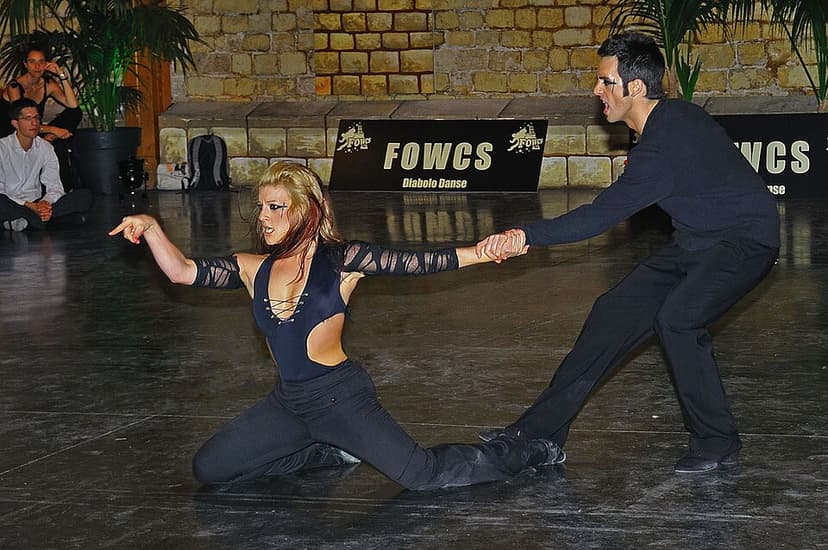
Competitive Champion · Performer · Innovator
Jordan Frisbee
West Coast Swing's Modern King
Why They Matter
He pushed the creative boundaries of WCS and helped transform it from a pattern-based dance into a truly improvisational art form.
Known For
Biography
Jordan Frisbee was born in Los Angeles in 1983 and began West Coast Swing at age eleven after being invited to try the dance. Before committing fully to dance, he appeared in films, television and advertising as a child. His early partners included Olivia Dasso and Jessica Cox, with whom he competed in showcase events.
Frisbee formed his defining partnership with Tatiana Mollmann in 2000, a collaboration that would span decades of competitive success, choreography and teaching. The pair specialized in Classic West Coast Swing, a division emphasizing timing, connection and character over the assisted movements and lifts of Showcase style. Their competitive record includes US Open Classic-division victories in 2004, 2005, 2006, 2008, 2011, 2012 and 2014. Beyond their partnership work, Frisbee demonstrated improvisational range through Strictly Swing victories: with Sarah Vann Drake in 2004 (as co-choreographer of the winning Midwest Rebels team), with Mary Ann Nunez in 2005, with Jessica Cox in 2006 and 2010.
The World Swing Dance Council identified Frisbee and Mollmann as a major influence on West Coast Swing's early-2000s evolution, specifically noting their ability to add individual musical interpretation while preserving the dance's timing and fundamental character. Their musicality often distributed interpretive weight between partners: one dancer might sustain or simplify a phrase while the other articulated a secondary layer, then focus would shift. This approach allowed the couple to balance smooth, connected movement with sharply placed accents.
Frisbee's institutional recognition followed his competitive achievements. The California Swing Dance Hall of Fame designated him a Rising Star in 2010 and a Shining Star in 2018, inducting him and Mollmann as a Couples entry that same year. The Open added Frisbee and Mollmann to its Walk of Legends in 2019.
Teaching became a parallel legacy. JT Swing documents Frisbee and Mollmann as certified instructors maintaining an online curriculum organized around connection, footwork, musicality, drills and historic vocabulary. The Open's workshop schedules from 2024 and 2025 list classes including "Smooth Transitions" and "The Details That Win." As of 2026, the pair remain confirmed instructors at The Open, demonstrating ongoing transmission of competitive knowledge to the next generation of dancers.
Career Highlights
Began West Coast Swing at approximately age eleven, based on the Hall’s 1983 birth year and age statement. Caution: the calendar year is inferred. Source
Formed the partnership with Tatiana Mollmann that became central to his competitive, choreographic and teaching career. Source
Won The Open’s Classic division with Mollmann; also won Strictly Swing with Sarah Vann Drake and co-choreographed the winning Midwest Rebels team with Mollmann. Source
Repeated as Classic champion with Mollmann and won Strictly Swing with Mary Ann Nunez. Source
Won the Classic division with Mollmann and Strictly Swing with Jessica Cox. Source
Won the Classic division with Mollmann. Source
Received the California Swing Dance Hall of Fame Rising Star designation; The Open also records a Strictly West Coast Swing win with Cox. Hall
Won The Open’s Classic division with Mollmann. Source
Repeated as Classic champion with Mollmann. Source
Won another Classic title with Mollmann. Source
Entered the California Hall as both a Shining Star and Couples inductee with Mollmann in 2018, followed by The Open Walk of Legends in 2019. California Hall
Listed with Mollmann among The Open’s confirmed instructors. Source
Legacy & Impact
Frisbee's enduring significance rests on the union of competitive record, choreographic innovation and structured pedagogy. With Mollmann, he demonstrated that Classic West Coast Swing could absorb individual musical texture and contemporary styling without sacrificing timing or the dance's recognizable character. That approach—visible through a long title record and globally distributed teaching—became reproducible for other dancers and partnerships. His improvisational results with multiple credited partners, meanwhile, proved the skills were not confined to a single rehearsed partnership, establishing a model of adaptability and listening that remains relevant to competitive West Coast Swing practice.


Explore More Legends
Discover the dancers, teachers, choreographers, and cultural icons who shaped how the world moves.
Keep the thread going
Dance history, technique, and the occasional rabbit hole — in your inbox. Thoughtful, infrequent, unsubscribe anytime.
Free. No spam. One click to leave.