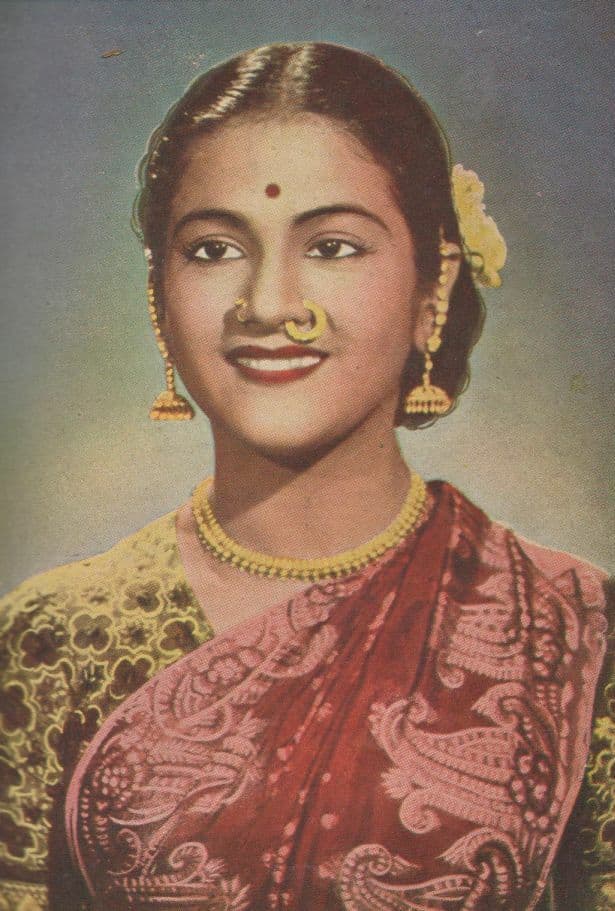
Kamala Lakshmi Narayanan
Legend of Dance
Why They Matter
Kamala’s importance lies in the breadth of her transmission. Her film dances carried Bharatanatyam-inflected performance to popular audiences, her concert career helped define the prestige and theatrical appeal of the Vazhuvoor tradition, and her school sustained that lineage in the Indian diaspora.
Styles Kamala Lakshmi Narayanan shaped
Each one links to the style’s own page — its origins, music, tempo and video.
Biography
Kamala Lakshmi Narayanan was born in Mayuram in 1934 and grew up partly in Bombay. She began dancing at five, first studying Kathak and appearing in stage programs before film producers recruited her as a child performer. Baby Kamala became a familiar screen presence in her early years, making cinema one of the earliest platforms for her dance.
After her family moved south during the Second World War, Kamala undertook Bharatanatyam training with Kattumannar Kovil Muthukumara Pillai. She gave her arangetram in 1941 and then became a disciple of Vazhuvoor Ramiah Pillai. His teaching shaped the elegant, expressive approach with which she would be identified, while her own visibility helped establish the Vazhuvoor tradition as a leading modern concert style.
Kamala moved easily between cinema and the classical stage. Dance sequences in the 1947 Tamil film *Naam Iruvar*, choreographed by her guru to patriotic songs, reached a mass audience during the year of Indian independence. In 1948 she became one of the youngest featured performers at the Music Academy in Chennai, returning annually until the 1970s. The Academy later recalled the large audiences her performances attracted and the standard she set for brilliance, grace, and dignity.
From the 1940s through the 1970s, Kamala represented India at international cultural events and performed for visiting dignitaries. Her engagements included coronation festivities for Queen Elizabeth II in 1953 and a performance during U.S. President Dwight D. Eisenhower's 1959 state visit to India. India awarded her the Padma Bhushan in 1970.
Kamala became a teacher of equal importance. After visiting and teaching at Colgate University, she settled in the United States in 1980 and established Sri Bharatha Kamalalaya School of Dance. Through instruction in the New York–New Jersey region and student graduation performances in India, she transmitted the Vazhuvoor repertoire and performance values across generations and national settings. The Music Academy gave Kamala its first Platinum Jubilee Lifetime Achievement Award on January 1, 2001, and the National Endowment for the Arts named her a National Heritage Fellow in 2010. She died in Millbrae, California, on November 23, 2025, leaving a career that connected Indian cinema, post-independence cultural representation, the modern Bharatanatyam stage, and the Indian diaspora's institutions of classical-dance education.
Career Highlights
Gave her Bharatanatyam arangetram under Kattumannar Kovil Muthukumara Pillai’s training. National Endowment for the Arts
Reached wide audiences through patriotic dance sequences in the Tamil film Naam Iruvar. National Endowment for the Arts
Became one of the youngest featured artists at the Music Academy, Chennai. Music Academy, Madras
Performed during festivities associated with Queen Elizabeth II’s coronation. National Endowment for the Arts
Performed during President Dwight D. Eisenhower’s state visit to India. National Endowment for the Arts
Received India’s Padma Bhushan. National Endowment for the Arts
Settled in the United States and developed Sri Bharatha Kamalalaya School of Dance. National Endowment for the Arts
Received the Music Academy’s first Platinum Jubilee Lifetime Achievement Award. Music Academy, Madras
Named an NEA National Heritage Fellow. National Endowment for the Arts
Died in Millbrae, California, on November 23. Music Academy, Madras
Gallery
Legacy & Impact
Kamala's significance lies in the breadth of her transmission across three interconnected domains. Her film dances carried Bharatanatyam-inflected performance to popular audiences; her concert career helped define the prestige and theatrical appeal of the Vazhuvoor tradition; and her school sustained that lineage in the Indian diaspora. Rather than treating cinema, classical stage work, and pedagogy as separate careers, her life demonstrates how each could reinforce the reach and continuity of the others.


Explore More Legends
Discover the dancers, teachers, choreographers, and cultural icons who shaped how the world moves.
Keep the thread going
Dance history, technique, and the occasional rabbit hole — in your inbox. Thoughtful, infrequent, unsubscribe anytime.
Free. No spam. One click to leave.