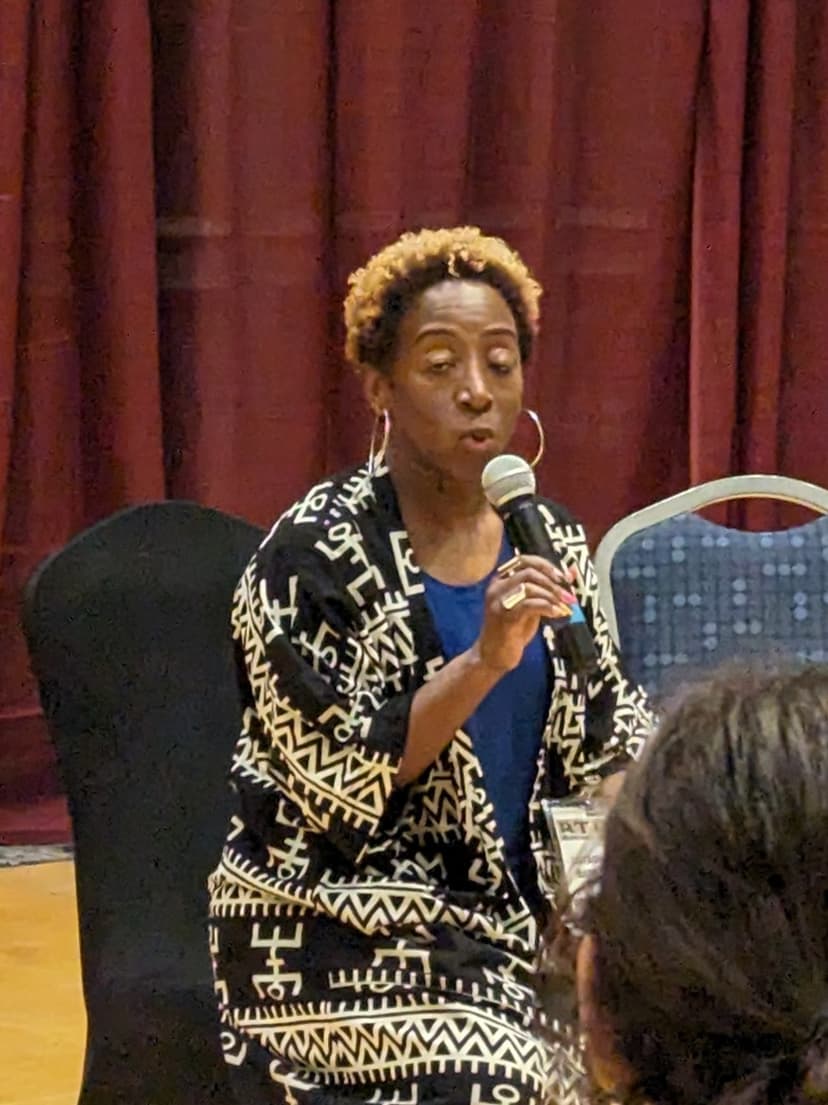
Latasha Barnes
Legend of Dance
Why They Matter
Barnes matters because she makes historical continuity physically and socially legible. Her work refuses a split between “street,” “social” and “concert” dance, showing how Black American forms share practices of improvisation, rhythm, competition, community and personal style even when their…
Styles Latasha Barnes shaped
Each one links to the style’s own page — its origins, music, tempo and video.
Watch
Works & Process Bubble Performance: The Jazz Continuum
Works & Process
The commissioning organization's footage demonstrates the intergenerational and cross-form structure of Barnes's signature work.
LaTasha Barnes on dance and hip-hop
Arizona State University
Barnes explains her academic and cultural framing in an official university video.
Post-Show Talk: LaTasha Barnes
Jacob's Pillow
A first-person discussion from a major dance institution supports the work's context and intent.
Biography
LaTasha Barnes is an American dancer, choreographer, educator and scholar based in Richmond, Virginia, whose work reconnects Black American social dances across generations. In the 2010s, she emerged in international battle and social-dance communities while beginning to trace the relationships among house, hip-hop, funk, jazz and swing-era vernacular dance. Rather than treating these as isolated genres, Barnes studied how African diasporic rhythm, improvisation, social exchange and individual expression recur across them, bridging community knowledge with academic research. She completed a self-designed master's degree in ethnochoreology, Black studies and performance studies at New York University's Gallatin School in 2019, and joined Arizona State University's School of Music, Dance and Theatre faculty in fall 2021, where she now serves as an associate professor.
In 2021, Works & Process commissioned *The Jazz Continuum*, which premiered at the Guggenheim Museum before appearing at Jacob's Pillow. The work brings together dancers and musicians fluent in vernacular jazz, Lindy Hop, house, hip-hop, waacking and related practices, with sound design and music composition by Charles Turner and Sean Mason. Barnes has also contributed to *Swing Out*, a collaborative concert work developed with Caleb Teicher, Evita Arce and Nathan Bugh that preserves the improvisational and communal conditions of Lindy Hop.
Barnes's achievements have been recognized widely. The Bessies honored her as an Outstanding Performer for sustained achievement in 2021, and in 2023 awarded her the Outstanding Choreographer/Creator prize for *The Jazz Continuum* at the Joyce Theater. Her work is distinctive for demonstrating how rhythmic logics migrate across distinct dance forms—a house-derived jack settling into Lindy Hop pulse, compact footwork widening into waacking's arm pathways, jazz timing surfacing inside a hip-hop groove. In *The Jazz Continuum* and her teaching, these transitions are the argument itself: continuity is demonstrated through shared impulse and social exchange rather than a linear parade of named styles.
Career Highlights
After a serious traffic injury, began a recovery process that led into intensive street- and club-dance study; exact chronology requires first-person confirmation. Dance Magazine Dance Magazine
Won a Juste Debout dance battle in Paris with Toyin Sogunro, as reported in secondary biographical sources. Wikipedia Wikipedia
Completed a self-designed master's degree at NYU Gallatin in ethnochoreology, Black studies and performance studies. Arizona State University Arizona State University
The Jazz Continuum premiered through Works & Process at the Guggenheim and later appeared at Jacob's Pillow. Arizona State University Arizona State University
Joined Arizona State University's School of Music, Dance and Theatre faculty. Arizona State University Arizona State University
Received a Bessie Award as an Outstanding Performer for sustained achievement in dance. Arizona State University Arizona State University
The Jazz Continuum received a New England Foundation for the Arts National Dance Project grant. Arizona State University Arizona State University
Won the Bessie for Outstanding Choreographer/Creator for The Jazz Continuum at the Joyce Theater. The Bessies The Bessies
Served as an associate professor of dance at Arizona State University, continuing research, teaching and performance work. Arizona State University Arizona State University
Gallery
Legacy & Impact
Barnes matters because she makes historical continuity physically and socially legible. Her work refuses a split between street, social and concert dance, showing how Black American forms share practices of improvisation, rhythm, competition, community and personal style even when their scenes do not recognize one another. Through performance, teaching and scholarship, she gives dancers tools to understand lineage without turning living culture into a museum object, allowing each form to retain its distinct history while revealing the shared impulses that connect them.

Explore More Legends
Discover the dancers, teachers, choreographers, and cultural icons who shaped how the world moves.
Keep the thread going
Dance history, technique, and the occasional rabbit hole — in your inbox. Thoughtful, infrequent, unsubscribe anytime.
Free. No spam. One click to leave.