Sean Gandini
Legend of Dance
Why They Matter
Gandini's contribution is the sustained argument that juggling can think choreographically. Through notation, ensemble timing, and collaborations with dance, music, opera, and magic, he helped shift contemporary juggling away from a sequence of tricks toward full-length works organized by spatial…
Biography
Sean Gandini is a choreographer, performer, and director who transformed contemporary juggling into a full choreographic language. Raised in Havana, Cuba, from roughly age four to twelve, Gandini discovered juggling at sixteen after being captivated by magic and mathematics. He began his professional life in the 1980s with regular street performance in London's Covent Garden and touring work with physical-theatre companies including Ra-Ra Zoo, where direct audience feedback and his interest in pattern and number encouraged him to treat juggling as a composable system.
In 1992, Gandini co-founded Gandini Juggling with Kati Ylä-Hokkala, a partnership that proved foundational to his artistic method. Gandini's intense focus on geometry, rhythm, and notation merged with Ylä-Hokkala's rhythmic-gymnastics and dance background to make bodily phrasing inseparable from object flight. Early works emerged from sustained exchanges with choreographer Gill Clarke and used siteswap notation to organize throwing patterns, establishing a new formal vocabulary for juggling as dance.
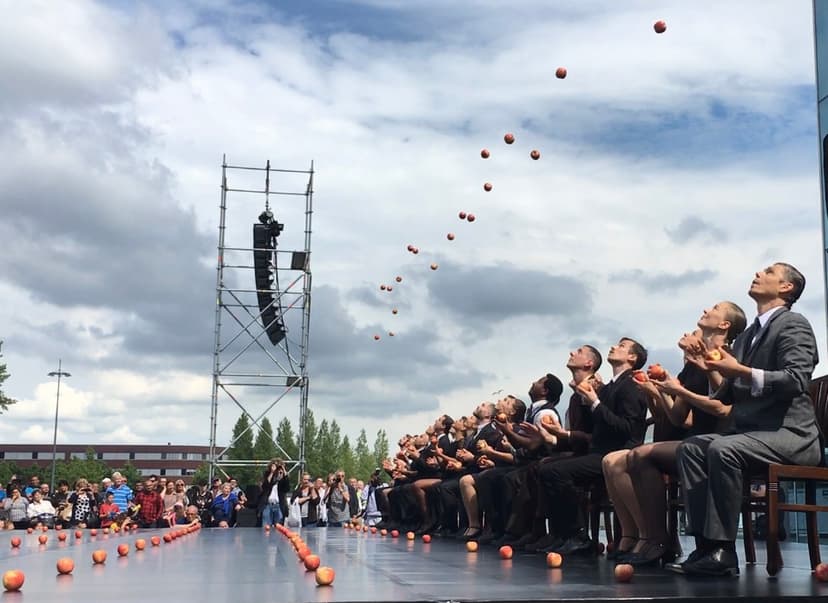
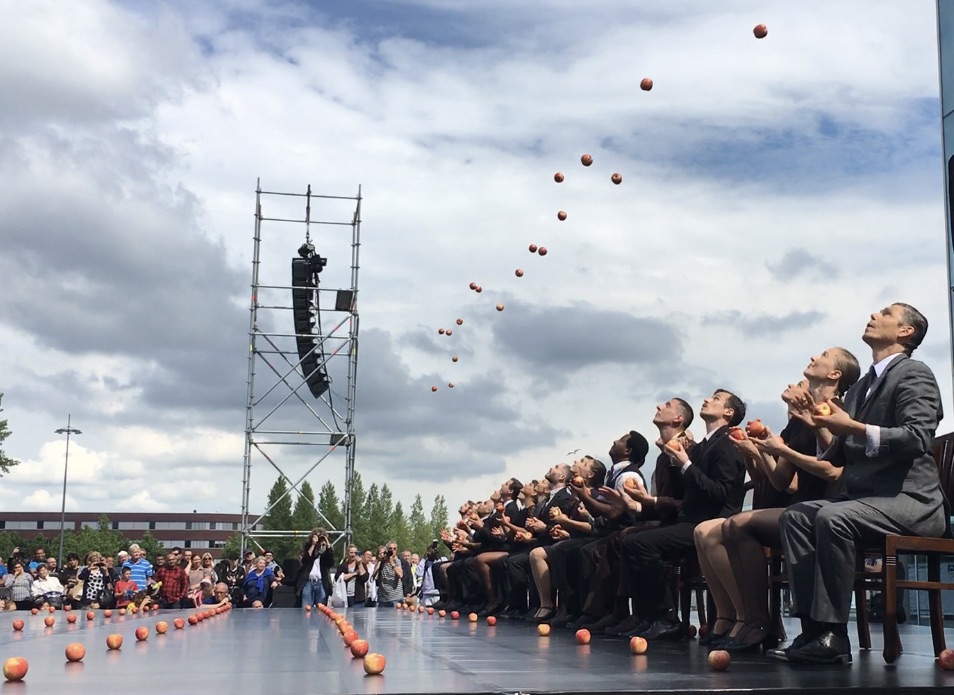
The company's repertoire ranges from formal studies to theatrical works. *Smashed* turned apple juggling into a darkly comic homage to Pina Bausch; *Twenty/Twenty* was created as a London Olympics commission; *Remembering Rastelli* combined rhythmic club work, foot stamping, body percussion, and ring passing; and *4 x 4: Ephemeral Architectures* paired four jugglers with four ballet dancers under choreography by Ludovic Ondiviela. Gandini's method repeatedly places juggling "on a date" with another art form so each practice exposes the other's assumptions.
Gandini extended this choreographic approach into opera, choreographing the skills ensemble for Philip Glass's *Akhnaten* at English National Opera in 2016. The production later reached the Metropolitan Opera in 2019 and 2022, with the juggling embedded in the production's ritual architecture, object arcs functioning as visual counterpoint to Glass's score and the singers' movement. He also directed *Spring* in 2018 in collaboration with choreographer Alexander Whitley.
In 2023, Gandini and Ylä-Hokkala premiered *The Games We Play*, a lecture-performance reflecting on three decades and thousands of shows. His 2025 work *Heka* returned explicitly to childhood magic while continuing to ask how deception, mathematics, and embodied timing can share a stage. Across these projects, Gandini operates as choreographer-researcher as well as virtuoso performer, using mathematical structure and collaborative practice to remake what juggling can express.
Career Highlights
Performed regularly in London's Covent Garden and toured with physical-theatre companies including Ra-Ra Zoo. Gandini Juggling
Co-founded Gandini Juggling with Kati Ylä-Hokkala. Metropolitan Opera
Developed the company's first major dance-juggling experiment, nEither eiTher Both aNd, from workshops with Gill Clarke. Gandini Juggling
Created Remembering Rastelli, combining rhythmic club work, foot stamping, body percussion, and ring passing. Gandini Juggling
Created Twenty/Twenty as a London Olympics commission. Gandini Juggling
Directed 4 x 4: Ephemeral Architectures, pairing ballet and juggling with choreography by Ludovic Ondiviela. Production dossier
Choreographed and performed in the skills ensemble for English National Opera's Akhnaten. English National Opera
Directed Spring in collaboration with choreographer Alexander Whitley. English National Opera
Made his Metropolitan Opera debut as choreographer for Akhnaten. Metropolitan Opera
Co-created and performed The Games We Play with Ylä-Hokkala. Gandini Juggling
Directed Heka, reconnecting the company’s juggling research with his early interest in magic. Gandini Juggling
Gallery
Legacy & Impact
Gandini's lasting contribution is the sustained argument that juggling can think choreographically. Through notation, ensemble timing, and collaborations with dance, music, opera, and magic, he shifted contemporary juggling away from trick sequences toward full-length works organized by spatial and conceptual questions. Equally important, Gandini Juggling became an enduring laboratory in which co-artists, especially Kati Ylä-Hokkala, could develop that language over decades. For dancers and circus artists now, his work proves that object manipulation and bodily phrasing are a single choreographic problem.


Explore More Legends
Discover the dancers, teachers, choreographers, and cultural icons who shaped how the world moves.
Keep the thread going
Dance history, technique, and the occasional rabbit hole — in your inbox. Thoughtful, infrequent, unsubscribe anytime.
Free. No spam. One click to leave.