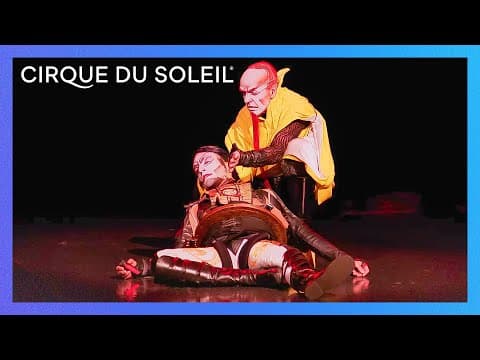
Kà (2004)
Kà is a resident circus-theatre spectacle created and directed by Robert Lepage for Cirque du Soleil, staged in a purpose-built theatre at the MGM Grand, Las Vegas, with previews from November 26, 2004 and a premiere on February 3, 2005. It was the first Cirque du Soleil production built around a continuous, four-act-style narrative — twin heirs separated by a coup, pursued across sea, forest and mountain, and reunited through a final battle — rather than the abstract cabaret-of-acts format the company had used until then.
What it contains
- Aerial Straps — The Forest · The Forest scene — Firefly Boy's rescue and duet with the Twin Sister (2007–present) — The Firefly Boy 'swoops down' on straps to rescue the falling Twin Sister and then dances with her aerially 'within the trees,' accompanied by a singer suspended in the vines; the show's own choreography note lists aerial straps among its core techniques. Source: "Firefly Boy (Aerial straps (2007–present))"
- Poi (Fire Poi) · General fight and combat choreography across the show, per the Choreography section — Poi manipulation technique is repurposed to handle staves and batons within the martial fight choreography rather than performed as a standalone flow-arts number. Source: "Poi for manipulating staves and batons"
- Chinese Pole — The Forest · The Forest scene, 'Pole jumping' act (staged 2004–2007, later replaced) — A pole act titled 'Pole jumping' formed part of The Forest scene between 2004 and 2007, consistent with the 'swing poles' apparatus named in the general choreography description; later swapped for the aerial-straps number. Source: "Forest (The Forest (Second part of the scene) / Pole jumping (Second part of the act, 2004–2007))"
- Tumbling for Dance — Pillars · The 'Pillars' act change, present 2004 to its later removal — Performers vaulted and leapt over roughly 15-foot pillars while combining martial arts and acrobatic skill; the act was cut for safety and fit. Source: "Performers leapt over pillars whilst displaying their martial arts and acrobatic skills."
What is danced
The credited choreography (per the article's own Choreography section) draws on modern wushu taolu forms, Chinese opera-style stage combat, poi technique adapted to manipulate staves and batons, Brazilian capoeira, bungee work, aerial straps, swing-pole work, and stunts performed on the rotating 'Wheel of Death.' This is fight-choreography and circus-apparatus vocabulary rather than a single dance idiom: bodies are moving through martial forms and rigged apparatus work simultaneously with the 50-ton moving sand-cliff deck and cantilevered tatami deck, so performers must time acrobatic and martial phrases to platforms that tilt to 100 degrees and drop 72 feet.
Specific numbers described in the synopsis include the Firefly Boy's aerial-straps entrance and duet with the Twin Sister in The Forest scene (danced 'within the trees' above a singer suspended in the vines), and — in the 2004–2007 version of the same scene — a 'pole jumping' act later replaced by the straps number. An earlier sequence, 'Pillars,' had performers vault and leap over 15-foot pillars showing martial arts and acrobatic skill; it was cut after Lepage judged it dangerous and ill-fitting. The Wheel of Death sequence in 'Slave Cage' has two performers running the giant pendulum-arm apparatus and then breaking into stunt work on its moving surface.
The article does not describe step vocabulary, counts, or technique names in the detail a dance-technique page would need — this is a circus-production account, and several named practices here (wushu taolu, capoeira, the Wheel of Death itself) have no corresponding code in the taxonomy offered, which is noted below as gaps rather than forced into an approximate match.
Context
Kà arrived as Cirque du Soleil was expanding its permanent Las Vegas footprint (following Mystère and O), and the article frames it explicitly as a break from that house style: 'the first Cirque du Soleil production to deviate from the company's usual format... it presents a more straightforward story, unlike the more abstract visuals of other Cirque productions.' Bringing in Robert Lepage — a director known for multimedia and machine-driven theatre rather than circus arts — signalled Cirque folding narrative stagecraft and platform automation into what had been an acrobatic variety format, at a reported cost of $165 million for show and theatre together.
Staging history
Kà has run as a single fixed production in its custom-built theatre at the MGM Grand since 2004/2005 and has not toured or been restaged elsewhere in the source material. The show's content has shifted incrementally: the 'Pillars' act was removed for safety and fit; the number of Valets was reduced from three to two; and the aerial vocabulary in The Forest scene changed from a 'pole jumping' act (2004–2007) to the Firefly Boy's aerial-straps number (2007–present). Following the on-stage death of performer Sarah Guillot-Guyard in June 2013, the Final Battle scene was replaced by a transitional number, 'The Dressing-Ritual' (itself dating to a 2004 rotational act), before the Battle Scene was reinstated in stages through late 2014.
How to watch it
Watch for the handoff between apparatus and combat vocabulary — performers move from wushu-derived fight choreography into poi-style stave work, capoeira, bungee and strap sequences, often as the sand-cliff or tatami deck itself is rotating or tilting beneath them. The Wheel of Death sequence in 'Slave Cage' and the Firefly Boy's aerial-straps duet in The Forest are the two clearest set-piece 'numbers' the synopsis singles out; the now-cut 'Pillars' sequence is worth knowing about as an example of choreography the company judged too dangerous to keep.
Structure
- Scene 1 · The PageantThe court celebrates the twins' return with a pageant and flute duet before the palace is attacked and the Emperor and Empress are killed.
- Scene 2 · The StormThe court flees the burning palace; the Twin Brother is shot and left behind, and the escape boat sinks in a storm.
- Scene 3 · The DeepThe Twin Sister dives to rescue the drowning Nursemaid, set to a piano and cello duet.
- Scene 4 · Archer's DenThe Archers celebrate their victory and the Counselor's Son unveils the Death Machine.
- Scene 5 · Wash-up on ShoreThe Twin Sister's group encounters giant puppet sea creatures on a cork-covered beach.
- Scene 6 · Lantern (Shadows)The Court Jester teaches the wounded Twin Brother shadow puppetry before he is captured by the Archers.
- Scene 7 · The ClimbThe Twin Sister's group scales a mountain and is attacked, becoming separated.
- Scene 8 · BlizzardThe Twin Sister is reunited with the Nursemaid via a mountain tribe, but the Archers find them.
- Scene 9 · Archers AttackThe mountain tribe's flying-machine escape device saves the group; the Twin Sister falls into a forest.
- Scene 10 · Flutes (Captivity)The Chief Archer's Daughter frees the imprisoned Twin Brother, and their romance develops through shared flute-playing and a dance with the twins' flutes.
- Scene 11 · The ForestThe Firefly Boy rescues the falling Twin Sister and invites her to an aerial dance in the trees before she continues her search.
- Scene 12 · Slave CageEnslaved former courtiers work the Wheel of Death; two escape the cage to perform stunts on the moving machine, sparking the Empire's revolt.
- Scene 13 · Final BattleThe Twins, aided by the Firefly Boy and forest people, defeat the Counselor's forces.
- Scene 14 · AftermathPeace is restored, the twins marry their partners, and the Archers, Counselor and his blinded son return in reconciliation.
- Scene Pillars (removed act change) · PillarsPerformers vaulted and leapt over tall pillars showing martial arts and acrobatic skill; removed after being judged dangerous and a poor fit for the show.
Structure read from an encyclopaedia article, not from a libretto or score we hold. Confirm against a programme before treating the numbering as authoritative.
In the same lineage
Other staged works in the register connected to this one by author or lineage.
 KoozåCirque & spectacle · 2007Same lineage · video
 SaltimbancoCirque & spectacle · 1992Same lineage · video
 La NoubaCirque & spectacle · 1998Same lineage · video
 ZumanityCirque & spectacle · 2003Same lineage · video
 Nouvelle ExpérienceCirque & spectacle · 1990Same lineage · video
 ZedCirque & spectacle · 2008Same lineage · video
 Drawn to LifeCirque & spectacle · 2021Same lineage · video