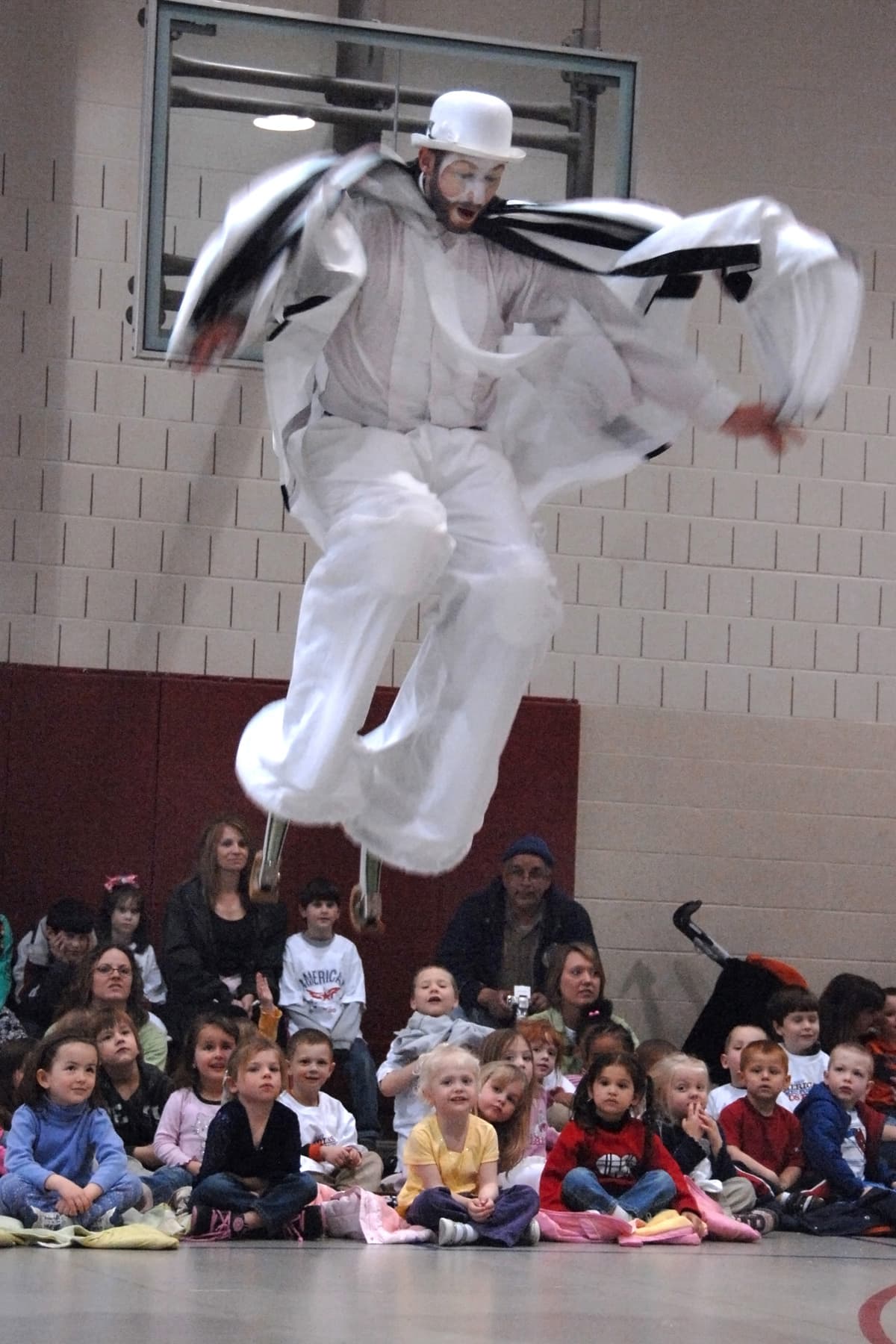
U.S. Air Force Photo/Josh Plueger · Public domain
Saltimbanco (1992)
Saltimbanco was a full-length Cirque du Soleil touring production, first presented under the company's Grand Chapiteau big top in 1992 and kept in continuous circulation, in two distinct physical formats, until its retirement in Montreal on 30 December 2012. It sits in the catalogue as a cirque-spectacle rather than a danced narrative work: a 51-member touring troupe of acrobats, aerialists, musicians and singers built around an urban-cityscape design concept, with characters (the Baron, the Ringmaster, the Songbird, the Punks, the Baroques, and others) rather than a plot.
What it contains
- Chinese Pole — Chinese poles · the Chinese poles act, centre stage — Up to 26 performers climb, drop, jump between poles, hang and spin on four tall vertical poles. Source: "Up to 26 performers performed in this act using four 25-foot-tall (7.6 m) poles in the middle of the stage."
- Aerial Straps — Aerial straps · the rotational Aerial straps act — A performer holds and moves through sustained shapes on straps, using upper-body strength for controlled poses. Source: "A performer swung on these straps and would use upper body strength to create many dangerous poses."
- Contortion & Extreme Flexibility Performance — Balancing on canes · the Balancing on canes act — A handbalancer sustains contortion poses, including the Marinelli bend, while balanced in handstand on raised supports. Source: "A handbalance artist performed feats of strength and various contortion poses, including the Marinelli bend, while balancing on high handstand supports."
- Contortion & Extreme Flexibility Performance — Contortion (retired) · the retired Contortion act — Four female contortionists performed extreme flexibility poses in an act inherited from a prior Cirque du Soleil production. Source: "This act featured four female contortionists from a previous Cirque du Soleil show, Nouvelle Expérience."
- Partner Acrobatics (Adagio) — Adagio trio · the Adagio trio act — Three acrobats perform sustained partner balances and lifts drawn from acrosport technique, an adagio-style trio act. Source: "Three acrobats performed in an adagio that drew inspiration from acrosport."
- Partner Acrobatics (Adagio) — Hand-to-hand · the Hand-to-hand act — One performer holds a sustained handstand balance supported entirely on the other's body, a classic hand-to-hand adagio hold. Source: "A duo used an incredible amount of body strength in this act as one would balance in a handstand on the other."
What is danced
The article does not describe a choreographed through-line; instead it lists a fixed set of discrete apparatus- and skill-based acts that were combined and rotated over the show's twenty-year life. Several of these are explicitly acrobatic partner work: the adagio trio act is described as drawing 'inspiration from acrosport', and the hand-to-hand duo act is built on one performer holding a handstand balanced on the other's body. The Chinese pole act, staged on four 25-foot poles in the centre of the stage with up to 26 performers, and later reduced technical specifications (24-foot poles) recorded in the set section, involved climbing, dropping, jumping between poles, hanging and spinning. A handbalancing/contortion act ('Balancing on canes') combined hand-to-hand strength poses including the Marinelli bend with sustained handstand holds on raised supports, and a separate contortion act (retired after 1998, inherited from Nouvelle Expérience) featured four female contortionists.
Other named acts sit outside any code offered here and are recorded only as taxonomy gaps: solo and duo trapeze, aerial bungee, a Spanish web ('vertical rope') act, boleadoras twirling combined with taiko playing, tightrope/double-wire work, diabolo, ribbon-and-hoop manipulation, and artistic/trick cycling. The Russian swing act — artists launched off a swing into twists, spins and flips before landing on human pyramids or mats — reads as tumbling-adjacent acrobatics rather than aerial work proper. Across the run, acts were added, retired, or moved between the Grand Chapiteau and arena formats, so the exact bill a given audience saw depended on the year and tour leg; the article itself flags this instability repeatedly.
Context
The article situates Saltimbanco within Cirque du Soleil's early growth, becoming (by the time of its 2012 closure) the company's longest-running production, with 6,000 performances across 200 cities and 14 million spectators. It also names several tours as company firsts — the first Cirque du Soleil show in Turkey and Ukraine (2011), Slovakia and Amman (2012), and the first to tour South America (2006) — marking the show as an instrument of the company's international expansion rather than a purely artistic landmark.
Staging history
Saltimbanco toured under the Grand Chapiteau tent from 1992 to 2006, closing that format in Rio de Janeiro on 10 December 2006. It was then rebuilt as a smaller arena production with fewer performances per city, opening 31 July 2007 in London, Ontario, and toured North America, Europe, South Africa, Australia, New Zealand and parts of Asia and Eastern Europe before its final performance in Montreal on 30 December 2012. The score by René Dupéré was issued as a 1992 studio album, re-released with bonus tracks in 2001, distributed as a staff-only live recording ('Saltimbanco Live in Amsterdam'), and re-recorded with updated vocals and instrumentation in 2005; a 1993 live filming in Atlanta was released on VHS in 1994, and a 2012 behind-the-scenes documentary went unreleased until surfacing online in 2025.
How to watch it
Watch for the difference between held-strength acts (hand-to-hand, canes, contortion) built on sustained balance and shape, and momentum acts (Russian swing, Chinese poles, bungee) built on launch, flight and catch. The show's own staging plays this against a cityscape design of contradictions, using a suspended metal-ring rosace and coloured gel lighting to give the acrobatics a cinematic frame rather than a bare circus-ring look.
Structure
- Adagio trioThree acrobats perform partner-balance work described as drawing on acrosport.
- Chinese polesUp to 26 performers climb, drop, jump between, hang from and spin on four tall Chinese poles.
- Balancing on canesA handbalance artist performs strength and contortion poses, including the Marinelli bend, on high handstand supports.
- BoleadorasTwo performers twirl boleadoras and later play taiko in a complementary percussive act.
- Russian swingArtists launch off a swing into twists, spins and flips, landing on human pyramids, mats and other props.
- Solo trapezeA single artist swings very high and spins, catching the trapeze bar with her legs.
- Hand-to-handA duo perform sustained handstand balances, one supported on the other.
- BungeeFour aerialists suspended from bungees flip, swing and bounce in synchronization.
- Aerial strapsA performer swings on aerial straps, holding demanding poses using upper-body strength.
- Contortion (retired)Four female contortionists, inherited from Nouvelle Expérience, performed this act until it was dropped after 1998.
Structure read from an encyclopaedia article, not from a libretto or score we hold. Confirm against a programme before treating the numbering as authoritative.
In the same lineage
Other staged works in the register connected to this one by author or lineage.
 KàCirque & spectacle · 2004Same lineage · video
 KoozåCirque & spectacle · 2007Same lineage · video
 La NoubaCirque & spectacle · 1998Same lineage · video
 ZumanityCirque & spectacle · 2003Same lineage · video
 Nouvelle ExpérienceCirque & spectacle · 1990Same lineage · video
 ZedCirque & spectacle · 2008Same lineage · video
 IvesianaBallet · 1954Same lineage · video
 Drawn to LifeCirque & spectacle · 2021Same lineage · video