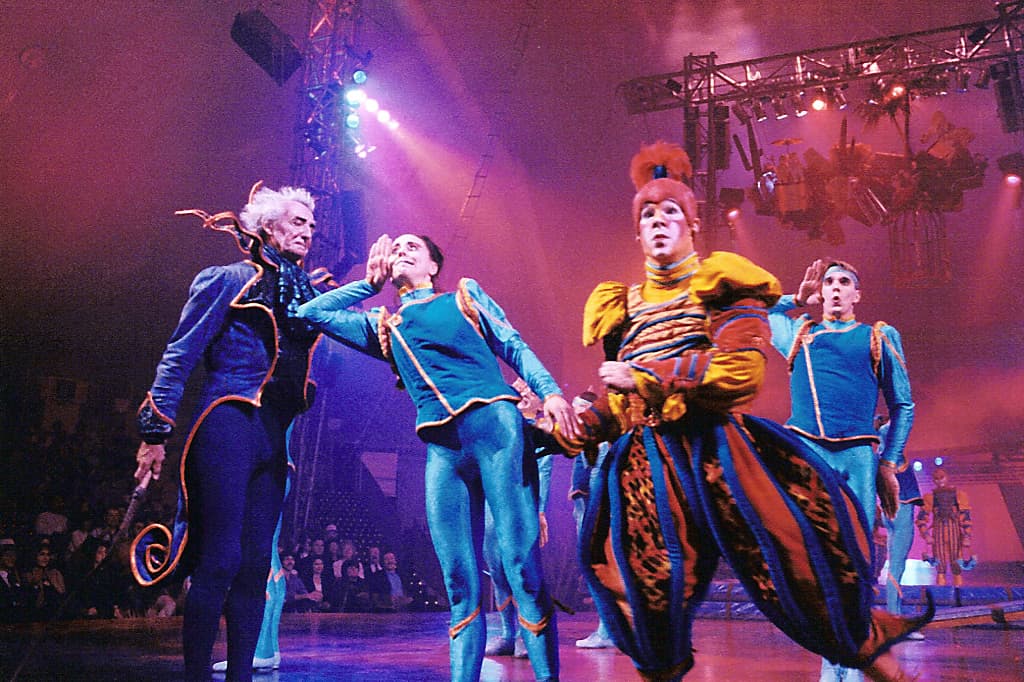
Nouvelle Expérience was Cirque du Soleil's fourth touring production, premiering in Montreal on 8 May 1990 under a grand chapiteau and running until November 1993, including a year-long residency at the Mirage in Las Vegas. It is a cirque-spectacle in the strict sense the catalogue means: a sequence of discrete circus acts (contortion, aerial straps, trapeze, teeterboard, tightrope, foot juggling, chair balancing) strung together inside a loose allegorical frame about jewels of the Earth, Flounes, Devils and a Corporation, devised by director Franco Dragone after Jules Verne's La Chasse au Météore.
It belongs in a dance catalogue not because it is choreographed in the ballet or modern-dance sense but because Dragone's staging innovation — removing the curtain between performer and audience and requiring artists to stay in character throughout — reshaped circus performance into continuous theatrical movement, a template Cirque du Soleil used for its subsequent shows. The physical vocabulary is almost entirely apparatus-based circus discipline rather than danced technique, which the record below reflects.
What it contains
- Aerial Straps — Aerial straps · Aerial straps act, performed to 'L'oiseau' — A solo male performer suspended on two hanging leather straps spins, flips and hangs in the air, the core vocabulary of aerial straps work. Source: "A muscular man approaches two leather straps hanging from the ceiling. He takes to the straps and takes flight."
- Contortion & Extreme Flexibility Performance — Contortion · Contortion act, performed to 'Meandres' — Four women twist and bend into unbelievable positions on a suspended platform, a solo-ensemble display of extreme flexibility and backbending characteristic of contortion performance. Source: "Four women, clad in pink, take to a suspended platform. The four twist and bend themselves into unbelievable positions."
- Partner Acrobatics (Adagio) — Korean plank · Korean plank act, tower-building sequence — Acrobats are flipped onto one another's shoulders to build human towers, a partnered acrobatic balance-and-toss sequence. Source: "form towers by flipping acrobats onto other acrobats' shoulders"
- Partner Acrobatics (Adagio) — Russian bar/Trampoline/Korean cradle · Korean cradle segment of the combined Russian bar/Trampoline/Korean cradle act — Men strapped to platforms take women by the hands to swing and flip them between one another, a base-and-flyer partner acrobatic exchange. Source: "Two men are strapped in on platforms, and take women by their hands to swing and flip them between one another."
What is danced
The credited 'acts' section of the article is really a scene-by-scene account of circus disciplines rather than choreography: contortion on a suspended platform, a Korean plank (teeterboard) sequence building into partner towers, solo trapeze, fil de fer (rola bola into tightrope), aerial straps, a three-apparatus flying/Russian trapeze sequence, foot juggling (antipodism), a combined Russian bar/trampoline/Korean cradle number, and chair balancing under a flaming cake. Each is performed to a discrete cue from René Dupéré's score, and each is essentially a soloist or small ensemble apparatus act rather than a group dance number.
The clearest match to the movement categories this catalogue tracks is the contortion act — four women twisting and bending into extreme shapes on a suspended platform — and the aerial straps solo, both described in enough physical detail to code with confidence. The Korean plank and Korean cradle sequences involve genuine partner acrobatics (acrobats flipped onto each other's shoulders to build towers; women swung and flipped hand-to-hand between two men), which sits close to partner-acrobatic vocabulary even though the named apparatus itself is not in this taxonomy.
Most of the acts described — teeterboard, rola bola, tightrope, flying and Russian trapeze, foot juggling/antipodism, Russian bar, trampoline, chair balancing — are circus disciplines with no equivalent code offered here; they are listed under taxonomy_gaps rather than mis-coded. A choreographer or historian consulting this entry should treat it as a circus-arts inventory first and a dance-technique record only secondarily: the article gives no ballet, jazz, or theatrical-dance vocabulary anywhere in the show.
Context
1990 sits early in Cirque du Soleil's transition from a struggling Québécois touring troupe to an international brand: the company had just abandoned reviving an earlier show (Le Cirque Réinventé) after poor reviews, and Nouvelle Expérience was built from plans left by a departed collaborator, Caron, reworked by Guy Laliberté and Gilles Ste-Croix with returning director Franco Dragone. Dragone's condition for returning — full creative control of the show's environment, including the removal of the traditional circus curtain and a requirement that performers remain in character throughout — marked a shift away from vaudeville-style circus presentation toward a continuous theatrical dramaturgy, a structural change credited with making Nouvelle Expérience the company's most commercially successful show to that point.
Staging history
The show toured as a grand chapiteau production across North America from its Montreal premiere on 8 May 1990 to its close in Las Vegas on 21 November 1993, including a year-long sit-down engagement at the Mirage Resort and Hotel on the Las Vegas Strip, where it was seen by part of an overall audience exceeding 1.3 million over the full run. Clown-role casting changed across the run (David Shiner, Geoff Hoyle and Rodrigue 'Chocolat' Tremblay from 1990–91, replaced by Kenny Raskin, Gerry Regitschnig and Paul Vachon from 1992–93), and the musical numbers shifted slightly between years, with some tracks (e.g. the Russian Bar/Trampoline/Korean Cradle cue 'Éclipse') specific to 1990–91 and others added later.
How to watch it
Watch for the absence of a curtain break between numbers: performers stay in role (Flounes, Devils, Corporation, Everyman) as they move between acts, so transitions are staged as narrative rather than as stagehand changeovers. Within each act, attention should go to apparatus technique rather than dance steps — the extreme range of motion in the contortion platform work, the held lines and dynamic release in the aerial straps solo, and the partner trust work in the teeterboard towers and Korean cradle swings.
Structure
- ContortionFour women on a suspended platform twist and bend into extreme positions, performed to 'Meandres'.
- Korean plankPerformers bounce each other into the air on a seesaw-like plank, adding twists, spins and acrobatic towers.
- Solo trapezeA woman is lifted to a trapeze and performs a solo aerial number while Flounes and Devils watch below.
- Fil de ferA Floune performs on a wooden ball, then a tightrope walker takes over a low wire, joined eventually by the ringmaster.
- FanfareA parade led by Madame Corporation introduces the following act.
- Aerial strapsA solo male performer spins, flips and hangs from two leather aerial straps to a lyrical cello piece.
- TrapezeSix performers swing and perform tricks between a regular trapeze, a two-layered trapeze and a Russian trapeze.
- Foot jugglingTwo performers spin umbrellas and cloths on their feet and hands, one juggling the other with her feet.
- Russian bar/Trampoline/Korean cradleThree combined acts: bouncing on a flexible bar carried by two men, trampoline work, and women swung and flipped between men on cradle platforms.
- Balancing on chairsA performer stacks chairs and balances atop them along with a flaming birthday cake, sung live by Cécile Ardail.
Structure read from an encyclopaedia article, not from a libretto or score we hold. Confirm against a programme before treating the numbering as authoritative.
In the same lineage
Other staged works in the register connected to this one by author or lineage.
 KàCirque & spectacle · 2004Same lineage · video
 KoozåCirque & spectacle · 2007Same lineage · video
 SaltimbancoCirque & spectacle · 1992Same lineage · video
 La NoubaCirque & spectacle · 1998Same lineage · video
 ZumanityCirque & spectacle · 2003Same lineage · video
 Graduation BallBallet · 1940Same lineage · video
 IvesianaBallet · 1954Same lineage · video
 EchoCirque & spectacle · 2023Same lineage · video