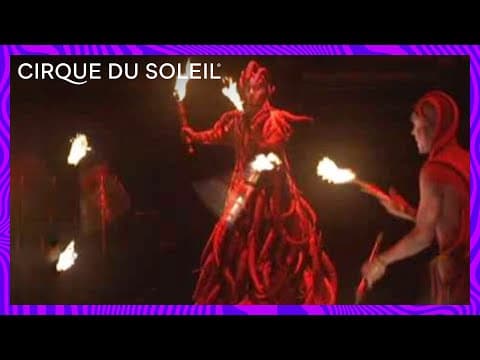
Zed (2008)
Zed was Cirque du Soleil's second permanent Asian resident production, opening on 1 October 2008 in a purpose-built theatre at Tokyo Disney Resort in Urayasu, Chiba. It is a cirque-spectacle built on a Tarot-derived cosmology — a Fool-figure named Zed mediates between the People of the Sky and the People of the Earth — realised through a sequence of circus disciplines (aerial silk, straps, Chinese pole, banquine, high wire, hand-to-hand, flying trapeze, juggling, baton twirling, lasso work) rather than through a danced narrative in the ballet or modern-dance sense.
It belongs in a performance catalogue chiefly as a large-scale ensemble circus-theatre work with a fixed act structure, a commissioned score (René Dupéré), and named apparatus-based turns that function like a suite of danced numbers within a themed frame — closer to a divertissement structure than to book-musical choreography, which is why the acts are treated below as its 'numbers'.
What it contains
- Aerial Silks — Solo tissue · Solo tissue act — Performer wraps aerial silk fabric around her body, then executes flips and twists to unwrap herself in mid-air, a full aerial-silks sequence. Source: "the artist wrapped the silk around her body, she flipped and twisted to unwrap herself"
- Aerial Straps — Straps · Straps act — Two performers execute synchronised aerial strap tricks, holding and releasing tension in the straps while positioned as representatives of opposing worlds. Source: "Straps: Two women, each representing the different worlds performed tricks in perfect synchronisation."
- Chinese Pole — Poles and trampoline · Poles and trampoline act — Performers climb poles as part of an act explicitly titled with Chinese poles in the accompanying score cue. Source: "Reaching Up (Chinese Poles and Trampoline)"
- Partner Acrobatics (Adagio) — Hand to hand · Hand to hand act — A duet built on hand-to-hand balancing between two partners, a classic partner-acrobatic adagio form used here to represent the union of the earth and sky characters. Source: "Hand to hand: A woman of the sky and a man of the earth united in this touching balancing act."
- Tumbling for Dance — Lassos · Lassos act — Performers tumble through spinning lassos while the ropes are manipulated, combining tumbling passes with rope work. Source: "they would spin the lassos while tumbling through them"
What is danced
The article gives a clear act list, and each act is built around a single circus apparatus or discipline rather than a stepped vocabulary: bungee-assisted flipping and twisting off a trapeze (Bungee); lasso spinning combined with tumbling through the moving ropes (Lassos); pole-climbing paired with trampoline jumps (Poles and trampoline); a solo aerial-silk (tissue) act in which the performer wraps and then unwraps herself in the fabric while flipping and twisting (Solo tissue); high-wire crossing (High wire); club, disc and fire-club juggling (Juggling); mass acrobatic throwing and human-tower building by porters (Banquine); synchronised strap work between two performers cast as opposing 'worlds' (Straps); competitive-style baton spinning and throwing (Batons); a balancing hand-to-hand duet between a 'sky' woman and an 'earth' man (Hand to hand); and a four-trapeze flying act with flips (Flying trapeze), before all acts combine in the Charivari finale.
For a dancer or teacher, the most transferable vocabulary is in the aerial and partner-acrobatic acts: the Solo tissue number is a textbook aerial-silks sequence (wrap, drop, unwrap, flip) that the article describes in enough detail to identify the technique; the Straps act is explicitly named as an aerial-straps duet in both the acts list and the accompanying track title ('Zed in Love (Aerial Straps)'); and the Hand-to-hand act is a classic adagio balancing turn between two acrobats. The Chinese-pole element is confirmed by the music cue 'Reaching Up (Chinese Poles and Trampoline)', which the acts description otherwise folds together with trampoline work.
Several of the show's central disciplines — bungee-trapeze, lasso manipulation, trampoline, tightwire/high-wire walking, group-throw banquine, club/fire juggling, competitive baton twirling, and flying trapeze — are not represented in the taxonomy offered for this entry and are listed as gaps rather than mis-coded. This is typical of Cirque's repertoire: the show's identity rests on apparatus discipline and ensemble spectacle more than on a codified dance technique, so the catalogue's dance-style codes can only capture a partial cross-section of what is actually performed.
Context
By 2008 Cirque du Soleil was well into its expansion of fixed 'resident' productions attached to entertainment resorts (following Las Vegas precedents such as Mystère and O), and Zed was its second such Asian venture, built for a purpose-designed theatre at Tokyo Disney Resort. The production sits within Cirque's house style of the 2000s: a loose esoteric or mythological frame (here, Tarot Arcana) used to string together apparatus-based circus turns with an original orchestral-world-music score, in this case by longtime Cirque composer René Dupéré.
Staging history
Zed ran exclusively at the Cirque du Soleil Theatre, Tokyo Disney Resort, from October 2008. Performances were suspended after the 2011 Tōhoku earthquake and tsunami (11 March–20 April 2011), during which the cast relocated to Cirque's Macau facilities to train alongside the crews of Zaia and the touring show Koozå; the show reopened on 23 April 2011 after safety inspections, and a new inflatable air-bag safety device was installed for the high-wire act as a direct response to the earthquake risk. The production closed permanently on 31 December 2011, a business decision tied to the post-disaster environment, after reaching one million guests faster than any other show in Japan and passing 1,000 performances. Its flying-trapeze act and accompanying music were subsequently reused in Cirque's Las Vegas resident show Mystère from 2012, and Cirque released a 2010 documentary short (Zed in Tokyo) and a 2020 60-minute streamed special drawn from a December 2011 filming of the closing performances.
How to watch it
Watch the acts as a suite of apparatus solos and duets tied together by the earth/sky costume-colour scheme (iridescent pale/silver for the sky people, gold-ochre-Venetian-blue for the earth people) rather than by narrative mime; the Solo tissue and Straps numbers are the clearest examples of pure aerial technique, while Hand to hand and Banquine show partner- and group-acrobatic balancing and throwing. The high-wire act is worth attending to for its added safety rigging, introduced after the 2011 earthquake, which is unusual documented context for a circus apparatus act.
Structure
- VortexOpening effect: a large silk sheet covering the stage appears to plummet into a hole, creating a vortex.
- BungeeFour female performers representing the sky flip and twist off a trapeze using bungee cords.
- LassosA Chinese troupe spins lassos and tumbles through them in an act representing the earth.
- Poles and trampolineMen from the earth try to reach the women of the sky by jumping from a trampoline and climbing poles.
- Solo tissueA solo aerial-silk act representing the air: the performer wraps the silk around her body, then flips and twists to unwrap herself.
- High wireA trio walks a high wire set at the border between the sky world and the earth world.
- JugglingMen representing the earth juggle clubs, discs and fire clubs.
- BanquineA large group of acrobats are thrown by porters and form high human towers.
- StrapsTwo women, each representing a different world, perform synchronised strap tricks.
- BatonsA world-champion baton twirler spins and throws up to three batons at once.
- Hand to handA sky woman and an earth man perform a balancing hand-to-hand duet symbolising the union of worlds.
- Flying trapezeArtists swing between four trapezes performing flips; this act and its music were later reused in Mystère.
- CharivariThe finale in which the two worlds unite and every preceding act comes together.
Structure read from an encyclopaedia article, not from a libretto or score we hold. Confirm against a programme before treating the numbering as authoritative.
In the same lineage
Other staged works in the register connected to this one by author or lineage.
 KàCirque & spectacle · 2004Same lineage · video
 KoozåCirque & spectacle · 2007Same lineage · video
 SaltimbancoCirque & spectacle · 1992Same lineage · video
 La NoubaCirque & spectacle · 1998Same lineage · video
 ZumanityCirque & spectacle · 2003Same lineage · video
 Nouvelle ExpérienceCirque & spectacle · 1990Same lineage · video
 IvesianaBallet · 1954Same lineage · video
 Drawn to LifeCirque & spectacle · 2021Same lineage · video