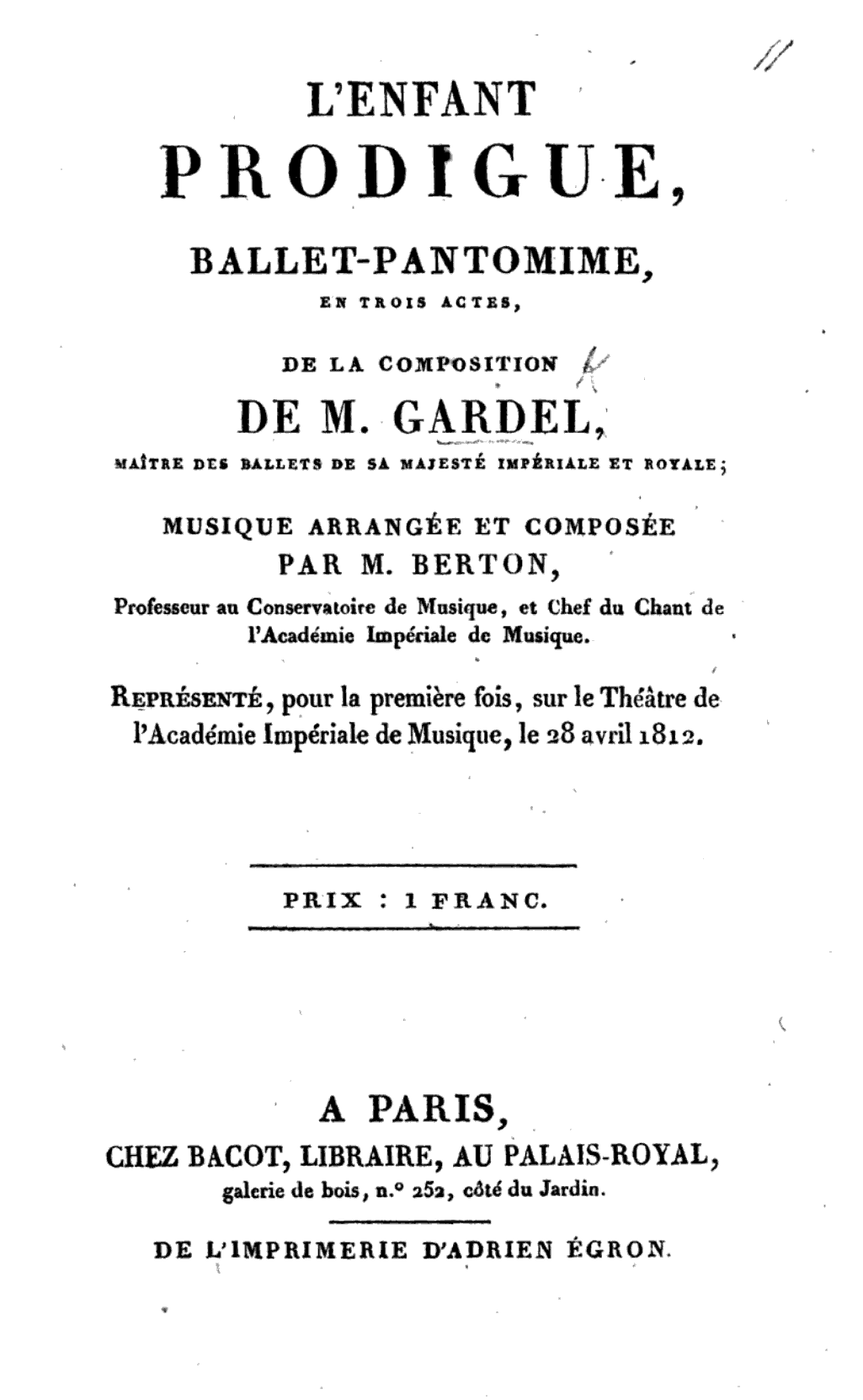
Pierre Gardel — Google Books · Public domain
L'enfant prodigue is a three-act ballet-pantomime made by Pierre Gardel, ballet-master of the Paris Opera, and first given there on 28 April 1812. It adapts the biblical Parable of the Prodigal Son, with the emperor Napoleon personally choosing this subject over Gardel's preferred alternative, a ballet on William Tell.
What is danced
The article does not describe the ballet's step vocabulary, and no divertissement, pas or named dance number survives in the source text. What it does give is a single, telling piece of performance evidence: in the reworked May 1812 staging, Auguste Vestris played the Prodigal Son 'showcasing his mime talent' rather than being singled out for virtuosic dancing, which points to a work built on dramatic gesture and narrative pantomime in the tradition Gardel practiced at the Opera, rather than on a display-driven divertissement structure.
Beyond that, the only concrete staging detail is scenic rather than choreographic: the set for the Egyptian scenes drew on the desert and the temple of Apis at Memphis, implying a spectacle of processional and pictorial staging (crowd groupings, tableaux) typical of grand Empire-period ballet-pantomime, but the article gives no specifics of steps, partnering, or ensemble patterning to describe with confidence.
Given this, no style codes are assigned from the taxonomy on offer: assigning classical-ballet vocabulary to a work known here mainly through cast list, plot and set description would be inferring from company and era rather than from anything actually described as danced, which the brief for this catalogue explicitly rules out.
Context
1812 places this squarely in the Napoleonic-era Paris Opera, where Pierre Gardel had held sway as ballet-master since the 1780s and where ballet-pantomime — extended narrative works told through mime and grand tableaux rather than through short divertissements — was the dominant form. The subject itself is a piece of Napoleonic cultural politics: Gardel wanted to stage William Tell, with its overtones of liberty and resistance, but the emperor steered him instead toward the safely apolitical Prodigal Son, an instance of direct imperial intervention in the choice of a ballet's story.
Staging history
The ballet was revised within days of its own premiere: after the 28 April 1812 opening, 'criticized elements were removed' for a second performance on 2 May 1812, with some cast changes (Vestris took over the title role, opposite Mlle Chevigny as the mother and Madame Gardel as Jephtelle). The article records no later revivals, transfers, or subsequent stagings beyond this initial reworking.
How to watch it
Approach it as a mimed narrative in three acts following the parable's own shape — departure, dissipation, return — rather than as a display piece; the reworking between the two 1812 performances suggests the Opera itself treated legibility of the story and decorum of the staging as the main issues to solve. Attend to the Egyptian-inflected scenography (the desert, the temple of Apis at Memphis) as the vehicle for spectacle, since the source gives no indication of technical dance display carrying that role.
Structure
- Act IAzaël, the Prodigal Son, announces his intent to leave home for Memphis; his father gives him money despite his grief, and his mother is sorrowful.
- Act IIIn Memphis, Azaël squanders his wealth in indulgence and betrays Lia, a Moabite girl who loves him; rejected by her father, she drowns herself in the Nile.
- Act IIIDestitute and robbed in the desert, Azaël is inspired by an angel to return home, where he first meets Jephtelle.
Structure read from an encyclopaedia article, not from a libretto or score we hold. Confirm against a programme before treating the numbering as authoritative.
More from Pierre Gardel
Other staged works in the register connected to this one by author or lineage.


