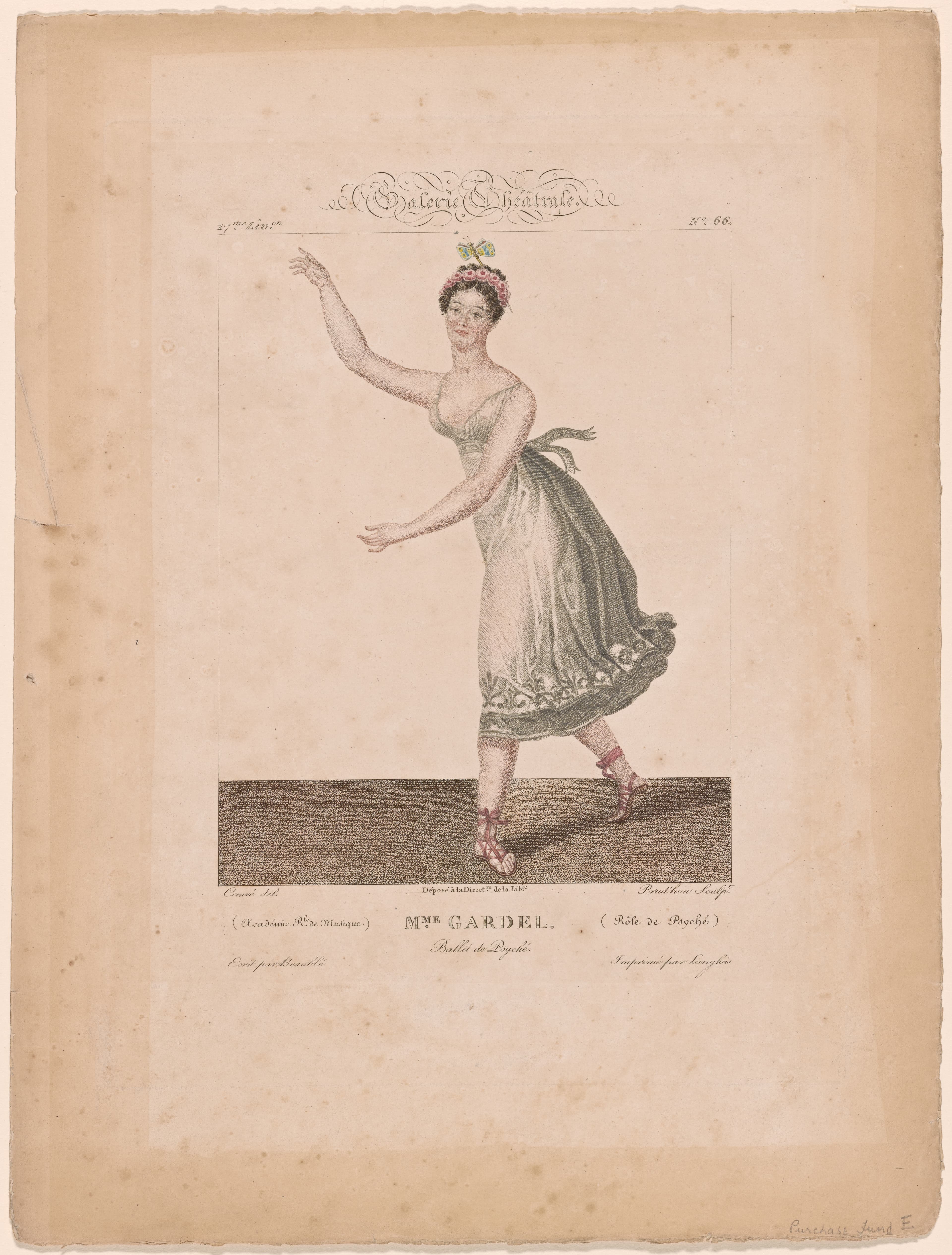
Scan by NYPL — https://digitalcollections.nypl.org/items/d47f6640-a950-0131-bee3-58d385a7b928 · Public domain
Psyché is a three-act ballet-pantomime (ballet d'action) created by Pierre Gardel, maître de ballet of the Paris Opéra, and first given there on 14 December 1790 under the title Psiché. It dramatises the myth of Psyche and Cupid, drawing on La Fontaine's 1669 fable Les amours de Psyché et de Cupidon, and became one of the most durable works of the pre-Romantic Opéra repertory, remaining in the house's programme from 1790 until 1829.
What is danced
The article does not describe specific steps, holds or technique used in the ballet; what survives in the source is scenography (a countryside with a temple of Venus, a palace built by Love, a hell dominated by the Phlegethon and Cerberus's lair) and casting, not a movement description. It is explicitly categorised as a 'ballet-pantomime' and 'ballet d'action', a genre built on mimed dramatic action integrated with formal dance rather than pure divertissement, but the source gives no detail on how Gardel distributed mime versus danced passages across the three acts.
Context
Psyché belongs to the late-18th-century French ballet d'action tradition associated with Noverre, in which narrative pantomime was fused with academic dance at the Paris Opéra. Gardel made the work explicitly in dialogue with two predecessors on the same myth — Noverre's and Jean Dauberval's versions, the latter staged at Bordeaux in 1788 — and used the rivalry to justify his own attempt, as he recounts at length in his own defensive statement quoted in the article. Its nearly forty-year run (1790–1829, 1,161 performances) makes it a benchmark for the longevity of a single Opéra ballet in this period, straddling the transition from the Ancien Régime stage into the early Romantic era.
Staging history
The ballet premiered at the Théâtre National in Paris on 14 December 1790 and stayed in the Paris Opéra repertoire continuously to 10 April 1829, apart from a pause in 1828, totalling 1,161 performances. It was revived on 23 February 1829 as a benefit performance honouring Gardel, at which the Italian dancer Marie Taglioni danced the title role of Psyche as a tribute to him — a notable crossing of the emerging Romantic-ballet generation with Gardel's older ballet d'action.
How to watch it
Attend to the shifts in setting across the three acts — pastoral temple grounds, Love's nocturnal palace, and a hell-scape with Cerberus — since the article frames the work through its stagecraft as much as its dancing. Because it is a ballet-pantomime, expect mimed dramatic action carrying the myth's narrative beats (Psyche's trials, Love's intervention) alongside formal danced episodes performed by principal dancers such as Auguste Vestris (Love) and Gardel himself (Apollo).
More from Pierre Gardel
Other staged works in the register connected to this one by author or lineage.


