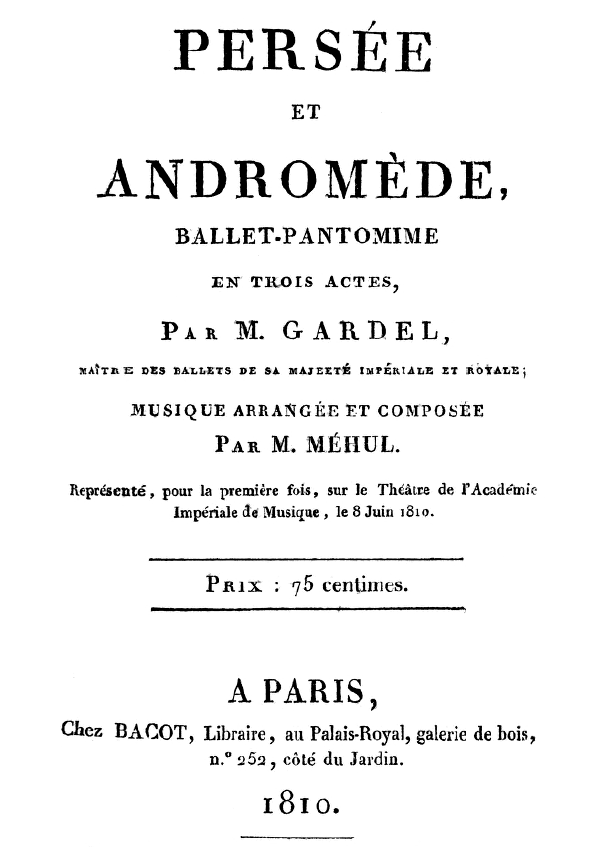
Pierre Gardel — Google Books · Public domain
Persée et Andromède is a three-act ballet-pantomime created by Pierre Gardel, ballet master of the Paris Opéra, and first given there on 8 June 1810. It stages the myth of Perseus and Andromeda with deliberate alterations to the classical story, made, the article says, to sharpen dramatic interest and stage effectiveness, and was dedicated by Gardel to Karl Philipp, Prince of Schwarzenberg, the Austrian ambassador to Napoleon's court.
What is danced
The source article does not describe the choreography itself — no step vocabulary, no pas, no named divertissements, and the roles section is blank ('The principal roles were entrusted to artists such as:' with no names following). What it gives instead is the physical architecture of the piece: Act I unfolds in a flower-decked public square set up for games, framed by Juno's temple and the king's palace with a bridge behind; Act II moves into the king's gardens among statuary including a figure of Jupiter; Act III shifts to a palace courtyard belonging to Cepheus, with an arm of the sea visible in the distance. As a ballet-pantomime of this period and house, the work would have combined mimed dramatic action with formal dance episodes in the Noverre-descended tradition Gardel inherited, but the article gives no basis for specifying which scenes carried dancing versus mime, or what steps or forms were used in them.
Context
In 1810 Gardel had long held the post of ballet master at the Paris Opéra, continuing the ballet d'action lineage established by Noverre, in which mythological or heroic subjects were reshaped into pantomime-driven narrative spectacle rather than pure divertissement. The practice of arranging a ballet's score from existing music, as Méhul did here by folding in a rondeau from a Steibelt sonata, was standard for the house at the time rather than an original through-composed commission. The dedication to an Austrian diplomat sits inside the year of Franco-Austrian rapprochement under Napoleon, though the article itself offers no commentary on that political backdrop.
How to watch it
Because the record preserves the sets rather than the steps, attend to what the three settings imply about the dramaturgy: a public square built for games, a formal garden with statuary, and a royal courtyard opening to the sea each mark a shift in the story's register from public spectacle to private and finally dynastic space. Read the piece as a pantomime-ballet of the pre-Romantic Paris Opéra tradition, where mimed narrative carried as much weight as formal dance, and note that the myth was knowingly altered rather than followed literally.
More from Pierre Gardel
Other staged works in the register connected to this one by author or lineage.


