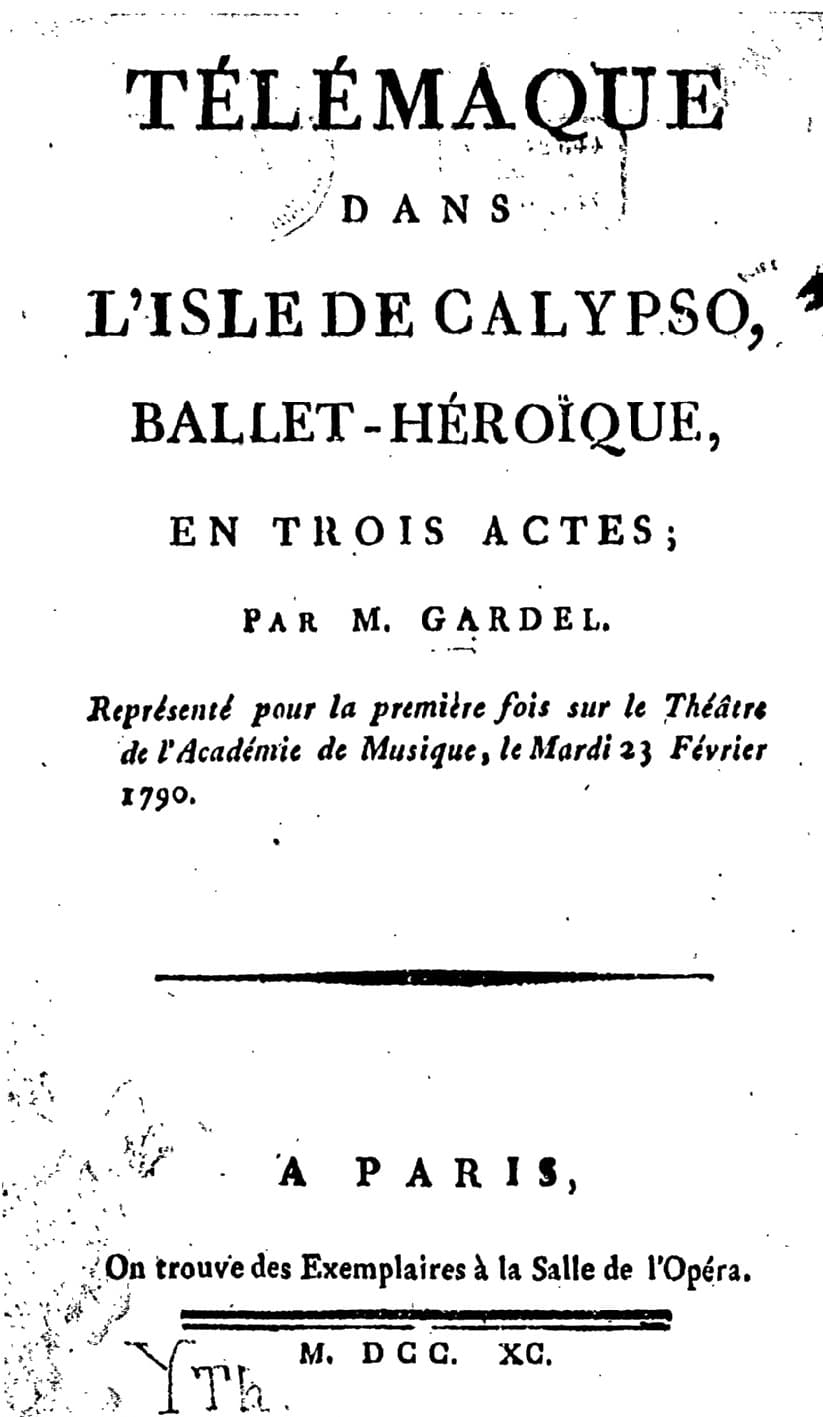
Pierre-Gabriel Gardel — https://gallica.bnf.fr/ark:/12148/bpt6k5734720x/f2.item · Public domain
Télémaque dans l'île de Calypso is a three-act ballet-pantomime made by Pierre Gardel, premiered at the Paris Opéra on 23 February 1790 with music by Ernest-Louis Müller. It sits in the repertoire of the pre-Revolutionary and Revolutionary-era Paris Opéra, where Gardel was the house's leading choreographer, and it stayed in active repertoire for over seventy years, with performances recorded as late as 1866.
What is danced
The article does not describe specific steps, holds, or technical vocabulary. What it does establish is that the work is a 'ballet-pantomime' in which Gardel's skill lay in fusing character-driven mime with dance passages — contemporaries praised this combination and the ballet's overall execution, but no set numbers, pas, or named divertissements are described. The synopsis mentions activities that would plausibly have been rendered as dance set-pieces — Calypso's nymphs performing 'games' in Act I in which Eucharis 'wins multiple contests', festivities that close Act I, and a hunt with Venus, Love and the Graces opening Act III — but the source gives no choreographic detail for any of these, so no style code can be responsibly attached to them.
Context
1790 places this work in the late ballet d'action period at the Paris Opéra, the tradition shaped by Noverre's reforms that fused expressive pantomime with academic dance rather than treating dance as ornamental interlude. Gardel was the dominant choreographic figure at the Opéra through this transitional era, bridging the pre-Revolutionary court-adjacent repertoire and the institution's continuation through the Revolutionary and Napoleonic periods; a mythological subject staged with pantomime-driven storytelling and an extended run through multiple political regimes reflects how resilient this repertoire model was at the Opéra.
Staging history
According to the article, the ballet was performed from its 1790 premiere until 1816, was reinstated in 1819, and remained in the repertoire until 24 November 1866 — an unusually long institutional life spanning the ancien régime, the Revolution, the Empire, the Restoration, and into the Second Empire. No cast list, revival choreographer, or design credits beyond Gardel and Müller are given in the source.
How to watch it
Attend to how mime and dance passages alternate rather than blend into a single continuous danced fabric — this alternation, not a signature step vocabulary, is what the article singles out as Gardel's achievement. Treat the contest scenes and the hunt as likely danced set-pieces even though the source does not specify their vocabulary, and note that disguise (Calypso as Diana, Mentor as Minerva) drives much of the plotted mime in Act III.
Structure
- Act IMentor and Telemachus are shipwrecked on Calypso's island; Calypso organizes games in which the nymph Eucharis wins multiple contests and catches Telemachus's attention; festivities close the act.
- Act IINymphs prepare a garland for the sleeping Telemachus; Venus grants Calypso Cupid's power, causing romantic confusion; Mentor uses Calypso's jealousy to arrange Telemachus's departure by ship.
- Act IIIEucharis prepares for a hunt with Venus, Love and the Graces; disguises (Calypso as Diana, Mentor as Minerva) drive a confrontation and rescue; the ship is burned by Bacchantes and Telemachus and Mentor leap into the sea.
Structure read from an encyclopaedia article, not from a libretto or score we hold. Confirm against a programme before treating the numbering as authoritative.
Credits
- composer: Ernest-Louis Müller
More from Pierre Gardel
Other staged works in the register connected to this one by author or lineage.


