André Laclôtre — France Musique · Public domain
La boîte à joujoux (1919)
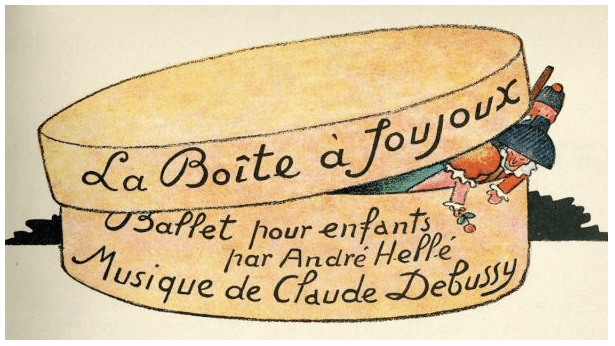
La boîte à joujoux is a ballet score Debussy completed as a piano reduction in 1913, based on a scenario by the artist-writer André Hellé drawn from his own children's story of the same name. Debussy died before orchestrating it; André Caplet completed a successful orchestration, and the ballet was not staged until 1919, after Debussy's death and after the First World War had forced a postponement.
What is danced
The article gives a musical and dramatic structure — a prelude, four tableaux, an interpolated waltz, and an epilogue — plus a plot summary involving three toy characters (a toy soldier, a doll, a quarrelsome polichinelle) each carrying their own leitmotiv, who play out a love triangle, a battle, a wounding, a nursing-back-to-health, and a marriage. This is enough to reconstruct a narrative arc but the article gives no choreographic detail whatsoever: no named choreographer, no described steps, holds, or technique, and no account of how any staging realised the toy-soldier's battle, the doll's waltz, or the reconciliation in movement.
Context
The article situates the work within Debussy's late output for children, alongside his Children's Corner suite written for his daughter Emma-Claude ('Chouchou'); the ballet was conceived from a stated wish to engage a child's imagination, with Debussy at one point considering a puppet-show format before settling on the ballet scenario as devised by Hellé. Its composition (1913) and posthumous staging (1919) place it either side of the First World War, which the article credits directly with the delay, and its premiere came after Debussy's own death, so the composer never saw it performed.
Staging history
The article records only that the ballet's staging was postponed by the outbreak of the First World War and that it was not staged until 1919, after Debussy's death; it names no venue, company, or choreographer for that or any later production, and Caplet's orchestration is noted as the version that made staging possible.
How to watch it
Follow the three leitmotivs the article attributes to the soldier, the doll, and the polichinelle — since the drama is described as running through musical themes attached to characters, a staging is likely to lean on mime and characterisation built from those motifs rather than on abstract dancing. Expect the shape sketched by the section titles: a sleeping toy shop, a doll's waltz, a battlefield, and a domestic epilogue — but treat any specific staging choices you see as the director's/choreographer's invention, since the source material here is silent on them.
Structure
- Le sommeil de la boiteThe toy-box is asleep; establishes the world before the toys act.
- Le magasin de jouetsThe toy shop is introduced, setting the three principal toys in place.
- Danse de la poupéeA waltz for the doll, one of the toy-box's principal characters.
- Le champ de batailleThe soldier and the polichinelle fight over the doll; the soldier is wounded.
- La bergerie a vendreA later tableau in the toys' unfolding story, following the battle.
- Apres fortune faiteA further tableau depicting the aftermath of the toys' fortunes.
- EpilogueThe doll nurses the soldier, they fall in love, marry, and live happily ever after.
Structure read from an encyclopaedia article, not from a libretto or score we hold. Confirm against a programme before treating the numbering as authoritative.
Credits
- composer: Claude Debussy
More from Claude Debussy
Other staged works in the register connected to this one by author or lineage.