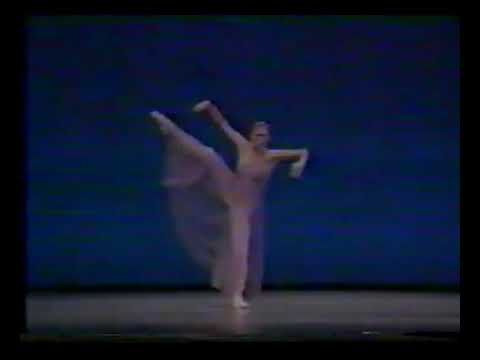
Antique Epigraphs is a plotless ballet Jerome Robbins made for New York City Ballet, set to an orchestration of Debussy's Six épigraphes antiques (originally for piano, four hands, 1914) together with Debussy's solo flute piece Syrinx (1913). It premiered on February 2, 1984, at the New York State Theater, Lincoln Center, with costumes by Florence Klotz and lighting by Jennifer Tipton.
What is danced
The article does not describe the choreography itself — no step vocabulary, formation, or cast breakdown survives in the source beyond the credits and the music's own structure. What it does give is the score's programme: Debussy's six epigraphs each carry an evocative title (invoking Pan, an unnamed tomb, a propitious night, 'the dancer with crotales', 'the Egyptian woman', and morning rain), and these were themselves written to accompany Pierre Louÿs' Les Chansons de Bilitis, prose poems presented as newly discovered verse by a contemporary of Sappho. That literary frame — an invented antiquity, filtered through a French Symbolist imagination — is the material Robbins was working from, but the article gives no evidence of how, or whether, he mapped individual epigraphs onto discrete danced episodes.
Because the source is silent on steps, holds, or technique, no movement vocabulary can be responsibly coded from it. A reader wanting to know what the piece actually looks like in performance will need to consult reviews or film, neither of which the article supplies in usable detail (the NYT piece is cited only by author and date, with no excerpted content).
Context
The ballet dates from early 1984, the year after George Balanchine's death, when Robbins — long Balanchine's junior partner in shaping New York City Ballet's identity — was one of the company's senior remaining choreographic voices. Turning to an obscure, atmospheric Debussy score built around invented antiquity fits a broader pattern in his later NYCB work of small-scale, musically driven pieces made without narrative scaffolding, in contrast to the story ballets and Broadway work earlier in his career.
How to watch it
Listen for the six discrete epigraphs in the score and watch for whether the choreography marks their boundaries, since the titles (a Pan invocation, a nameless tomb, a night made propitious, a dancer with crotales, an Egyptian figure, a morning rain) suggest an episodic rather than continuous structure. Note also the shift from the orchestrated ensemble epigraphs to the unaccompanied flute of Syrinx, which the article places alongside them and which would read as a distinct, exposed solo passage against the fuller orchestral sections.
Credits
- composer: Claude Debussy
Related works
Other staged works in the register connected to this one by author or lineage.
 West Side StoryMusical theatre · 1957Robbins · video
 Fancy FreeBallet · 1944Robbins · video
- DybbukDybbukBallet · 1974Robbins
 The ConcertBallet · 1956Robbins · video
 A Suite of DancesBallet · 1994Robbins · video
- AndantinoAndantinoBallet · 1981Robbins
- In Memory Of ...In Memory Of ...Ballet · 1985Robbins
- KhammaKhammaBallet · 1947Music by Debussy