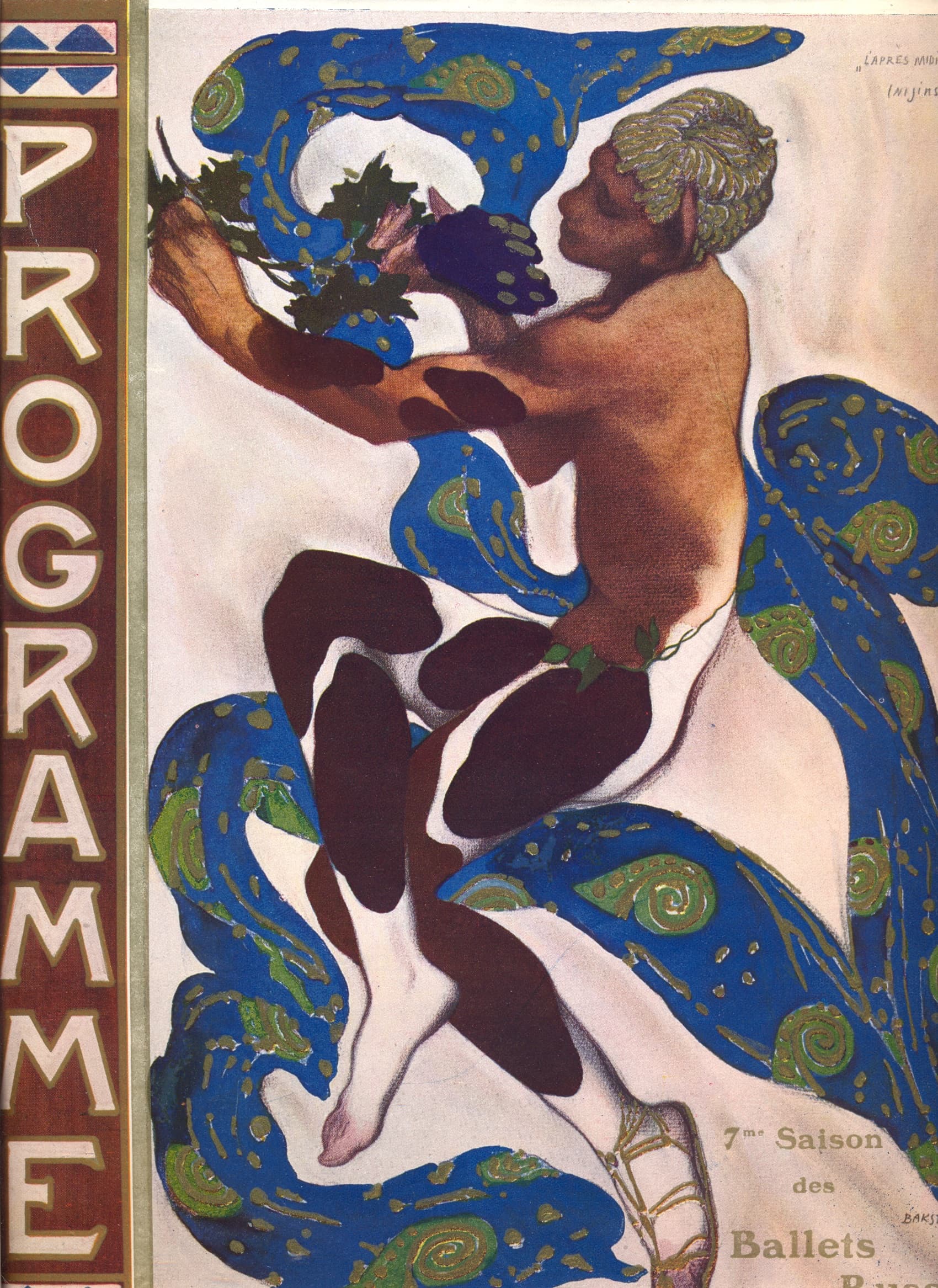
Léon Bakst — Early (low-res) version taken from http://www.silverage.ru/paint/bakst/bakst_rab.html Replaced with a higher-res scan from The Decorative Art of Leon Bakst, Dover Publishing · Public domain
The Afternoon of a Faun (L'Après-midi d'un faune) is Vaslav Nijinsky's first ballet as choreographer, made for Diaghilev's Ballets Russes and premiered at the Théâtre du Châtelet in Paris on 29 May 1912, with Nijinsky himself dancing the Faun. Set to Debussy's Prélude à l'après-midi d'un faune and designed by Léon Bakst after Mallarmé's poem, the twelve-minute piece shows a faun encountering nymphs by a pool, culminating in an act of solitary desire over a discarded veil.
It sits in the catalogue as one of the founding works of modernist ballet: a deliberately anti-classical, anti-narrative piece built from flattened, profile-facing poses borrowed from Greek vase painting and Egyptian and Assyrian frescoes, performed barefoot. Its premiere caused a public scandal over its erotic ending and split the Ballets Russes, ending Michel Fokine's tenure as the company's sole choreographer.
What is danced
The choreography rejects academic ballet vocabulary almost entirely. Dancers move in tightly synchronised groups "passing each other in parallel lines, as if in a moving frieze," holding stylised, angular poses "as might be seen on an ancient vase" and travelling largely in profile, as on a bas relief, rather than in the open, turned-out lines of classical technique. The Faun's own movement is built from animal-suggestive gestures — eating grapes held to his face, following the nymphs with his eyes before his head or body moves, a slow rise from his mound — rather than steps in the conventional sense. The ballet contains a single jump, executed by the Faun over an imagined stream, which contemporary critics singled out precisely because dancing of any conventional kind is otherwise absent: "the fabulous Nijinsky, the peerless dancer, who as the faun does no dancing."
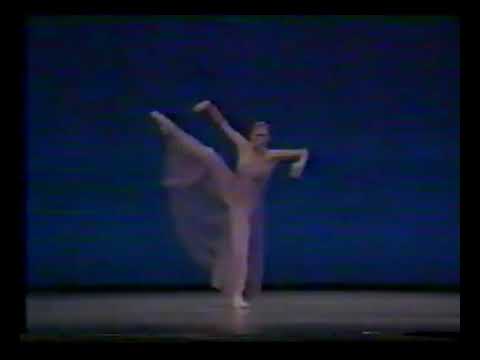
The nymphs' vocabulary is similarly non-balletic: long held arabesques, a "mechanical walk" for the sixth nymph's entrance, kneeling and rising with elbows turned out and hands pointed at the waist or sky during a stylised bathing sequence, and unison entrances and exits that read as processional rather than danced in the usual sense. The final section — the Faun spreading the discarded veil on the ground, lowering his body onto it, tensing and curling back before relaxing — was performed as an act of physical, sculptural intensity rather than steps, and this is what generated the scandal.
Because the vocabulary was unlike anything the company's dancers had trained in, the piece demanded extraordinary rehearsal for its length: ninety rehearsals for twelve minutes of stage time, with Nijinsky teaching by demonstration rather than explanation and using his sister Bronislava Nijinska as a working model for the choreography before it was set on the company. Dancers reportedly found the movement "completely unnatural" and initially believed the piece unstageable.
Context
Faun was made in 1912 inside the Ballets Russes at a moment when Diaghilev was looking for an alternative to Michel Fokine's house style and gave his lead male dancer, Nijinsky, his first choreographic commission. Bakst, Nijinsky and Diaghilev drew directly on Greek vase painting and Egyptian and Assyrian frescoes seen in the Louvre, and on stagecraft (two-dimensionality, stylised posture, a narrowed stage, deliberate pauses) that Bakst had absorbed from the director Vsevolod Meyerhold. The result, alongside Nijinsky's subsequent Jeux and Le Sacre du printemps, is treated as one of the earliest modern ballets, breaking with the fluid, virtuosic, narrative-driven idiom Fokine had built for the company.
The production's difficulty and its content directly caused the end of the Fokine–Nijinsky choreographic partnership: Fokine resented the rehearsal time it consumed, disputed Nijinsky's competence to communicate choreography, and left the company on bad terms once Faun was staged, even though the two had been highly successful collaborators as dancer and choreographer up to that point.
Staging history
The Ballets Russes withheld Faun from its 1912 London season, showing it instead in Cologne and, on 11 December 1912, in Berlin before the Kaiser and the King of Portugal, where Diaghilev reported it a "huge success" with ten unprotested encores, though the stage manager Grigoriev thought it "fell flat." A 1913 Vienna showing was received coolly; a subsequent London run drew hissing but also an encore and warm press, including praise from The Times and the Daily Mail. After Diaghilev's death, Léon Woizikovsky, who had danced the Faun under Nijinsky's own teaching, reconstructed the ballet for Ballet Rambert from 1931, a staging Cyril Beaumont criticised when given without the full complement of nymphs. Rudolf Nureyev performed the role at the Nureyev Festival, London Coliseum, in July 1983, and in the late 1980s the notators Ann Hutchinson Guest and Claudia Jeschke produced a scholarly reconstruction from Nijinsky's own notebooks and dance notation together with Baron Adolph de Meyer's contemporary photographs; that reconstruction is the version most often programmed alongside other Ballets Russes repertoire today.
How to watch it
Watch for the frieze effect: dancers crossing largely in profile and freezing into vase-painting poses rather than sustaining continuous balletic movement, and for the fact that the Faun himself barely dances at all — his single jump is the piece's one conventional balletic event. The ending, in which the Faun lies down on the nymph's discarded veil, is played for physical and psychological intensity rather than virtuosity, and is the moment the original audience and critics fought over; a staging that omits or softens it, or that drops the corps of nymphs, is departing from the choreography as documented.
Credits
- composer: Claude Debussy
Related works
Other staged works in the register connected to this one by author or lineage.