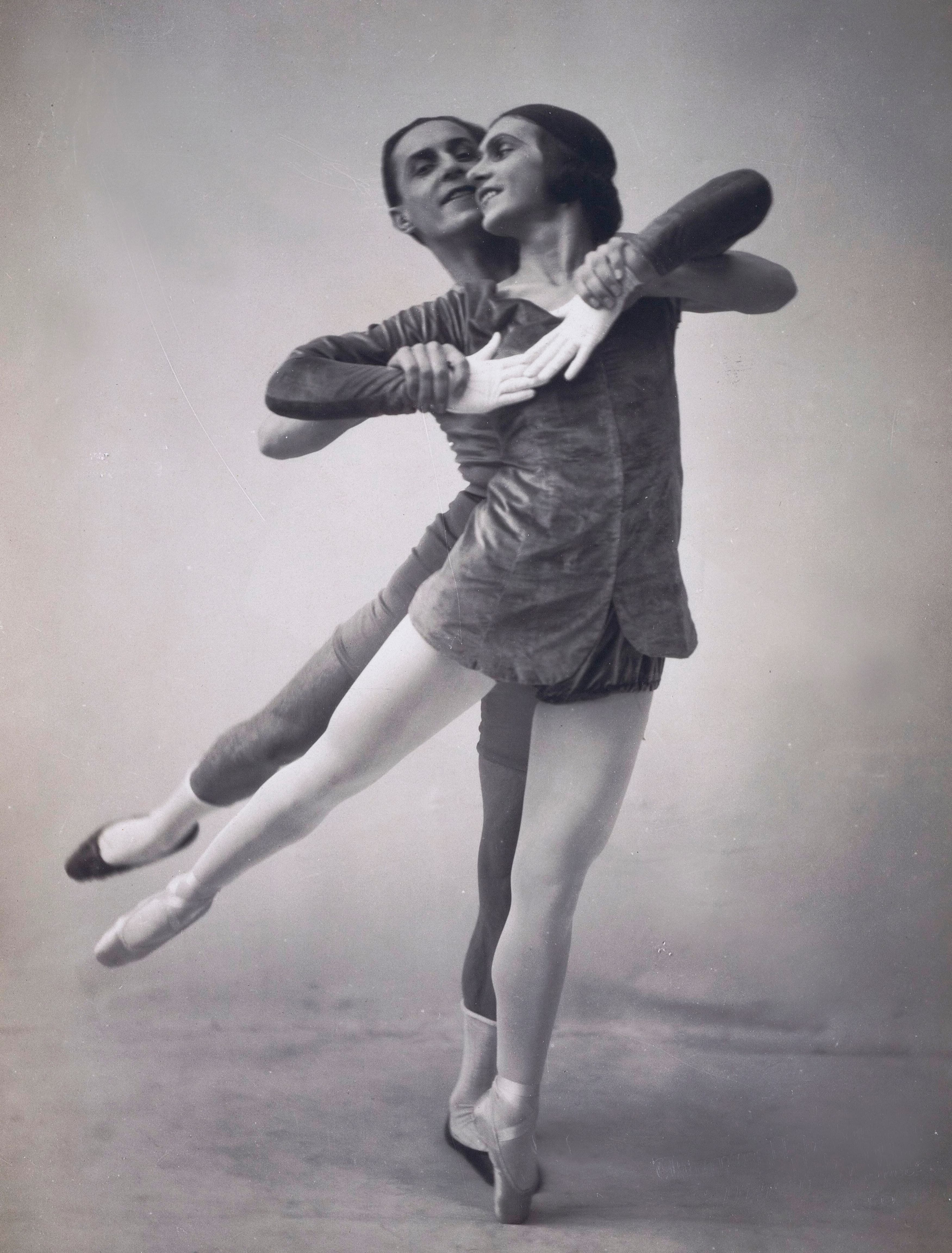
Detaille, Georges (1875-1955) — This file comes from Gallica Digital Library and is available under the digital ID btv1b7002551j · Public domain
Les biches (1924)
Les Biches is a one-act, plotless ballet made for Diaghilev's Ballets Russes, with a score by Francis Poulenc and choreography by Bronislava Nijinska (not recorded in our current record but stated throughout the source article), first given on 6 January 1924 at the Salle Garnier, Monte Carlo, with Nijinska herself dancing the central role of the Hostess. It depicts, without narrative, the flirtations and pairings of three young male athletes and a party of young women (and one androgynous 'garçonne' figure) over a summer afternoon, staged in a single white drawing-room set dominated by a large blue sofa.
What it contains
- Classical Ballet · The whole ballet — Ashton describes the work as built entirely from classical ballet steps even as the overall effect reads as new; the corps dances in formal group formations (lines, circles) typical of classical corps de ballet writing. Source: "the whole ballet is new, and yet it is, at the same time, composed entirely of classical movement with a new expression."
- Neoclassical Ballet · The whole ballet — Academic ballet steps reworked with inventive port de bras, flexed arms, a new kind of pas de bourrée, altered épaulement and asynchronous torso-leg movement, per Oberzaucher-Schüller's analysis of Nijinska's choreography. Source: "Like the music, the choreography of Les Biches is neoclassical."
- Classical Ballet — Adagietto · Adagietto tableau, the garçonne's solo — The garçonne dances a slow solo danced largely en pointe, watched by the assembled cast, before a formal pas de deux with an athlete. Source: "performs a slow dance, largely en pointe, watched by the women and the athletes."
What is danced
The article describes the choreography as classical in vocabulary but reworked: Nijinska took 'the classical repertory of steps as her starting point' and built from it 'an inventive port de bras, flexed arms, a new kind of pas de bourrée, variations of épaulements and pointe, and asynchronous movements of the torso and legs.' Frederick Ashton, writing in 1930, called the whole piece 'new' yet 'composed entirely of classical movement with a new expression' — the defining tension a dancer approaching this work has to hold.
Structurally the ballet runs as eight tableaux keyed to Poulenc's musical numbers. The corps of twelve women opens in the Rondeau with unison formations — lines, circles, groups, a single long line. The androgynous garçonne role (created on Vera Nemtchinova) performs a slow, largely en pointe solo in the Adagietto before a pas de deux with one of the athletes that ends in a kiss of the hand; the same pairing recurs in the Andantino, ending in 'a tight embrace.' The Hostess has a virtuoso solo in the Rag-Mazurka, described by critic Jan Parry as 'a fiendish tongue-twister for the feet.' Two women coded as a couple (the 'grey girls') dance a duet in the second Chanson dansée, and the ballet closes with all principals and corps together.
The three male 'athletes' bring a different, more demonstrative physical register — described as 'macho posturing' and preening to impress the women — set against the women's more conventionally balletic material, and Nijinska is reported to have made even the set's sofa into a dancing partner in the Jeu tableau. The overall demand is not narrative acting but the sustained, ironic deployment of academic ballet steps and épaulement to suggest social flirtation without ever breaking into mime-driven storytelling.
Context
Les Biches arrived in January 1924, in the middle of the Ballets Russes' postwar turn toward chamber-scaled, plotless, contemporary-dress works, alongside other Poulenc/Diaghilev collaborations of the same moment (the article notes Georges Auric's Les Fâcheux triumphed in a similar vein just before). Both Poulenc's neoclassical score — built on eighteenth-century forms with jazz and mazurka inflections — and Nijinska's choreography were understood at the time as a modern answer to Romantic-era ballet blanc: Nijinska herself 'viewed it as a twentieth-century equivalent of Les Sylphides,' replacing gauze-and-moonlight atmosphere with a contemporary house party and academic steps stripped of their conventional narrative use.
Staging history
The ballet moved quickly from Monte Carlo to Paris (May 1924, conducted by André Messager) and to London in 1925, where it was retitled The House Party for the Lord Chamberlain's censors amid concern over its sexual undertones. Nijinska went on to stage or supervise revivals for de Basil's Ballet Russe de Monte Carlo, the Markova-Dolin Ballet (1937), and the Grand Ballet du Marquis de Cuevas, which gave the New York premiere only in 1950. Frederick Ashton brought Nijinska back to restage it for the Royal Ballet in 1964 (filmed that year with Svetlana Beriosova and Georgina Parkinson), and the work has since passed through the Paris Opera Ballet (from 1991), Ballet Theatre Français, Oakland Ballet and Dance Theater of Harlem (which restored the optional choral sections), and Ballet West, among others, generally using recreations of Marie Laurencin's original designs. Separate rechoreographings of Poulenc's score — Peter Darrell's Houseparty (BBC television, 1964) and Thierry Malandain's version for Ballet Biarritz (2002) — have not entered standard repertoire the way Nijinska's original has.
How to watch it
Watch for the contrast between the corps de ballet's straightforwardly classical formations in the Rondeau and the deliberately 'off' details Nijinska layers on top elsewhere — flexed wrists, asynchronous torso-and-leg phrasing, unusual épaulement — which read as social commentary rather than decoration. The garçonne role is the interpretive crux: a woman in a boy's velvet costume dancing largely en pointe, whose pas de deux with a male athlete carries the ballet's ambiguous sexual charge without a word of mime.
Structure
- Act I · RondeauThe twelve women of the corps de ballet, in pink frocks and ostrich-feather headdresses, dance through lines, circles and groups before exiting six to each side.
- Act I · Chanson dansée (I)Three athletes dressed for rowing enter and preen to impress the women, in exaggerated masculine display.
- Act I · AdagiettoThe androgynous garçonne dances a slow solo largely en pointe, then pairs with one athlete in a pas de deux ending with a kiss of the hand.
- Act I · JeuThe women hide behind the sofa while the garçonne and her athlete cross absorbed in each other; the remaining two athletes dance before being pursued by the emerging women.
- Act I · Rag-MazurkaThe Hostess performs a virtuoso solo of intricately rhythmic footwork, then flirts with and is pursued by two athletes.
- Act I · AndantinoThe garçonne and the first athlete dance together, ending in a tight embrace.
- Act I · Chanson dansée (II)The two 'grey girls' dance together, exchanging a direct look before exiting on opposite sides.
- Act I · FinalThe full corps dances, then the principals enter: the Hostess with her two athletes, the first athlete with the garçonne, and the grey girls dancing separately.
Structure read from an encyclopaedia article, not from a libretto or score we hold. Confirm against a programme before treating the numbering as authoritative.
Credits
- composer: Francis Poulenc
More from Francis Poulenc
Other staged works in the register connected to this one by author or lineage.
 Les mariés de la tour EiffelBallet · 1921Music by Poulenc · video
 L'éventail de JeanneBallet · 1929Music by Poulenc
 Les Animaux modèlesBallet · 1942Music by Poulenc
 Swan LakeBallet · 1877Same lineage · video
 The NutcrackerBallet · 1892Same lineage · video
 CoppéliaBallet · 1870Same lineage · video
 Jazz CalendarBallet · 1968Same lineage · video
 Les RendezvousBallet · 1933Same lineage · video