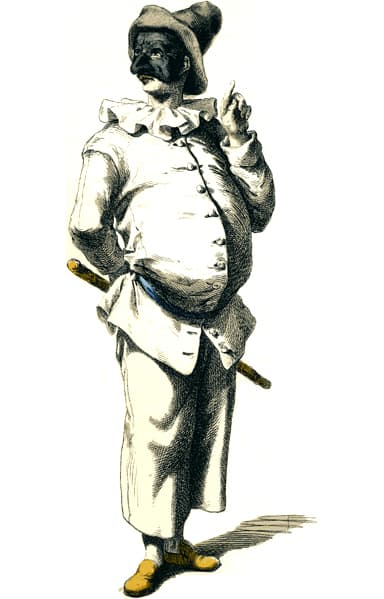
Maurice Sand — SAND Maurice. Masques et bouffons (Comedie Italienne). Paris, Michel Levy Freres, 1860 · Public domain
Pulcinella is a one-act, 21-section ballet made for Diaghilev's Ballets Russes, premiered at the Paris Opera on 15 May 1920 under Ernest Ansermet. Léonide Massine wrote the libretto and choreography and danced the title role himself, Pablo Picasso designed sets and costumes, and Stravinsky built the score from 18th-century music then attributed to Pergolesi (now known to be largely by other hands, including Domenico Gallo and Unico Wilhelm van Wassenaer).
What is danced
The article gives a detailed account of the plot and of the score's musical structure but does not describe the choreography itself in technical terms — no steps, holds, or ballet vocabulary are named. The synopsis is built from stock commedia dell'arte business: serenading suitors doused with water, a father chasing off intruders, Rosetta 'dances for Pulcinella and they kiss', a jealous beating, a faked stabbing used as a ruse, a disguised 'magician' staging a mock resurrection, and a triple wedding finale. This is pantomime-driven comic plotting (lazzi) rather than a described dance technique.
Context
The commission sits at the height of Diaghilev's Ballets Russes and its practice of pairing modernist visual artists (here Picasso) with composers reworking older material. Stravinsky himself framed the piece as the hinge of his career, writing that Pulcinella was 'my discovery of the past, the epiphany through which the whole of my late work became possible... a look in the mirror, too' — marking the start of his neoclassical period, in which older forms (arias, trios, dance-titled movements) are refitted with modern rhythm and harmony.
Staging history
The ballet premiered 15 May 1920 at the Paris Opera, conducted by Ernest Ansermet, with Massine dancing the title role he had also choreographed. It was revived and revised by George Balanchine and Jerome Robbins for New York City Ballet's 1972 Stravinsky Festival; both balletmasters danced in that premiere, Robbins in the title role, joined by Francisco Moncion as The Devil. Stravinsky separately revised his score in 1965, and had earlier extracted a concert suite (premiered by the Boston Symphony under Pierre Monteux in 1922) as well as several chamber arrangements under the title Suite italienne.
How to watch it
Watch for the interplay between the onstage vocal soloists (soprano, tenor, bass, and two sung trios) and the commedia dell'arte pantomime being played out below them — the faked stabbing and mock resurrection are the comic hinge of the plot. The score's borrowed 18th-century movement titles (Gavotta, Tarantella, Trio in tempo di minuetto) signal Stravinsky's pastiche method, but the article does not confirm whether Massine's original steps literally quoted those historical dance forms.
Credits
- composer: Igor Stravinsky
Related works
Other staged works in the register connected to this one by author or lineage.
 The Three-Cornered HatBallet · 1919Massine · video
 ParadeBallet · 1917Massine · video
- La Boutique fantasqueBallet · 1926Massine · video
- Gaîté parisienneBallet · 1938Massine · video
 MercureBallet · 1924Massine · video
 The FirebirdBallet · 1910Music by Stravinsky · video
 Danses concertantesBallet · 1944Music by Stravinsky · video
 The CageBallet · 1951Music by Stravinsky · video

