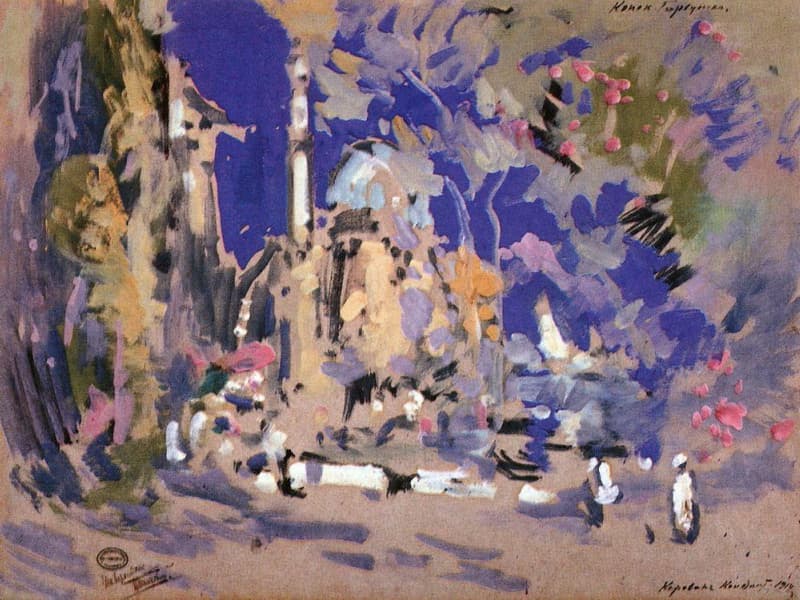
Konstantin Korovin — http://gallerix.ru/album/Korovin/pic/glrx-1145585404 · Public domain
This is the founding Russian-subject ballet of the Imperial stage: a four-act, eight-scene fairytale ballet with apotheosis, made by Arthur Saint-Léon to a score by Cesare Pugni, telling how Ivan the fool wins the Tsar Maiden with the help of a magic horse and ends up Tsar himself. It premiered with the Imperial Ballet in St Petersburg on 15 December 1864, with Marfa Muravyova as the Tsar Maiden; the article records that the planned Ivanushka, Timofey Stukolkin, broke his leg before opening and was replaced by an inexperienced dancer, Nikolay Troitsky.
What is danced
The article's clearest dance information concerns the ballet's folk-dance content rather than its classical vocabulary: Saint-Léon staged 'overall 22 Russian folk dances,' inventing much of the material himself (including an 'Ural dance') because, as a French choreographer, he was not deeply versed in genuine Russian folk dancing. This drew fire from critics such as Saltykov-Shchedrin and Nekrasov, who called it a parody of Russian dance rather than the real thing, even as it delighted audiences and spawned a wave of Russian-style Imperial ballets.
The work closes with a large-scale set piece: a Grand divertissement 'celebrating all the different nations of Russia,' opening with a Grand cortège danced to a march titled 'The Peoples of Russia,' and including Saint-Léon's own balletic treatment of Russian national dance. Petipa's 1895 restaging (as The Tsar Maiden) added a new prologue and apotheosis plus extra bravura variations for Pierina Legnani, composed by Riccardo Drigo — pointing to added classical display work for the ballerina, though the article does not describe its steps.
Beyond this, the article gives no scene-by-scene breakdown of steps, partnering, or technique, so no specific classical-ballet vocabulary (pointe work, mime conventions, pas de deux structure) can be verified from it directly.
Context
Made for the Imperial Ballet in 1864, this was, per the article, the first ballet built on a Russian story, arriving in a period when the St Petersburg company was dominated by imported French and Italian choreographers and largely Western subject matter. Its attempt to fold Russian folk material into an Imperial classical framework provoked an immediate split in critical opinion and, according to the article, set off two divergent lines of development — a more classical St Petersburg performance tradition and a Moscow tradition (crystallized by Sokolov's 1876 restaging) that leaned on genuine Russian folk dance — which the article says persisted as distinct 'schools' of Russian ballet into the 1930s.
Staging history
The ballet moved from St Petersburg to the Moscow Imperial troupe in 1866, with Saint-Léon himself restaging it there (Pugni revised his score) with Muravieva and Stukolkin again in the leads. José Mendez revived it in Moscow in 1893; Marius Petipa remounted it in St Petersburg in 1895 as The Tsar Maiden with Drigo's musical revisions and new bravura material for Pierina Legnani. Alexander Gorsky produced new stagings in Moscow (1901) and St Petersburg (1912), the latter revived by Lopukhov for the Kirov in 1945. In 1960 Alexander Radunsky made an entirely new choreographic version to a new score by Rodion Shchedrin for the Bolshoi (filmed in 1961 with Maya Plisetskaya and Vladimir Vasiliev), and Igor Belsky used the same Shchedrin score for a separate staging in Leningrad in 1963.
How to watch it
Watch for the tension the article itself flags: which passages read as genuine folk dance and which as a choreographer's invented idea of it, since contemporaries accused Saint-Léon of parody rather than ethnography. In the Petipa version, watch for the added prologue, apotheosis, and the bravura variations built for Legnani, distinct from Saint-Léon's original structure; the closing Grand divertignement of 'the different nations of Russia' is the ballet's largest set piece and worth attending to as a period showcase of national-character dance within an Imperial narrative ballet.
Credits
- composer: Cesare Pugni
Related works
Other staged works in the register connected to this one by author or lineage.
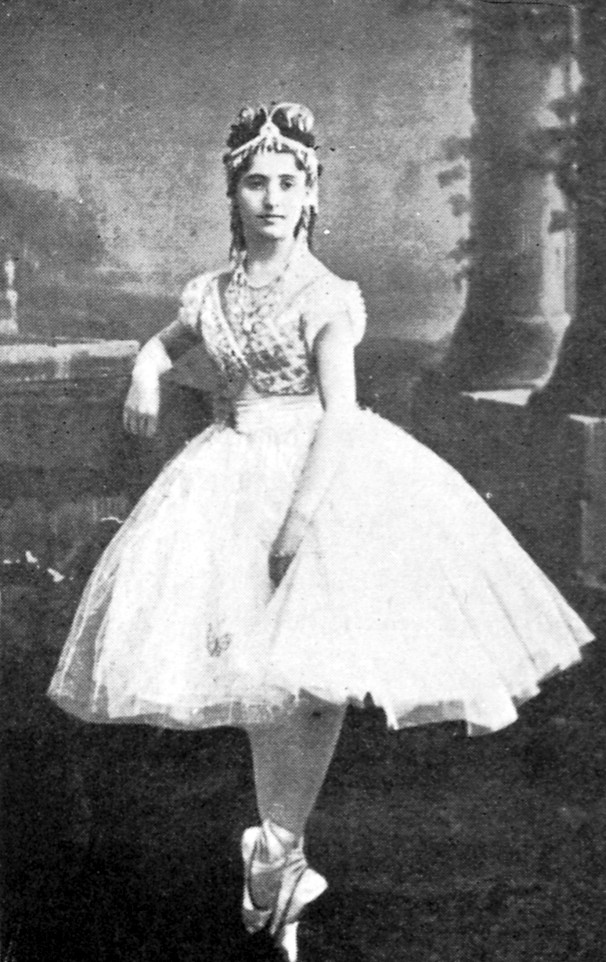 CoppéliaBallet · 1870Saint-Léon · video
 La sourceBallet · 1866Saint-Léon · video
 La Vivandière or MarkitenkaBallet · 1844Saint-Léon · video
 PâqueretteBalletSaint-Léon
 Pas de QuatreBallet · 1845Music by Pugni · video
 The Pharaoh's DaughterBallet · 1862Music by Pugni · video
- The Traveling DancerThe Traveling DancerBallet · 1864Music by Pugni
- Catarina or La Fille du BanditBallet · 1846Music by Pugni
