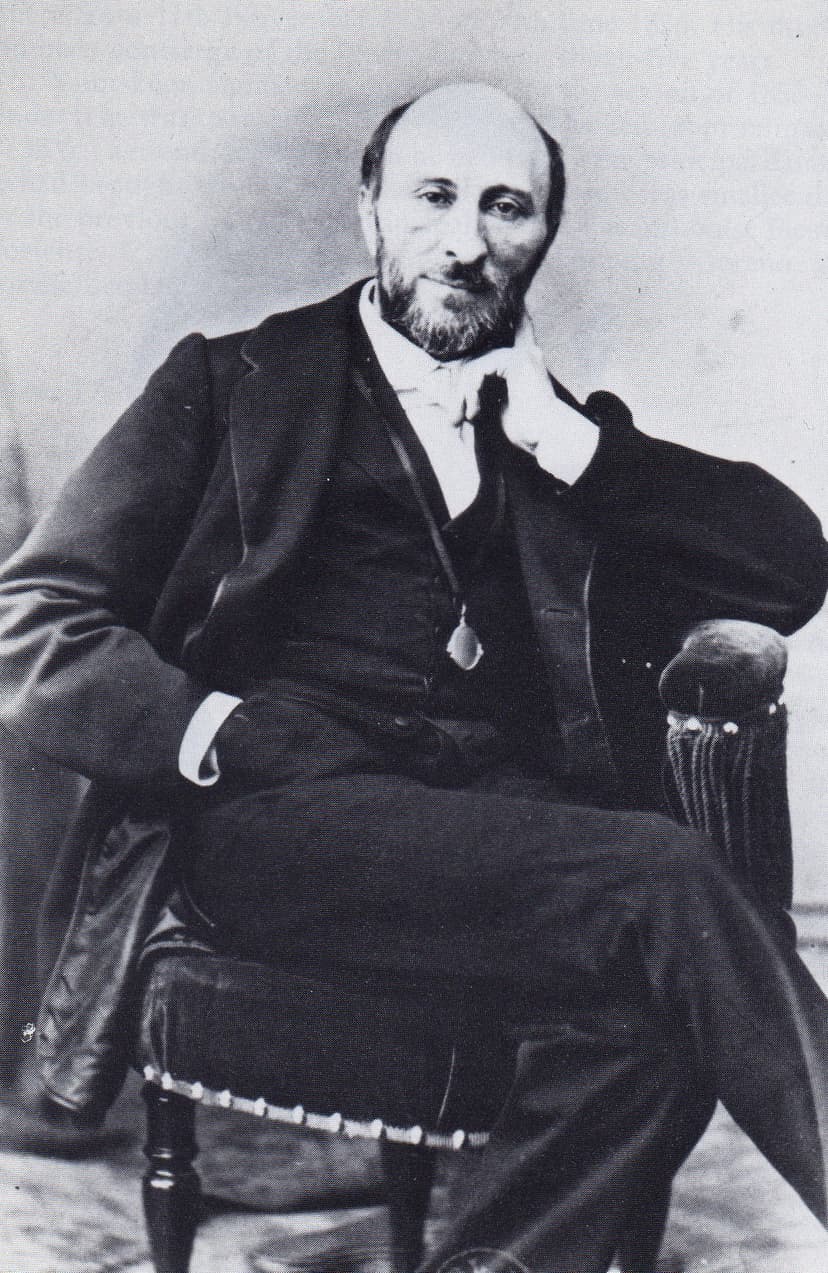
Arthur Saint Leon
Legend of Dance
Why They Matter
Saint-Léon connects performance, choreography, music and documentation. Coppélia remains his most visible creation, but his deeper importance lies in the combination of stage practice and analytical method: he could dance, play violin, construct ballets and devise a written system for retaining them
Styles Arthur Saint Leon shaped
Each one links to the style’s own page — its origins, music, tempo and video.
Watch
Coppélia Act II — Swanilda pretends to be Coppélia
Royal Ballet and Opera
Institutional excerpt shows how dramatic mime and classical technique interact in a major modern production
Coppélia Act III pas de deux
Royal Ballet and Opera
Shows the virtuoso classical vocabulary associated with the ballet's modern stage life
Why The Royal Ballet love dancing Coppélia
Royal Ballet and Opera
Performer testimony helps explain characterization beyond the surviving steps
The Royal Ballet rehearse Coppélia
Royal Ballet and Opera
Makes transmission and coaching visible rather than presenting choreography as a fixed artifact
Coppélia — 2024 Mariinsky production feature
Mariinsky Theatre
Shows a contemporary institutional reinterpretation and supports caution about versioning
Delibes: Coppélia — Bolshoi Ballet trailer
BelAir Classiques
Documents a major licensed screen release and explicitly contextualizes the 1870 premiere
Biography
Arthur Saint-Léon was born Charles Victor Arthur Michel in Paris on 17 September 1821 and raised largely in Stuttgart, where his father worked as a dance master. He received parallel training in dance and violin, studying with violinists Joseph Mayseder and Niccolò Paganini. This dual formation shaped his stage identity: throughout his career, Saint-Léon presented himself not only as a dancer but as a musician with a sophisticated grasp of theatrical rhythm.
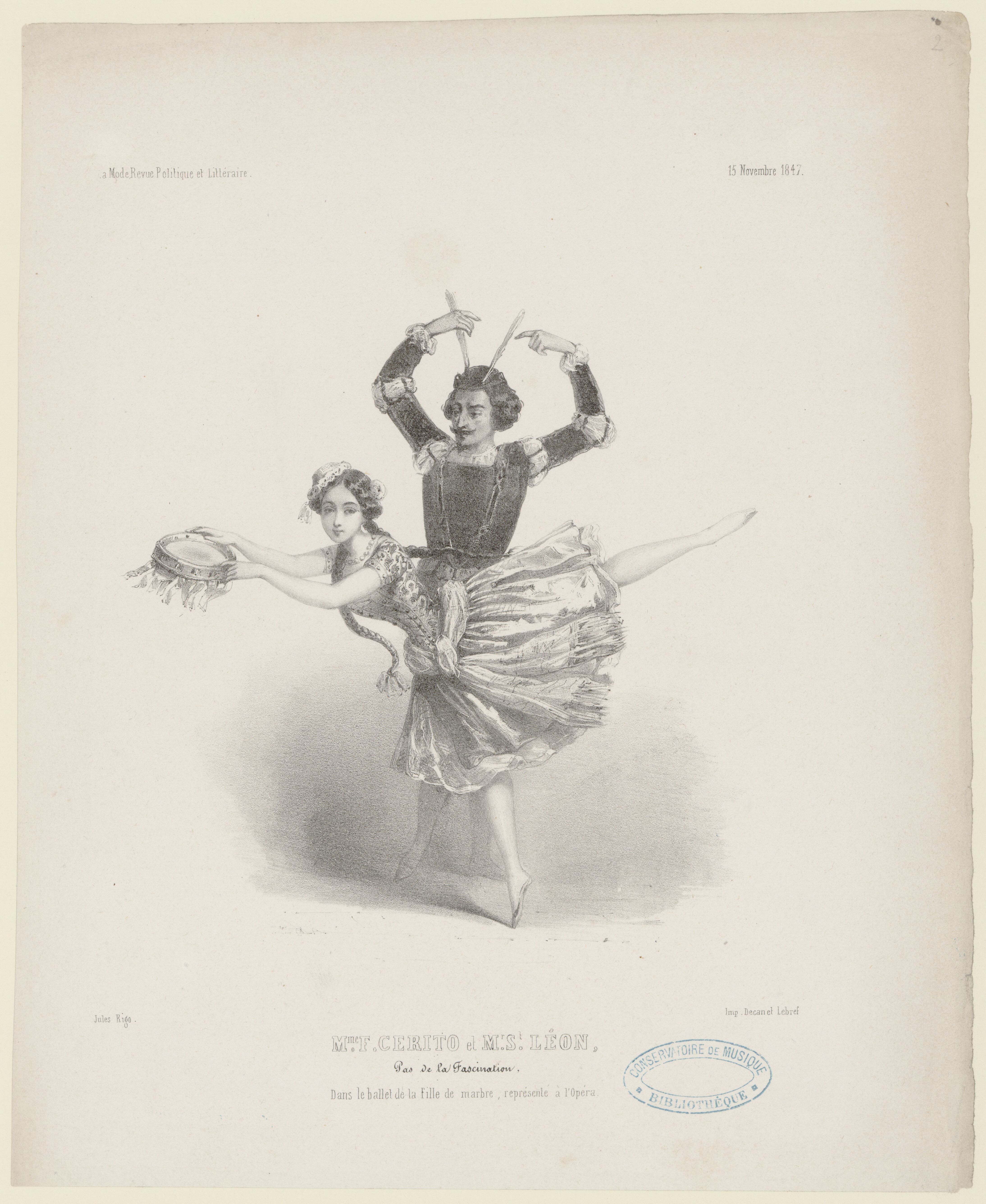
As a young performer he toured widely across continental Europe and Britain, building a reputation at a moment when Romantic ballet's public mythology often centered the ballerina. His technical attack, elevation and demi-caractère versatility helped make male virtuosity visible to European and British audiences. Saint-Léon's artistic partnership with Italian ballerina Fanny Cerrito became central to his early choreographic work. They married in 1845 and appeared together in ballets made around Cerrito's gifts. *La Vivandière*, created in London in the 1840s with music by Cesare Pugni, became especially important: Saint-Léon later notated its Pas de Six. An 1847 lithograph by Jules Rigo depicts Cerrito and Saint-Léon in *La Fille de marbre*, preserving the partnership's theatrical image alongside credits to the ballet's composer and choreographer.
In 1852 Saint-Léon published *La Sténochorégraphie, ou Art d'écrire promptement la danse*, a system using staff-like notation and schematic figures to record ballet movement. It extended notation beyond footwork toward arms, torso and head, though no score should be mistaken for a complete capture of performance style. In 1856 he published *De l'état actuel de la danse*, writing not only about movement notation but about the institutional condition of dance in France.
From 1859 to 1869 Saint-Léon served as ballet master of the Imperial Ballet in St Petersburg, succeeding Jules Perrot. His Russian decade produced a large repertory, often with composers Cesare Pugni or Ludwig Minkus, and unfolded alongside the emerging authority of Marius Petipa. Works such as *The Little Humpbacked Horse* and *Le Poisson doré* reflected the imperial stage's aesthetic and representational contexts. Saint-Léon also continued to work in Western Europe rather than maintaining a single-city career.
In Paris he collaborated with librettist Charles Nuitter and composers Ludwig Minkus and Léo Delibes on *La Source* in 1866. Saint-Léon, Nuitter and Delibes then created *Coppélia*, based on stories by E. T. A. Hoffmann. The ballet premiered at the Paris Opéra in 1870 with young Giuseppina Bozzacchi as Swanilda. Saint-Léon supplied the choreography and shared the scenario with Nuitter, while Delibes's score became inseparable from the ballet's durability. Saint-Léon died in Paris on 2 September 1870, only months after *Coppélia* opened and amid the Franco-Prussian War's disruption of theatre. The ballet survived through revision and transmission rather than as an untouched artifact. The *La Vivandière* Pas de Six known today reflects reconstruction from notation: Ann Hutchinson Guest and Pierre Lacotte restored it in the twentieth century. These afterlives make Saint-Léon a test case for how choreography persists through scores, coaching, adaptation and institutional repertory.
Career Highlights
Born Charles Victor Arthur Michel in Paris on 17 September.
Established a European career as both virtuoso dancer and violinist.
La Vivandière, created for Fanny Cerrito with music by Cesare Pugni, entered the London repertory.
Married Fanny Cerrito, his principal partner and muse during a productive early period.
Appeared with Cerrito in La Fille de marbre, documented in Jules Rigo’s contemporary lithograph.
Published La Sténochorégraphie, his system for recording dance movement.
Published De l’état actuel de la danse, a critique of dance and its institutions in France.
Became ballet master of the Imperial Ballet in St Petersburg, succeeding Jules Perrot.
Created The Little Humpbacked Horse with Cesare Pugni for the Imperial stage.
Choreographed La Source at the Paris Opéra with Charles Nuitter and composers Minkus and Delibes.
Coppélia, choreographed by Saint-Léon to Delibes’s score and a scenario by Saint-Léon and Nuitter, premiered at the Paris Opéra.
Died in Paris on 2 September, leaving a repertory whose transmission depends on revival, revision and notation.
Gallery
Works
5 stage works credited to Arthur Saint Leon, 1844–1870.
- La Vivandière or Markitenka (1844)Ballet · Choreographer
- La source (1866)Ballet · Choreographer
- Coppélia (1870)Ballet · Choreographer
- The Little Humpbacked HorseBallet · Choreographer
- PâqueretteBallet · Choreographer
Credits sourced from Wikidata (CC0), one citation per field. Works without a recorded premiere date are listed last. Titles link to the work in Limelight.
Legacy & Impact
Saint-Léon connects performance, choreography, music and documentation. *Coppélia* remains his most visible creation, but his deeper importance lies in combining stage practice with analytical method: he could dance, play violin, construct ballets and devise a written system for retaining them. The recoverable *La Vivandière* material shows why notation matters, while the loss or alteration of other works shows its limits. His transnational career among London, Paris and imperial St Petersburg remains essential to understanding how ballet personnel and repertory circulated among Europe's major stages.


Explore More Legends
Discover the dancers, teachers, choreographers, and cultural icons who shaped how the world moves.
Keep the thread going
Dance history, technique, and the occasional rabbit hole — in your inbox. Thoughtful, infrequent, unsubscribe anytime.
Free. No spam. One click to leave.