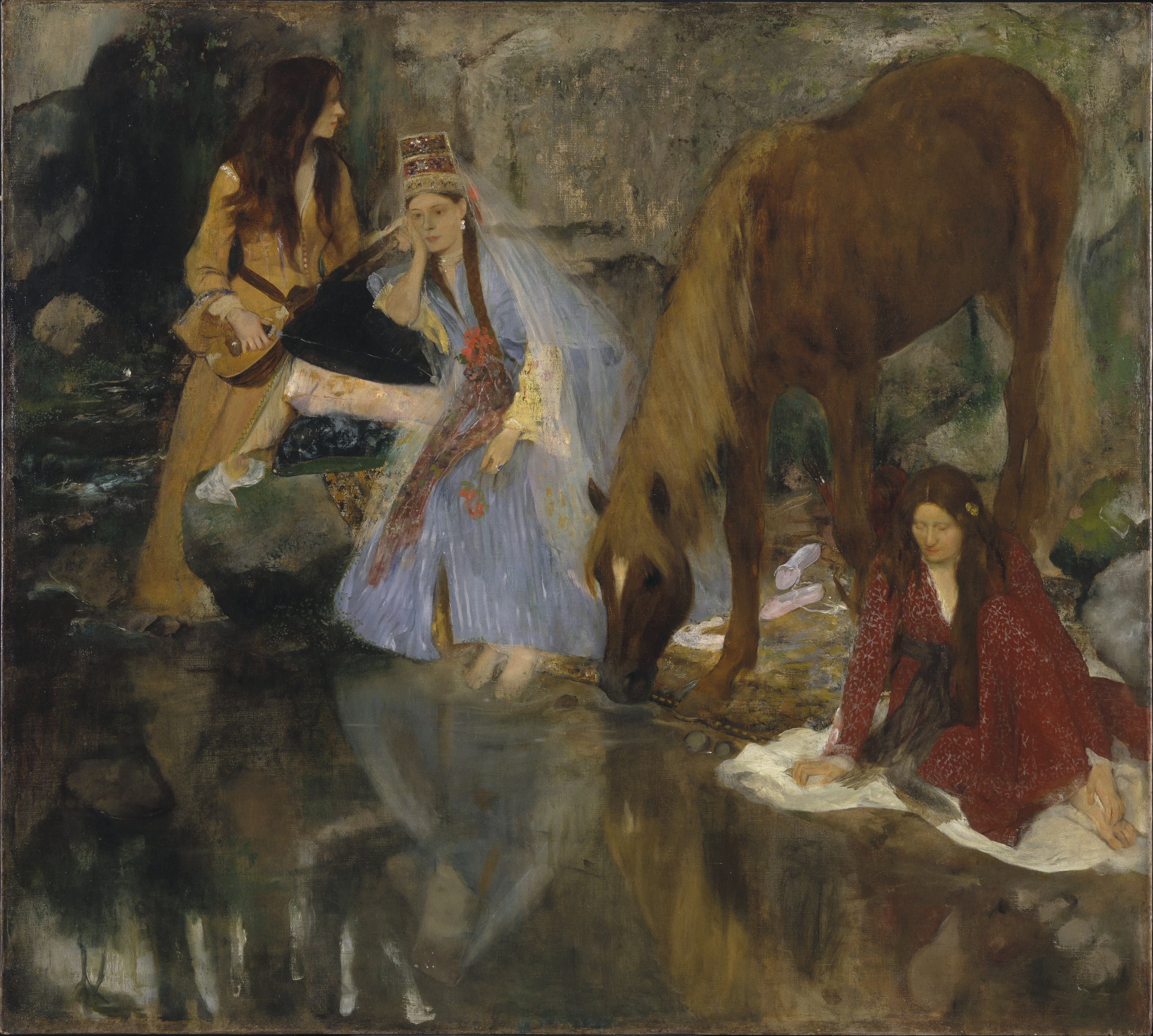
Edgar Degas — AAGhYpJO3FXcfA at Google Cultural Institute maximum zoom level · Public domain
La source is a full-length ballet in three acts (four scenes) made for the Paris Opéra, first given on 12 November 1866 with choreography by Arthur Saint-Léon to a libretto he wrote with Charles Nuitter. Its score is split between two composers — Ludwig Minkus wrote Act I and the second scene of Act III, Léo Delibes wrote Act II and the first scene of Act III — making it a hybrid production typical of the mid-century Opéra, where house composers and outside contributors were combined for a single evening.
What is danced
The article does not describe choreography in terms of steps, holds or technique; what survives in it is the shape of the evening as a sequence of named numbers in the piano score — variations for the ballerina (danced first by Salvioni, then rewritten for Grantzow and again for Sangalli), a divertissement in Act II built from a 'Pas des voiles', a solo variation, a 'Danse circassienne' for a corps of slaves, a Scherzo-Polka for Naïla, a Mazurka, and a closing Grand Pas d'action and Marche dansée. This tells us the ballet followed the standard grammar of a grand Opéra ballet of its period — solo variations, a character divertissement, a corps ensemble, and a concluding march — without the article specifying the actual vocabulary danced in any of them.
Context
La source sits at the point where the Romantic ballet of the 1830s–40s (sylphs, nymphs, doomed love, a ballerina who must vanish or die) was giving way to the grander, more decorative spectacle-ballet that Petipa would later perfect in St Petersburg; its plot device of a water-nymph who sacrifices herself for a mortal's happiness is squarely in the Romantic line, even as the production's scale and its divertissement structure look forward. The article frames its real historical importance as musical rather than choreographic: it was Delibes's first major ballet score, and contemporary critics judged his music 'fresh and more rhythmic' than Minkus's, effectively launching him as a ballet composer ahead of Coppélia and Sylvia.
Staging history
The 1866 premiere with Guglielmina Salvioni was judged a poor fit for the title role and only became a success the following year when Adèle Grantzow took over as Naïla; a further revival in 1872 for Rita Sangalli introduced new variations, probably composed by Delibes himself. The ballet travelled to St Petersburg (1902, choreographed by Achille Coppini for Olga Preobrajenska, under the title Naïla), was the setting for Nijinsky's solo debut at the Mariinsky in 1907, and was revived by Agrippina Vaganova in Leningrad in 1925 for Marina Semyonova; a pas de deux from it, credited to Konstantin Sergeyev after Coppini, is still used in Vaganova Academy graduation performances. George Balanchine made an entirely new choreography for New York City Ballet in 1968, and the score was also staged at La Scala in the 1870s under Cesare Marzagora, after Saint-Léon.
How to watch it
Because the complete Saint-Léon choreography is lost, most performances a dancer or student will actually see are the surviving pas de deux or the Delibes-derived suites played in concert; watch for the divide between the two composers' contributions, since the Delibes numbers (Act II, Act III scene 1) were singled out by contemporaries as markedly more inventive than the Minkus sections. In the Vaganova/Sergeyev pas de deux tradition, the piece functions as a showcase variation vehicle rather than a narrative scene, so expect bravura solo and partnered work detached from the original plot.
Structure
- Act INouredda's wedding party rests by a stream; the hunter Djémil picks a flower for her and is punished for his impudence, but the nymph Naïla rescues him and vows to help him win Nouredda.
- Act II · DivertissementAt the Khan's palace, entertainment is given for the wedding guests including a solo for the favourites and a dance for Circassian slaves; Djémil, disguised, offers gifts, and Naïla emerges from a magically created spring to dance for and bewitch the Khan.
- Act IIIDjémil pursues Nouredda, who still refuses him; Naïla agrees to help him again on condition that she herself will die once Nouredda loves him, and the ballet ends with Naïla vanishing into the earth as the spring dries up.
Structure read from an encyclopaedia article, not from a libretto or score we hold. Confirm against a programme before treating the numbering as authoritative.
Credits
- composer: Léo Delibes
- composer: Ludwig Minkus
Related works
Other staged works in the register connected to this one by author or lineage.
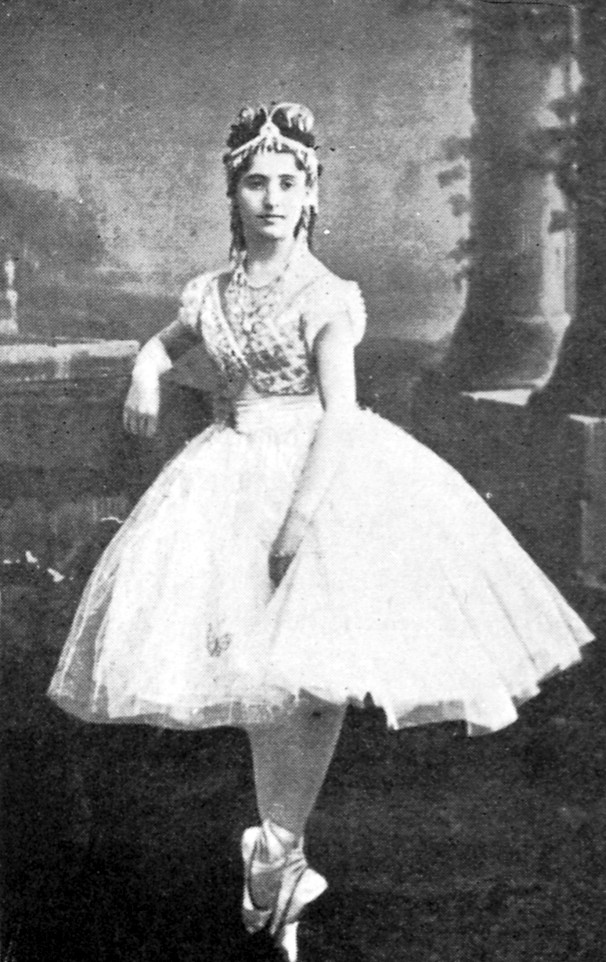 CoppéliaBallet · 1870Saint-Léon · video
 La Vivandière or MarkitenkaBallet · 1844Saint-Léon · video
 The Little Humpbacked HorseBalletSaint-Léon · video
 PâqueretteBalletSaint-Léon
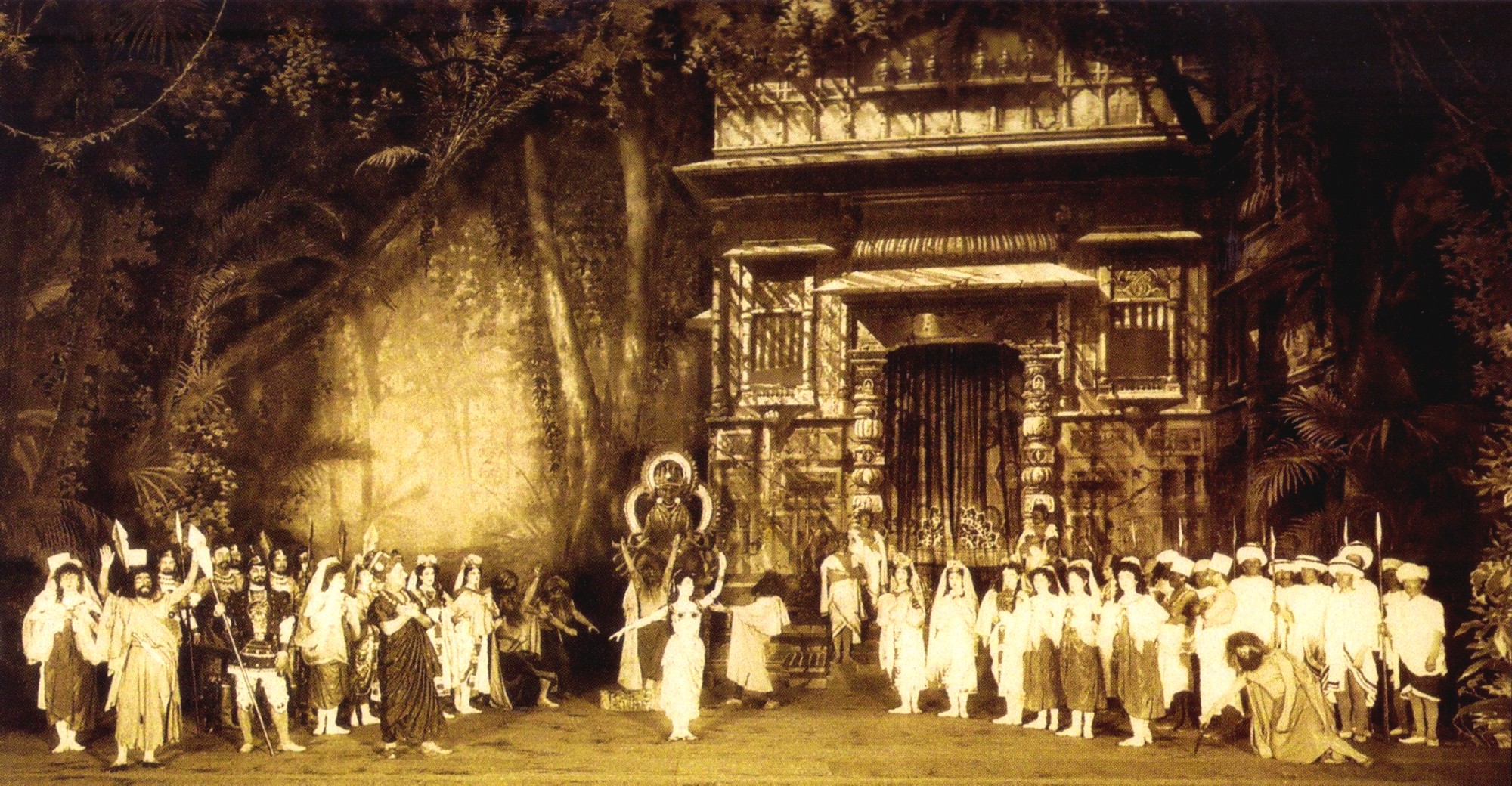 La BayadèreBallet · 1877Music by Minkus · video
 Don QuixoteBallet · 1869Music by Minkus · video
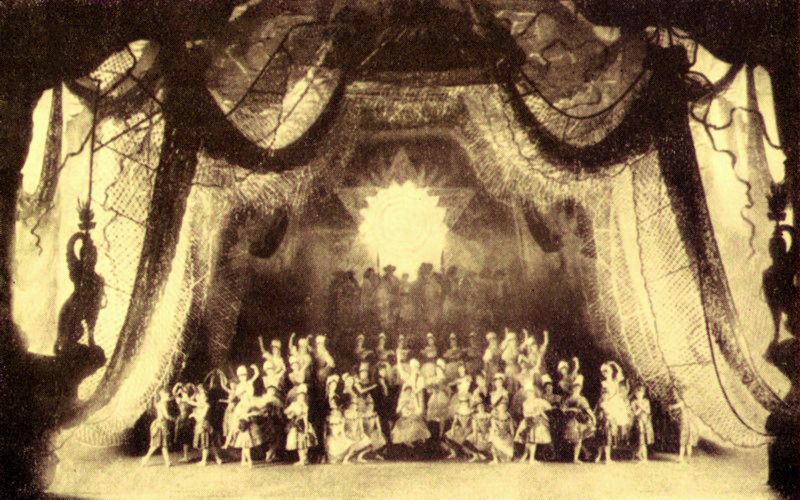 The Magic PillsBallet · 1886Music by Minkus
 SylviaBallet · 1876Music by Delibes · video