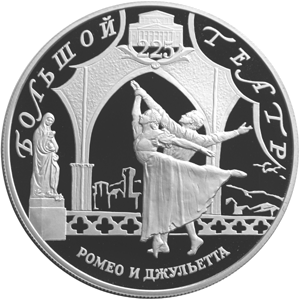
Банк России — http://www.cbr.ru/cash_circulation/memorable_coins/coins_base/showcoins/?cat_num=5115-0025 · Public domain
This is Prokofiev's Romeo and Juliet, Op. 64, composed in 1935 to a scenario by Adrian Piotrovsky and Sergey Radlov and best known today in the choreography Leonid Lavrovsky made for the Kirov Theatre. The score's tangled path to the stage — a rejected happy ending, a shelved Bolshoi contract, a first full staging abroad, and only then the Leningrad production that became canonical — makes this one of the clearest cases in the twentieth-century repertoire of a ballet's choreographic identity being fixed years after its music was finished.
What is danced
The article gives almost no direct description of steps or technique; it is a composition and production history, not a synopsis. What can be drawn from it is indirect: the numbered movements Prokofiev extracted into suites and a piano set point to the shape of the danced action — a folk dance and street-awakening scene, a Minuet for the arrival of guests, a masked-ball sequence, a balcony pas de deux ('Romeo and Juliet — Balcony Scene and Love Dance'), a duel culminating in the 'Death of Tybalt', Juliet's solo variation, a parting scene for the lovers, and a tomb scene. These titles describe musical content reused in concert suites and 'do not always correspond exactly' to the numbers in the complete ballet, so they should be read as indicative of scene-type, not as a reliable map of the stage action.
Context
The scenario was written to the precepts of 'drambalet' — dramatised ballet, promoted at the Kirov specifically to replace works built on 'choreographic display and innovation' with dance subordinated to psychological narrative. Prokofiev and his librettists' original tragicomic compromise (a happy ending, against Shakespeare) fell foul of Soviet cultural officials under Platon Kerzhentsev, and the ballet's Soviet staging was delayed for years, compounded by the fallout from the 1936 Pravda denunciation of Shostakovich that also touched Piotrovsky. The work therefore reached the stage first outside the USSR, in a truncated single-act Brno production in 1938, before Lavrovsky's fuller Leningrad version fixed the choreographic and narrative shape — restoring the tragic ending — that most later stagings inherit.
Staging history
The complete ballet's actual theatrical premiere, per the article, was in Brno on 30 December 1938, a single-act staging drawing mainly on the first two suites; the article does not name that production's choreographer. Lavrovsky's now-standard version followed on 11 January 1940 at the Kirov with Galina Ulanova and Konstantin Sergeyev, won the Stalin Prize, and was filmed by Mosfilm in 1955. From there the ballet became one of the most re-choreographed narrative works in the repertoire: Ashton (Royal Danish Ballet, 1955), Cranko (Stuttgart, 1962), MacMillan (Royal Ballet, 1965, with Fonteyn and Nureyev), Neumeier (Frankfurt/Hamburg, 1971/74), Nureyev (London Festival Ballet, 1977), Grigorovich (Bolshoi, 1979), Seregi (Budapest, 1985), Gable/Moricone (Northern Ballet, 1991), Maillot (Monte Carlo, 1996), Martins (NYCB, 2007), Pastor (Scottish Ballet, 2008) and Mark Morris, who in 2008 choreographed the reconstructed 1935 original score unearthed by Simon Morrison, followed by Ratmansky (National Ballet of Canada, 2011), Murphy (Australian Ballet, 2011), Welch (Houston Ballet, 2015) and Bourne (an asylum-set adaptation, 2019).
How to watch it
Because the same music has supported such different choreographic readings, watch for how a given production handles the balcony and bedroom-parting duets (lyric classical partnering) against the crowd and duel scenes (Dance of the Knights, Death of Tybalt), where mass ensemble work and mimed confrontation carry the drama. In Lavrovsky's drambalet lineage, expect pantomime integrated with classical vocabulary rather than danced-for-its-own-sake display; later versions (Grigorovich, Neumeier, Maillot, Bourne) each recast that balance differently, so the same numbered scenes can look markedly unlike each other from company to company.
Credits
- composer: Sergei Prokofiev
More from Sergei Prokofiev
Other staged works in the register connected to this one by author or lineage.
 ZoluškaBallet · 1945Music by Prokofiev · video
 The Tale of the Stone FlowerBallet · 1954Music by Prokofiev · video
 The Prodigal SonBallet · 1929Music by Prokofiev · video
 On the DnieperBallet · 1932Music by Prokofiev · video
 TrapezeBallet · 1924Music by Prokofiev · video
 CinderellaBallet · 1948Music by Prokofiev · video