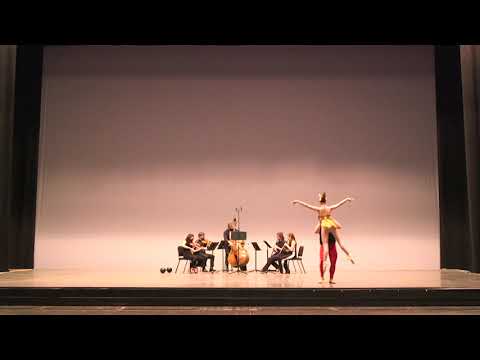
Trapeze (1924)
Trapèze is a chamber ballet score by Sergei Prokofiev, written in 1924 in Paris for a travelling troupe whose accompanying ensemble numbered only five musicians. That constraint pushed Prokofiev toward a chamber-scale piece in eight movements across five parts, and the music was later reworked into two concert pieces, the Quintet, Op. 39 (1924) and the Divertissement, Op. 43 (1925–29). The article records the complete eight-movement ballet's premiere in Gotha, Germany, on 6 November 1925, and notes a reconstruction of the ballet in 2002.
What is danced
The article does not describe any choreography, technique, or staging vocabulary — no choreographer is named in the source, and the surviving detail is musical: movement titles ('Matelote', 'The Ballerina', 'Dance of the Tumblers', 'Mourning the Ballerina') within an Overture-led five-part, eight-movement structure. These titles imply commedia/circus-adjacent character types (a ballerina figure, tumblers, mourning) but the article gives no synopsis, no description of steps, holds, or stage business, and no indication of pointe work, character shoe work, or acrobatic vocabulary actually performed. Without a choreographic record or a described sequence of action, nothing about what is actually danced can be responsibly asserted from this source.
Staging history
The article records one staging: the complete eight-movement version premiered in Gotha, a German town near Hanover, on 6 November 1925. It also notes that 'the Trapèze Ballet, reconstructed in 2002' exists in the five-part, eight-movement form described, implying the original choreography or staging had been lost and was later reconstructed from the score, though the article gives no detail on who undertook that reconstruction or where it was staged.
How to watch it
Because no choreographic record survives in this source, listeners and researchers typically encounter this material through the Quintet, Op. 39 rather than as staged dance; the movement titles ('Matelote', 'The Ballerina', 'Dance of the Tumblers', 'Mourning the Ballerina') are the only clue to the ballet's dramatic content and suggest circus- or commedia-adjacent characters rather than a conventional narrative ballet. Anyone approaching a staged revival should treat the choreography as a modern reconstruction rather than an inherited tradition, given the 2002 reconstruction noted in the record.
Structure
- OvertureOpening movement of the ballet; no synopsis or dance description given.
- MateloteNamed movement of the ballet; no synopsis or dance description given.
- The BallerinaNamed movement of the ballet; no synopsis or dance description given.
- Dance of the TumblersNamed movement of the ballet; no synopsis or dance description given.
- Mourning the BallerinaNamed movement of the ballet; no synopsis or dance description given.
Structure read from an encyclopaedia article, not from a libretto or score we hold. Confirm against a programme before treating the numbering as authoritative.
Credits
- composer: Sergei Prokofiev
More from Sergei Prokofiev
Other staged works in the register connected to this one by author or lineage.
 Romeo and JulietBallet · 1938Music by Prokofiev · video
 ZoluškaBallet · 1945Music by Prokofiev · video
 The Tale of the Stone FlowerBallet · 1954Music by Prokofiev · video
 The Prodigal SonBallet · 1929Music by Prokofiev · video
 On the DnieperBallet · 1932Music by Prokofiev · video
 CinderellaBallet · 1948Music by Prokofiev · video