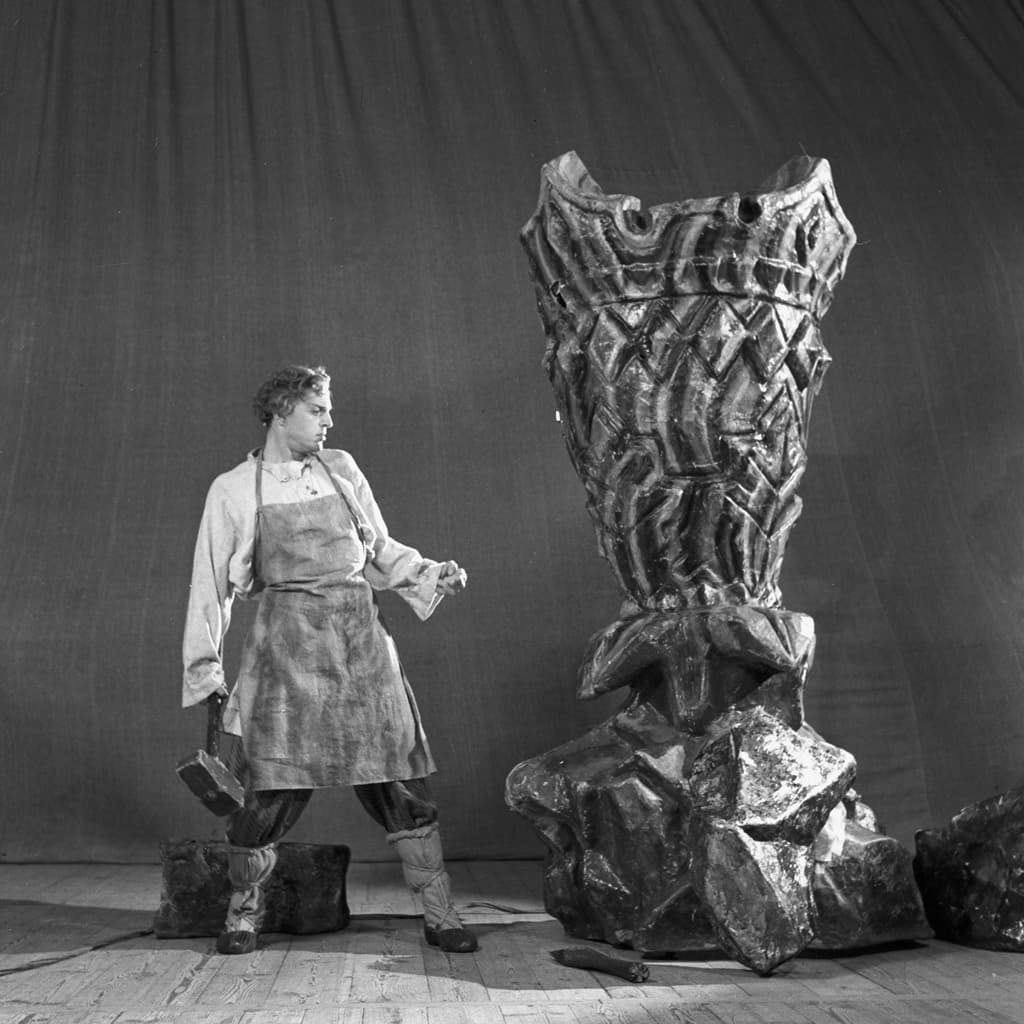
Umnov / Умнов — RIA Novosti archive, image #644727, http://visualrian.ru/ru/site/gallery/#644727 6x6 film / 6х6 негатив · CC BY-SA 3.0
The Tale of the Stone Flower (1954)
The Tale of the Stone Flower is Sergei Prokofiev's eighth and last ballet, composed between 1948 and 1953 and based on Pavel Bazhov's Ural folk tale The Stone Flower. The article identifies it as the last of a trilogy of ballets Prokofiev wrote 'in the Russian ballet tradition,' alongside Romeo and Juliet and Cinderella, and it reached the stage only after the composer's death.
What it contains
- Classical Ballet · the whole ballet — A full-length narrative ballet structured around soli, pas de deux, corps de ballet numbers and character divertissements (waltzes, round dances, gem and gypsy dances) in the Russian classical repertory tradition. Source: "is also the last of the trilogy of ballets Prokofiev wrote in the Russian ballet tradition"
- Classical Ballet · Act I, Scene 1, 'Scene and Duet of Katerina and Danila' — A partnered duet for the two leads, the classical pas de deux convention used to develop the central romance. Source: "Scene and Duet of Katerina and Danila"
- Classical Ballet · Act II, Scene 4, 'Scene and Waltz of the Diamonds' and 'Dance of the Russian precious stones' — Ensemble variations personifying jewels and stones, a set-piece 'treasure' divertissement of the kind found elsewhere in Russian classical ballet's underground/fantasy scenes; this parallel is my own inference, not stated by the article. Source: "Scene and Waltz of the Diamonds"
What is danced
The article gives no description of steps or technique; what survives here is the number list, which lays out the ballet's structure across a Prologue and two acts subdivided into eight scenes. That structure follows the standard grammar of a full-length narrative ballet of its period: named duets for the two leads ('Scene and Duet of Katerina and Danila'), villager and peasant-girl ensembles ('Round Dance', 'The Peasant Girls' Dance', 'The unmarried men's dance'), a soloist showpiece for the villain ('Severyan's Dance', repeated in Act II), a suite of divertissements once Danila is taken underground (the Waltz of the Diamonds, a Dance of the Russian precious stones, a Gypsy Dance with a Solo of the Gypsy Girl, a Russian Dance, an Ural Rhapsody), and a closing reunion pas de deux implied by 'The Joy of the reuniting of Katerina and Danila'. This is the alternation of pas de deux, corps de ballet number and character divertissement that any Bolshoi-trained dancer would recognise, but the source gives no detail on lifts, mime passages, or pointe versus character-shoe work, so none of that can be stated as fact.
Context
The work was completed in the final years of Prokofiev's life, after Romeo and Juliet and Cinderella, and belongs to the mid-century Soviet effort to sustain full-evening narrative ballet built on symphonic, Tchaikovsky-descended scores. Its 1954 premiere, two years after Stalin's death and a year after the composer's own, put it into the hands of a new generation of Bolshoi dancers and, per the article, the choreographer Yuri Grigorovich, whose staging of it is often treated as a landmark in his career — a point I know independently and flag as recall rather than something the article states outright.
Staging history
The article records a single staging: the 12 February 1954 premiere at the Bolshoi Theatre, Moscow, conducted by Yuri Fayer with choreography by Yuri Grigorovich, and a cast including Marina Kondratyeva and Yuri Grigoriev in the title roles, Raisa Struchkova as Katerina, Galina Ulanova, Aleksey Yermolayev as Severyan, and Maya Plisetskaya as the 'Icy Rusalka of the Copper Mountain'. It notes Prokofiev also drew four concert suites from the score (Wedding Suite Op. 126, Gypsy Fantasy Op. 127, Urals Rhapsody Op. 128, The Mistress of the Copper Mountain Op. 129) but gives no later revival history.
How to watch it
Watch for the alternation between the 'earth' scenes — village courtship dances, a quarrel over a malachite vase, a wedding suite extracted for concert use — and the 'underground' scenes dominated by the Mistress of the Copper Mountain, where the jewel and gem divertissements (Waltz of the Diamonds, Dance of the Russian precious stones) function as the ballet's fantastical showpiece sequence, in the manner of the jewel or vision scenes common to Russian full-length ballet.
Structure
- Act PrologueThe Mistress of the Copper Mountain is introduced and Danila is shown at his stone-carving work.
- Act I · Scene 1Danila searches for the stone flower, meets fellow villagers, and dances a duet with Katerina.
- Act I · Scene 2A village gathering of round dances, peasant and unmarried men's dances, and Severyan's solo dance, ending in an altercation over a malachite vase.
- Act I · Scene 3 · Danila enticed away by the Mistress of the Copper MountainThe Mistress lures Danila away underground.
- Act II · Scene 4The Mistress shows Danila the earth's treasures, including the Waltz of the Diamonds and a dance of the Russian precious stones, before revealing the stone flower itself.
- Act II · Scene 5Katerina searches for Danila; Severyan returns and the Mistress appears.
- Act II · Scene 6 · Ural RhapsodyA communal interlude built around the Ural Rhapsody and a Russian Dance.
- Act II · Scene 7 · Gypsy DanceA gypsy divertissement precedes Severyan's death at the Mistress's hands.
- Act II · Scene 8Katerina follows the Fire Spirits, finds Danila turned to stone, and the ballet ends with their reunion and the Mistress's gifts.
Structure read from an encyclopaedia article, not from a libretto or score we hold. Confirm against a programme before treating the numbering as authoritative.
Credits
- composer: Sergei Prokofiev
More from Sergei Prokofiev
Other staged works in the register connected to this one by author or lineage.
 Romeo and JulietBallet · 1938Music by Prokofiev · video
 ZoluškaBallet · 1945Music by Prokofiev · video
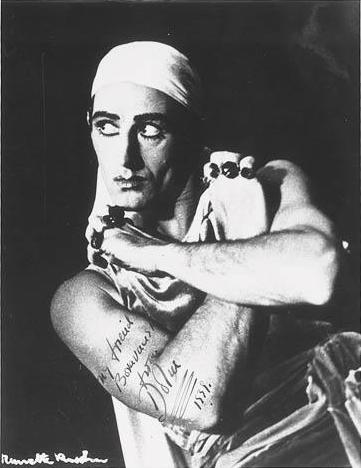 The Prodigal SonBallet · 1929Music by Prokofiev · video
 On the DnieperBallet · 1932Music by Prokofiev · video
 TrapezeBallet · 1924Music by Prokofiev · video
 CinderellaBallet · 1948Music by Prokofiev · video
 Square DanceBallet · 1957Same lineage · video
 The Green TableBallet · 1932Same lineage · video