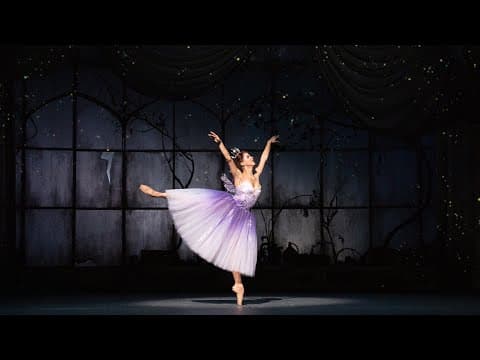
This is Frederick Ashton's 1948 realisation of Cinderella, set to Sergei Prokofiev's 1944 score, and billed here as a comic ballet. It is not a restaging of the Petipa/Ivanov/Cecchetti 1893 Mariinsky version (whose choreography does not survive) nor of the Soviet productions by Zakharov (Bolshoi, 1945) or Sergeyev (Kirov, 1946); Ashton made his own choreography to the existing score, cutting the Act III 'national dances' divertissement and a shorter Grasshoppers-and-Dragonflies number.
What it contains
- Classical Ballet · Whole ballet — Ashton's choreography is built throughout as an homage to Petipa's classical vocabulary, scaled to a full-evening ballet with variations, adagios and a pas de deux structure. Source: "The choreography of Cinderella is Ashton's homage to the classical tradition of Petipa"
- Classical Ballet · Ballroom entrance — Cinderella's transformation is danced literally as a shift into pointe technique: pointe work down a staircase followed by pas de bourrée across the stage. Source: "stepping en pointe down the stairs and advancing in pas de bourree to the front of the stage"
- Classical Ballet · Ballroom, the Ugly Sisters' set pieces — Comic character roles built from recognisable classical set pieces: a Petipa-style bravura variation quoting Odile and the Sugar Plum Fairy, and a supported fish-dive lift quoting the Sleeping Beauty pas de deux. Source: "the bossy Ugly Sister does a fish-dive with her suitor, a dream of the final pas de deux in The Sleeping Beauty"
What is danced
The ballet is built as Ashton's own homage to Petipa's classical grammar, on the model of his earlier plotless Symphonic Variations but expanded to full evening length. Cinderella is conceived as a demi-caractère dancer who dreams of becoming a ballerina, and the choreography enacts that transformation literally: her kitchen solo with a broomstick is danced in character/demi-caractère idiom, and her entrance to the ball is a shift into full classical vocabulary, marked by pointe work down a staircase and pas de bourrée to the front of the stage.
The two Ugly Sisters (one danced by Ashton himself) are comic roles built out of distorted classical steps rather than mime alone: the shy sister performs a Petipa-style set piece that quotes Odile's variation and the Sugar Plum Fairy, and the bossy sister executes a fish-dive lift with her suitor that parodies the climactic pas de deux of The Sleeping Beauty. These are technical classical steps (fouetté-adjacent bravura, supported adagio lifts) deliberately mishandled for comic effect, so the roles demand real ballet technique underneath the caricature. The final reconciliation between the Prince and Cinderella is played out through partnered classical dancing in which she confirms her identity as ballerina in his arms.
Context
Ashton had wanted to make a full-evening classical ballet since the success of the Vic-Wells Sleeping Princess in 1939, and by 1946-47 Ninette de Valois was publicly pushing for 'the first full-length English classical ballet.' Cinderella was chosen as the vehicle in 1948 over Delibes' Sylvia (which Ashton made later, in 1952), making it a deliberate attempt to build a home-grown equivalent to the great nineteenth-century Petipa/Tchaikovsky evening-length ballets, using a modern Russian score that Prokofiev himself had written with Tchaikovsky's models and Petipa's structural conventions in mind.
Staging history
The article traces a long lineage of Cinderella ballets before Ashton's version, none of which share his choreography: Duport's 1813 Vienna production (the earliest true Cinderella ballet), London's first complete version in 1822, the 1893 Mariinsky production by Petipa, Ivanov and Cecchetti (notable for Pierina Legnani's 32 fouettés, but with choreography now lost), Adeline Genée's 1906 Empire performance, and Andrée Howard's 1935 one-act version for Rambert's Ballet Club, in which Ashton himself danced the Prince. The Prokofiev score itself was first choreographed by Rostislav Zakharov for the Bolshoi in 1945 and by Konstantin Sergeyev for the Kirov in 1946, with Olga Lepeshinskaya, Galina Ulanova and Natalia Dudinskaya among its earliest interpreters, before Ashton made his own separate choreography to the same music in 1948.
How to watch it
Watch for the moment Cinderella crosses from demi-caractère broom-dance to full pointe work on her entrance to the ball — the shift in vocabulary is the ballet's central dramatic device. In the ballroom, watch the two Ugly Sisters' set pieces as deliberate, recognisable quotations of famous Petipa passages (Odile's variation, the Sugar Plum Fairy, the Sleeping Beauty pas de deux fish-dive) played for comic mismatch between step and dancer rather than for parody through mime alone.
Structure
- Scene kitchenCinderella, alone in the kitchen, dances a solo with a broomstick, imagining herself a ballerina.
- Scene ballroomCinderella enters the ball, stepping en pointe down the stairs and crossing the stage in pas de bourrée as her dream is realised.
- Scene ballroomThe two Ugly Sisters each perform set pieces at the ball: one a Petipa-style variation quoting Odile and the Sugar Plum Fairy, the other a fish-dive with her suitor quoting The Sleeping Beauty.
- Scene finaleThe Prince finds Cinderella; in his arms she confirms her identity as a ballerina and her dream is fulfilled.
Structure read from an encyclopaedia article, not from a libretto or score we hold. Confirm against a programme before treating the numbering as authoritative.
Credits
- composer: Sergei Prokofiev
More from Frederick Ashton
Other staged works in the register connected to this one by author or lineage.
 SylviaBallet · 1876Ashton · video
 Les PatineursBallet · 1937Ashton · video
 Symphonic VariationsBallet · 1946Ashton · video
 Marguerite and ArmandBallet · 1963Ashton · video
 OndineBallet · 1958Ashton · video
 A Month in the CountryBallet · 1976Ashton · video
 Les RendezvousBallet · 1933Ashton · video
 FaçadeBallet · 1931Ashton · video