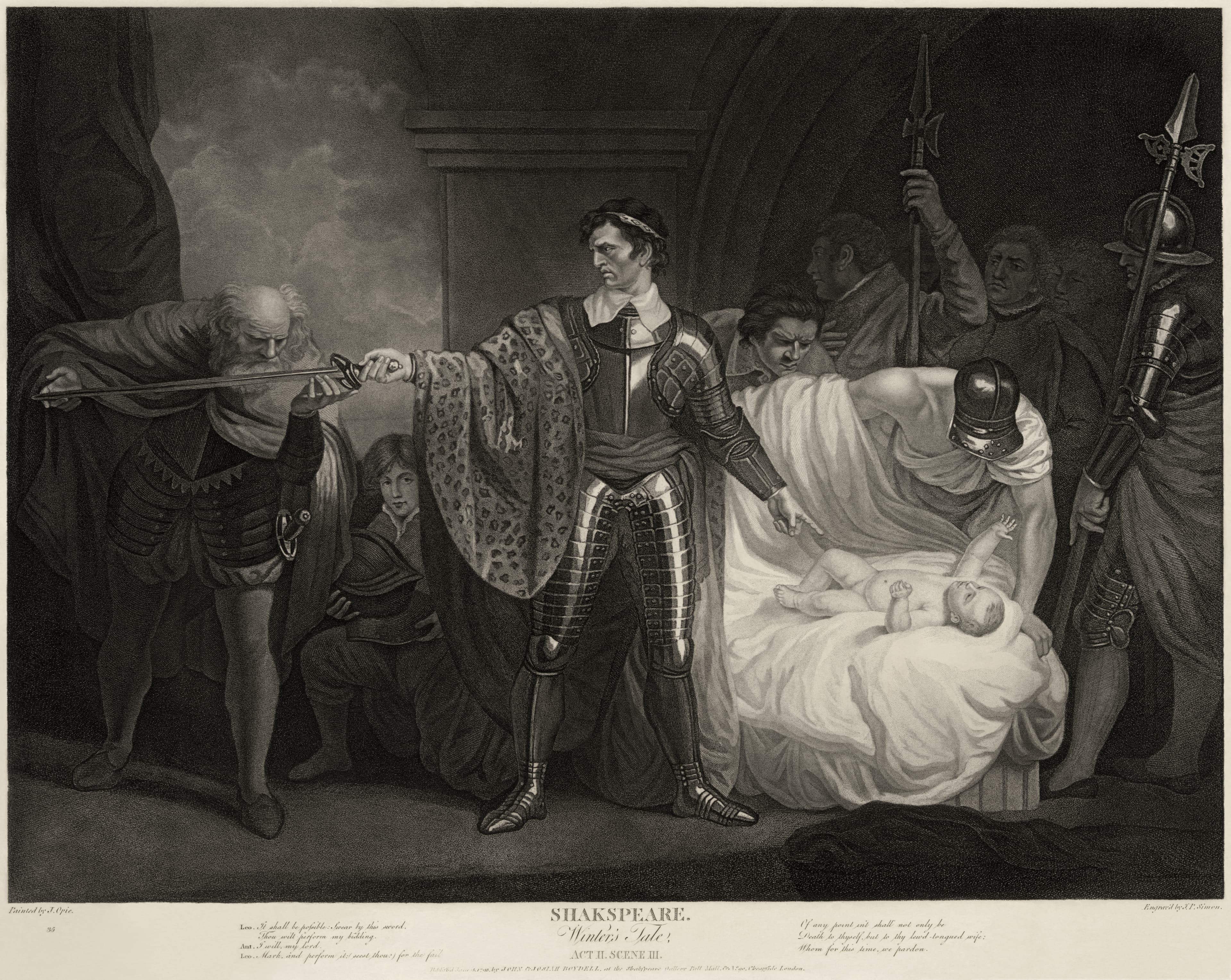
John Opie · Public domain
The Winter's Tale is a full-evening, three-act narrative ballet made by Christopher Wheeldon to a score commissioned from Joby Talbot, adapting Shakespeare's late romance of jealousy, loss and reconciliation. It was co-produced by the Royal Ballet and the National Ballet of Canada and premiered at the Royal Opera House on 10 April 2014, with a North American premiere the following year.
What is danced
The article does not describe the choreography in technical terms — no steps, holds, partnering shapes, or named divertissements are given in the source text. What can be said from the article is structural and dramaturgical: it is a three-act story ballet that compresses Shakespeare's five-act play, tracking a arc from Leontes's jealousy and the deaths of Hermione and Mamillius, through the pastoral Bohemian interlude sixteen years later where Perdita and Florizel fall in love, to the reunion and reconciliation in Sicilia. Critics singled out lead-dancer performances and called it a fully achieved story ballet, which points to a narrative-driven, character-carrying choreographic idiom rather than an abstract or plotless one, but the article gives no vocabulary-level evidence (no mention of pointe work, mime conventions, lifts, or ensemble patterning) that would let a specific technique code be attached with confidence.
Context
No dance-historical framing is given in the article beyond the production credits and reception. The piece was made as a commissioned, purpose-built score-and-choreography narrative ballet for two major companies working jointly, which the article documents through the co-production and premiere details, but it draws no line to broader trends in story-ballet making.
Staging history
The ballet premiered at the Royal Opera House, London, on 10 April 2014, staged by the Royal Ballet in co-production with the National Ballet of Canada; the North American premiere followed in 2015. A recording of the original cast, directed for the screen by Ross MacGibbon and filmed at the Royal Opera House in 2014, was released on Opus Arte DVD and later made available online during the COVID-19 pandemic.
How to watch it
Watch for how the production handles the play's split tone — the article notes the source play moves from intense psychological drama across its first three acts to lighthearted comedy in its last two — and for how design elements (Bob Crowley's scenery and costumes, Natasha Katz's lighting, and the special stage effects by Daniel Brodie and Basil Twist) carry the transitions between Sicilia and Bohemia and the sixteen-year time jump. The article gives no detail on choreographic convention, so attention to mime, pas de deux construction, or ensemble work should be treated as independent observation rather than something confirmed by this source.
Credits
- composer: Joby Talbot
Related works
Other staged works in the register connected to this one by author or lineage.
 Alice's Adventures in WonderlandBallet · 2011Wheeldon · video
 An American in ParisBallet · 2005Wheeldon · video
 Like Water for ChocolateBallet · 2022Wheeldon · video
 PolyphoniaBallet · 2001Wheeldon · video
 After the RainBallet · 2005Wheeldon · video
 CarouselBallet · 2002Wheeldon · video
 Within the Golden HourBallet · 2008Wheeldon · video
 ChromaBallet · 2006Music by Talbot · video