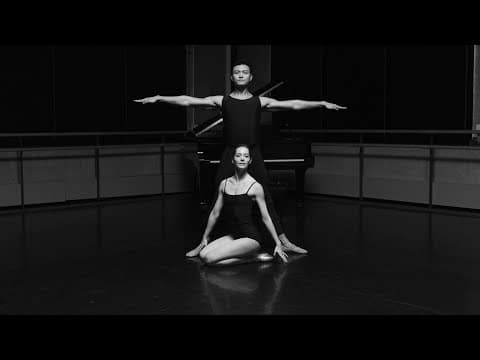
Polyphonia is a plotless, one-act ballet made by Christopher Wheeldon for New York City Ballet, set to a suite of György Ligeti's piano and vocal-adjacent works (Études, Musica ricercata, Invention, Three Wedding Dances, Capriccio No. 2), with costumes by Holly Hynes. It premiered on January 4, 2001 at the New York State Theater, opening NYCB's winter season, and was the first work Wheeldon made after retiring as a dancer to become the company's artist-in-residence.
It belongs in the catalogue as the piece widely credited with launching Wheeldon as a choreographic voice: it won the Laurence Olivier Award for Best New Dance Production in 2003, was picked up quickly by London, San Francisco and eventually Paris companies, and cemented his long working partnership with dancer Wendy Whelan, who went on to originate twelve more roles for him.
What it contains
- Neoclassical Ballet · the whole ballet, which is plotless throughout — Danced by four couples in an abstract, non-narrative format that reviewers linked directly to Balanchine's spare, unison-and-duet 'leotard ballets,' where choreography answers the music rather than mime or plot. Source: "though reviewers have noted it also includes homage to Frederick Ashton and George Balanchine, especially the latter's "leotard ballets""
What is danced
The cast is eight dancers — four men, four women — dancing an abstract, non-narrative structure across the separate Ligeti movements listed in the score. Wheeldon called the tone "romantic with comic twists," and named Norman Morrice's work as an inspiration, but reviewers read the piece as also paying homage to Frederick Ashton and, especially, to George Balanchine's plotless "leotard ballets" — the spare, unison-and-duet, black-and-white NYCB tradition built on musical response rather than mime or story. That lineage is the clearest description the article gives of what is actually danced: abstract, musically driven ensemble and partnering work rather than a costumed or character idiom.
The piece is built around contrasting duets and small-group sections keyed to individual Ligeti pieces (the two Études, the five Musica ricercata movements, Invention, the Three Wedding Dances, the Capriccio), which is a hallmark of the "leotard ballet" form — the choreography changes character number to number rather than following a plot. Wendy Whelan's central, long-running collaboration with Wheeldon, which she said helped her "begin to find herself as a dancer," points to demanding, exploratory partnering as a core feature, though the article does not itemize specific lifts or steps.
Beyond the genre label and cast size, the source gives no scene-by-scene choreographic detail — no synopsis, no described formations, no notated steps — so any account of specific vocabulary beyond "plotless" and "leotard ballet" homage would be going past what is documented here.
Context
Polyphonia arrived in January 2001 just as Wheeldon shifted from dancing to full-time choreography as NYCB's artist-in-residence, and it reads, by the article's own account, as a direct continuation and personal reworking of the Balanchine "leotard ballet" idiom that had defined the company's plotless repertory for decades, with an acknowledged debt to Ashton's classicism and Morrice's choreography as well. Its success — an Olivier Award and rapid uptake by companies outside NYCB — marked one of the clearest handoffs of that neoclassical, score-driven tradition to a new generation of choreographers at the turn of the millennium.
Staging history
After its NYCB premiere, Polyphonia was danced in London in 2002 by Benjamin Millepied's pick-up group Danses Concertantes (using NYCB dancers) at Sadler's Wells, which led to the 2003 Olivier Award for Best New Dance Production and a nomination for Wheeldon himself. The Royal Ballet and San Francisco Ballet both mounted it in 2003, Wheeldon's own Morphoses/The Wheeldon Company later performed it, and it entered the Paris Opera Ballet repertory in 2015 on a mixed bill marking Pierre Boulez's 90th birthday — Wheeldon's first work danced by that company. Boston Ballet, The Washington Ballet and Miami City Ballet have also staged it, and in 2020 NYCB released filmed extracts, including a pas de deux, in response to pandemic closures.
How to watch it
Watch for a plotless structure that changes mood and pairing with each Ligeti movement rather than following a story — the title itself refers to Ligeti's micropolyphony, so the choreography's interweaving of duets and ensemble lines is meant to echo the layered musical texture. Expect the spare, unadorned look (simple costumes, minimal set) associated with Balanchine's "leotard ballets," alongside moments of wit Wheeldon described as "comic twists" set against the piece's more romantic duets.
Credits
- composer: György Ligeti
More from Christopher Wheeldon
Other staged works in the register connected to this one by author or lineage.
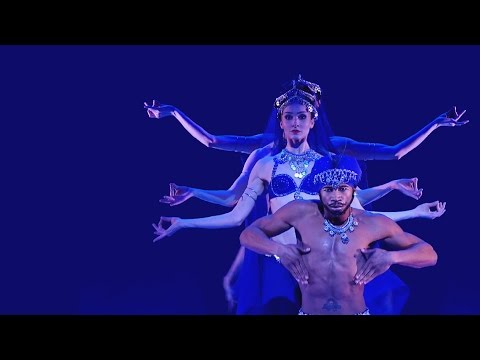 Alice's Adventures in WonderlandBallet · 2011Wheeldon · video
 The Winter's TaleBallet · 2014Wheeldon · video
 An American in ParisBallet · 2005Wheeldon · video
 Like Water for ChocolateBallet · 2022Wheeldon · video
 After the RainBallet · 2005Wheeldon · video
 CarouselBallet · 2002Wheeldon · video
 Tschaikovsky Piano Concerto No. 2Ballet · 1941Same lineage · video
- FanfareFanfareBallet · 1953Same lineage