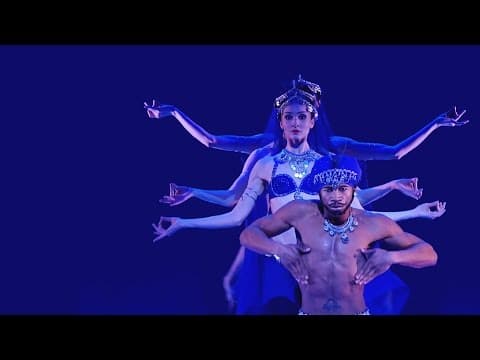
This is Christopher Wheeldon's full-length narrative ballet after Lewis Carroll's Alice's Adventures in Wonderland, made for The Royal Ballet with the National Ballet of Canada as co-producing partner, to a specially commissioned score by Joby Talbot and a scenario by playwright Nicholas Wright. It premiered at Covent Garden on 28 February 2011 with Lauren Cuthbertson as Alice, and was notable at the time as the Royal Ballet's first full-length narrative ballet commission since 1995 and its first full-length original score in twenty years.
What is danced
The article documents the ballet's structure, plot and instrumentation in detail but does not describe the choreographic vocabulary itself in technical terms — there is no mention of pointework, partnering technique, or named step vocabulary. What can be established is the ballet's shape: a doubling of roles (the same dancers play Alice's parents/Lewis Carroll/Jack as the Queen, King and White Rabbit and the Knave of Hearts), a series of set-piece episodes built around Carroll's famous scenes (the shrinking and growing, the pool of tears and the race to dry off, the Duchess's kitchen, the Mad Hatter's tea party, the croquet game with flamingos and hedgehogs, and the trial), and at least two formal duet passages — the Act 3 reunions of Alice and the Knave, and a pas de deux for the same pair that Wheeldon inserted when he expanded the ballet from two acts to three by 2012. The Act 3 synopsis also notes a discrete dance turn for the Queen of Hearts ("The Queen shows off her skill at dancing"), but the article gives no indication of its idiom.
Given this gap in the source, no specific style codes are being attached to sections of the work; a reviewer with access to reviews of the choreography itself, rather than the plot and staging, would be needed to characterise the vocabulary with confidence.
Context
The ballet was made at a moment when full-length, narrative-driven story ballets had become rare in the Royal Ballet's contemporary commissioning, the company having gone twenty years without a new full-length original score and sixteen years without a new full-length narrative work. Wheeldon, by 2011 an internationally established choreographer working mainly in a contemporary idiom, used the commission to build a family-friendly, effects-heavy production rather than one of the company's existing 'full-blooded' dramatic ballets, in his own words.
Staging history
The ballet was jointly commissioned by The Royal Ballet, Covent Garden, and the National Ballet of Canada, after Karen Kain, that company's artistic director, proposed a co-production on learning of the project; the National Ballet of Canada gave the North American premiere in 2011 with Jillian Vanstone. By 2012 Wheeldon had reworked the ballet from two acts into three and added a pas de deux for Alice and the Knave. Later stagings named in the article include the Royal Swedish Ballet (2016), the Royal Danish Ballet (2016–17), the Australian Ballet (2017) and the New National Theatre, Tokyo (2022). The 2011 premiere production and a 2017 Royal Ballet revival were filmed for DVD, both with Lauren Cuthbertson in the title role, and the Royal Danish Ballet streamed a recording (with Holly Dorger as Alice) during the COVID-19 pandemic.
How to watch it
Watch for the doubling of dancers between the Oxford 'real world' characters and their Wonderland counterparts (Alice's parents become the King and Queen of Hearts, the family friend Lewis Carroll becomes the White Rabbit, the gardener's boy Jack becomes the Knave), which is a directorial device as much as a choreographic one and shapes how the same performer's presence is used across the ballet. Note also the scale of the theatrical apparatus — the shrinking/growing effects, the pool-of-tears sequence, the croquet scene with flamingo and hedgehog props — since contemporary reviewers felt the staging sometimes competed with, rather than supported, the dancing itself.
Structure
- Act IAt a garden party Alice sees Jack unjustly dismissed; she follows Lewis Carroll, transformed into the White Rabbit, into Wonderland, where she shrinks and grows, swims in a pool of tears, visits the Duchess's kitchen, and is blindfolded to keep her from the Queen of Hearts.
- Act IIAlice consults the Cheshire Cat, attends the Mad Hatter's tea party, meets the Caterpillar and eats the mushroom that lets her enter the magic garden, then follows the fleeing Knave and White Rabbit.
- Act IIIIn the Queen's garden Alice helps the gardeners escape execution, the Queen and Duchess play croquet, Alice and the Knave are reunited, the Knave is put on trial, and the court collapses like a pack of cards as Alice wakes.
Structure read from an encyclopaedia article, not from a libretto or score we hold. Confirm against a programme before treating the numbering as authoritative.
Credits
- composer: Joby Talbot
More from Christopher Wheeldon
Other staged works in the register connected to this one by author or lineage.
 The Winter's TaleBallet · 2014Wheeldon · video
 An American in ParisBallet · 2005Wheeldon · video
 Like Water for ChocolateBallet · 2022Wheeldon · video
 PolyphoniaBallet · 2001Wheeldon · video
 After the RainBallet · 2005Wheeldon · video
 CarouselBallet · 2002Wheeldon · video
 Within the Golden HourBallet · 2008Wheeldon · video
 Five Movements, Three RepeatsBallet · 2012Wheeldon · video