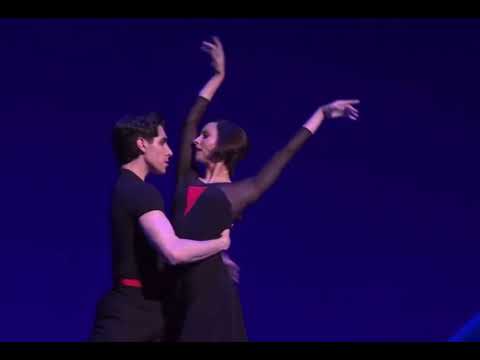
An American in Paris is a one-act plotless ballet made by Christopher Wheeldon to George Gershwin's 1928 orchestral tone poem of the same name, with designs by Adrianne Lobel, costumes by Holly Hynes and lighting by Natasha Katz. It premiered on 4 May 2005 at the New York State Theater, with Carla Körbes, Jenifer Ringer and Damian Woetzel in the three lead roles and Andrea Quinn conducting.
What it contains
- Classical Ballet · the whole one-act ballet — Wheeldon rejected putting a dancer off pointe specifically because the piece is a ballet, indicating the work was built and performed throughout on pointe in classical technique rather than a looser, filmic dance style. Source: "He said he considered to have one of the dancers be off pointe, but went against it as it is a ballet."
What is danced
The article gives no scene-by-scene account of steps or formations, but it records one telling choreographic decision: Wheeldon considered putting one of the dancers off pointe and rejected the idea specifically 'as it is a ballet' -- meaning the piece was made and performed on pointe throughout, in classical technique, rather than borrowing the flatter, filmic dance idiom of the 1951 movie it takes its music from. Wheeldon's own framing was that he wanted to 'balleticize' the material: he found the film's own choreography 'simple and uninteresting' and set out to replace it with denser, more structured ballet vocabulary suited to the concert hall rather than the screen.
Beyond that, the article does not describe individual numbers, lifts, partnering or corps patterning, so no set-piece movement detail (a central pas de deux, a corps section evoking Parisian street life, etc.) can be verified here. A reviewer's remark that Wheeldon was 'clever in capturing idealized Paris street life' though 'the dance never quite coheres' points to episodic, atmosphere-driven choreography rather than a through-danced narrative, but this is a critical impression, not a description of steps.
Context
The ballet dates from the middle of Wheeldon's tenure as a leading choreographic voice associated with New York City Ballet in the early 2000s, working in the Balanchine-descended tradition of plotless, score-driven ballet built on classical technique. Making a concert ballet out of a Gershwin film standard, rather than restaging the film's own dance numbers, was itself the point: Wheeldon treated the music as 'a great piece of classical music' independent of its cinematic history, and built new, fully balletic choreography around it rather than adapting existing screen choreography.
Staging history
The article covers the 2005 premiere but no subsequent revivals or restagings of the ballet itself. A decade later Wheeldon returned to the same Gershwin score and title to direct and choreograph a full stage musical adaptation of the 1951 film -- his directorial debut -- which opened at the Théâtre du Châtelet in Paris in 2014, transferred to the Palace Theatre on Broadway in 2015 and the Dominion Theatre in the West End in 2017, with Robert Fairchild and Leanne Cope originating the leads and Wheeldon winning the Tony Award for Best Choreography. That musical is a related but distinct work from the 2005 ballet catalogued here.
How to watch it
Watch for how a classical, pointe-based vocabulary is used to render Gershwin's jazz-inflected, urban score and its Paris-street-life atmosphere -- a deliberate choice against a looser, filmic style of dancing. Because the piece is plotless, attend to structure and mood across its scenes rather than to a narrated story; reviewers at the time found the atmosphere more successful than the choreography's overall cohesion.
Credits
- composer: George Gershwin
More from Christopher Wheeldon
Other staged works in the register connected to this one by author or lineage.
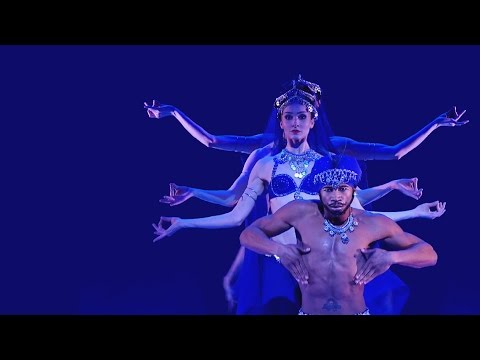 Alice's Adventures in WonderlandBallet · 2011Wheeldon · video
 The Winter's TaleBallet · 2014Wheeldon · video
 Like Water for ChocolateBallet · 2022Wheeldon · video
 PolyphoniaBallet · 2001Wheeldon · video
 After the RainBallet · 2005Wheeldon · video
 CarouselBallet · 2002Wheeldon · video
 Tschaikovsky Piano Concerto No. 2Ballet · 1941Same lineage · video
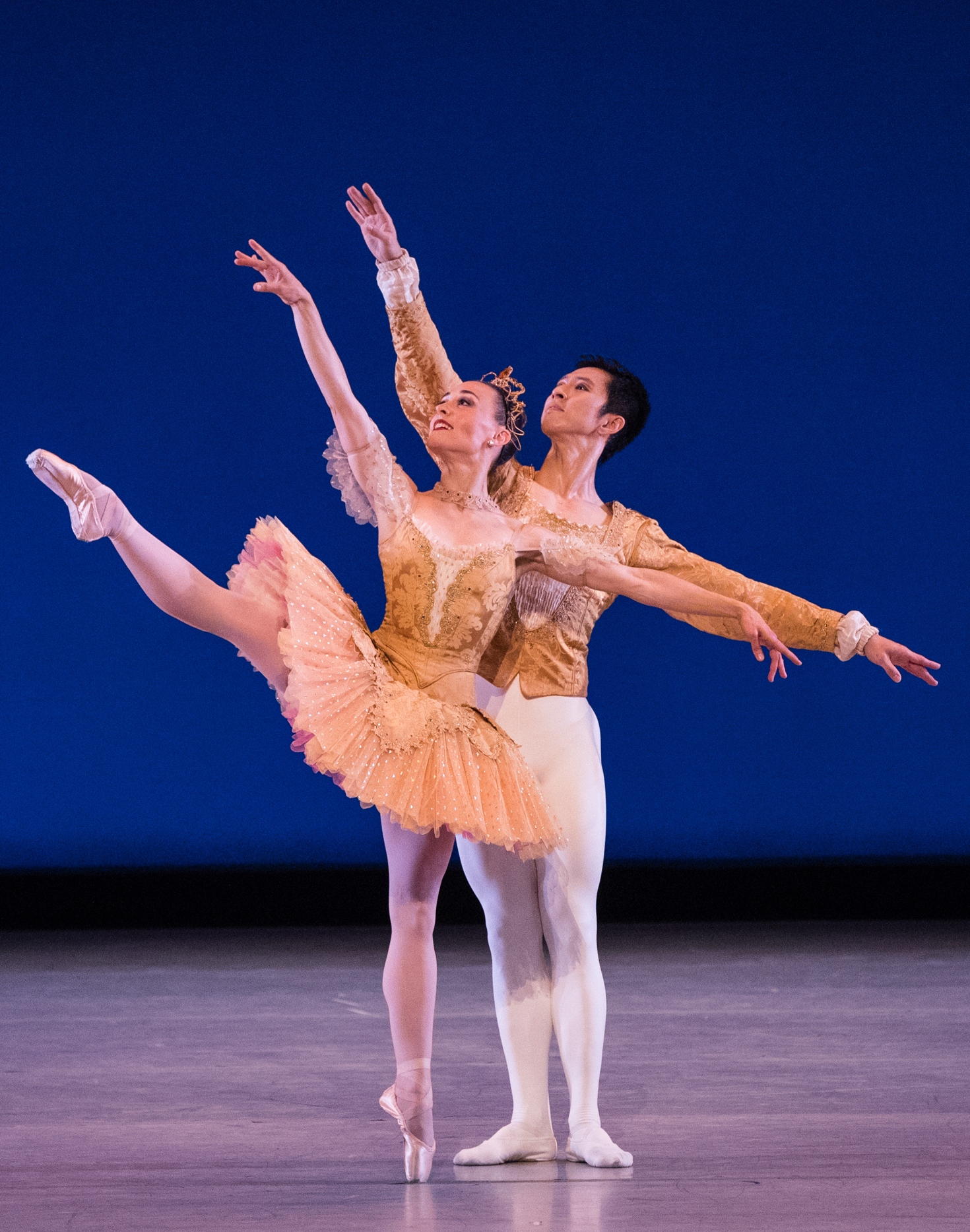 Theme and VariationsBallet · 1947Same lineage · video