Fusion Dance
Also known as: Blues Fusion, Fusion, Fusion Partner Dance
- Origin
- United States (San Francisco Bay Area, Colorado, Texas), later Canada and Europe
- Era
- 2000–Present
- Rhythm
- No fixed signature; dancers respond to whatever meter and subdivision the selected track offers
- Tempo
- Approximately 60-130 BPM, deliberately unbounded
- Character
- Exploratory, eclectic, improvisational, consent-forward
History & Cultural Context
Fusion is the one entry in this family that is not a Black American vernacular form. It emerged in the United States in the 2000s, with some accounts placing its beginnings in the 1990s, when dancers from the blues and swing revival scenes began improvising to music outside those genres. Rather than a fixed idiom it is a method: lead and follow with no required vocabulary, drawing technique from tango, contact improvisation, ballet, popping and whatever the track suggests, so a hip-hop record might pull popping into the dance while a downtempo electronic track pulls something closer to blues. Documented milestones include the Tangoed Up In Blues workshops that bridged the San Francisco blues and tango communities in 2005, the Lindy Booty weekends in California from 2004 that programmed non-Lindy music, the Houston Fusion Exchange in 2008 as the first national fusion event, and Recess Productions, which ran more than sixty events from Colorado to Europe between 2008 and 2018. The scene is notable for foregrounding explicit consent practices and for decoupling dance roles from gender more thoroughly than most partner forms. Its relationship to blues is contested: fusion borrows blues aesthetics and shares venues and personnel with the blues revival, but it is a contemporary invention with no claim to the historical lineage.
Cultural Significance
Fusion is a product of the mostly white North American blues and swing revival scenes of the 2000s, and its growth has sharpened the question of what the revival owes the Black American communities whose dances it draws on.
Characteristic Movement & Technique
No signature step; dancers switch between grounded blues weight, tango-derived pivots and dissociation, contact-improvisation weight sharing and isolation-based street vocabulary within a single song.
Partnering Dynamics
Close or open connection negotiated on the spot, with roles frequently switched mid-dance and an explicit community norm of checking consent for close embrace, dips and weight sharing.
Competitive Context
Largely non-competitive by design; some events run Jack-and-Jill formats, but the scene's culture emphasises social dancing and workshops over ranking.
Regional Variations
West Coast fusion leans toward contact improvisation and blues, Colorado's Recess-era scene toward eclectic programming, and European fusion toward tango and contemporary influences.
Common Misconceptions
Fusion is frequently presented as a form of blues dance or as its modern evolution; it is a separate contemporary invention, and treating it as blues obscures rather than honours the historical Black American idioms.
Peak Popularity
Fusion Dance Music & Tempo
Drawn from 17 Fusion Dance tracks in the LODance music library.
Example tracks at practice tempo
- Open — Rhye91 BPM
- Lovit — Marian Hill78 BPM
- Intro — The xx100 BPM
- Stars — The xx104 BPM
- Give Me One Reason — Tracy Chapman100 BPM
- Work Song — Hozier121 BPM
Fusion Dance on screen
Films and television where Fusion Dance appears, with the sequences worth watching for.
 High Strung: Free Dance (2018)3 sequences indexedCharlie auditions against the rehearsal · 00:36:18 · chor. Tyce DiorioProduction mechanics technical run · 01:15:32 · chor. Tyce Diorio; Phillip Chbeeb; Myles Thatcher; Nakul Dev MahajanFree Dance curtain-up ensemble · 01:27:02 · chor. Tyce Diorio; Phillip Chbeeb; Myles Thatcher; Nakul Dev Mahajan
 Save the Last Dance (2001)2 sequences indexedBallet and hip-hop practice montage · chor. Fatima RobinsonJuilliard audition · chor. Fatima Robinson
 Step Up (2006)2 sequences indexedTyler and Nora first rehearsal · chor. Anne Fletcher; Rosero McCoy; Jamal Sims; Zachary WoodleeSenior showcase finale · chor. Anne Fletcher; Rosero McCoy; Jamal Sims; Zachary Woodlee
 Take the Lead (2006)2 sequences indexedHip-hop and tango fusion rehearsal · chor. JoAnn Fregalette JansenBallroom competition finale · chor. JoAnn Fregalette Jansen
 The Next Step (2013–2022)2 sequences indexedRepresentative anchor — first A-Troupe dance · chor. Amy Wright (series head choreographer; sequence attribution not verified)Representative anchor — Regionals final · chor. Amy Wright (series head choreographer; sequence attribution not verified)
 Ballet Now (2018)1 sequence indexed1,2,3,4,6 fusion number
 Breakin' (1984)1 sequence indexedStage audition finale
 Flashdance (1983)1 sequence indexedConservatory audition · chor. Jeffrey Hornaday
 High Strung (2016)1 sequence indexedFinal violin-and-dance competition · chor. Dave Scott
Poster artwork from TMDB.
 This site uses TMDB and the TMDB APIs but is not endorsed, certified, or otherwise approved by TMDB.
What to Wear
Attire guidance for Fusion Dance and other Blues & Slow Social Dance dances. Each card below is sized to the moment — class, practice, social, or competition — because the wardrobe shifts as the stakes do.
Reading the cards
In Class
Comfortable clothes you can sweat in, plus smooth-soled shoes you can pivot in — leather or suede soles are the norm and rubber gym soles grab the floor hard enough to hurt a knee. Most venues ask that you change out of street shoes at the door. Because this is a close-connection dance, leave off long necklaces, dangling earrings, watches and anything with hooks or a rough seam that will catch a partner or scratch a forearm.
Social Dancing
Blues venues run from juke-joint casual to dressy at exchanges and late-night rooms; look at what the local scene wears and match it, but nothing formal is required. Hygiene is genuinely part of the dress code here in a way it is not in most styles — deodorant, mints, and a change of shirt in your bag, because you will be in close embrace for several songs at a stretch. Go light on perfume and cologne; many dancers are scent-sensitive, and it lingers on everyone you dance with.
Competition
Blues has no formal competitive circuit with a costume rulebook; the competitive format that exists is the Jack & Jill or Strictly contest run at weekend exchanges. Wear something that reads clearly from across the floor and that will survive several fast rounds without adjustment — and keep the same close-embrace rules in mind, since your partner is randomly drawn. Community norms outrank aesthetics: close embrace is invited rather than assumed, and nothing you wear should create contact your partner hasn't agreed to.
Shoes
Smooth soles that pivot: suede or chrome leather, never a rubber gym sole, which grabs a wooden floor hard enough to torque a knee mid-turn. Low, stable heels or flats — blues sits into the floor with bent knees and a high heel fights that all night. Indoor-only, changed at the door; most venues explicitly ban shoes that have been worn outside. Aris Allen and Só Dança sit at the affordable end, with Saint Savoy, Bleyer and Nueva Epoca above them.
In Practice
Practice wear is a little more fitted than social wear, because blues is about weight, pulse and what the torso is doing, and a teacher cannot correct what a drapey top hides. Train in the shoes you will social dance in — sole friction changes everything about how a pivot and a drag feel. Layers matter: practice rooms start cold and you will be soaked an hour in, so bring the spare shirt to practice too, not just to the dance.
By Role
Leaders
Class: Nothing that interferes with the frame or the point of contact: a top with sleeves or an undershirt, since a partner's hand rests on your shoulder and upper back for whole songs, and a spare shirt so that stays pleasant late in the night. Skip rigid collars, chest-pocket pens and a large belt buckle — all of them press into a partner in close embrace.
Competition: Jack & Jill and Strictly contests carry no costume rules, so wear what you social dance in, in a colour that separates you from the floor and the crowd. Keep the frame legible — nothing bulky through the shoulders, nothing that hides where your weight actually is, since that is what a judge is reading.
Followers
Class: Anything that lets you sit into a deep bend and travel through a slow drag — a skirt needs enough width for that, or wear trousers, and a pencil skirt will simply stop you. Leave off long necklaces, dangling earrings and loose clips: in close embrace they catch on a partner, and a caught earring hurts.
Competition: Same clothes as a social night, chosen for how they read from across the room; a skirt with some weight makes the pulse and the drag visible in a way leggings do not. Secure anything that can shift or fall, because you are dancing with a randomly drawn partner in front of judges and there is no second take.
Common Pitfalls
- ✗Rubber-soled trainers on a wooden floor — they grip through a pivot and knee injuries follow.
- ✗Wearing the shoes you arrived in; almost every venue asks you to change at the door.
- ✗Heavy fragrance in a close-embrace room, where it lands on every partner you have all night.
- ✗Long necklaces, dangly earrings and loose hair clips, which catch and tear in close embrace.
- ✗Treating close embrace as the default: it is offered and accepted, never assumed, and clothing should not force it.
Price Range
- Budget: Clothes you own, plus a smooth-soled shoe you can pivot in — a cheap leather-soled dress shoe or well-worn flats will get you started for under $50.
- Mid: Aris Allen or Só Dança dance shoes roughly $60–110, a suede brush around $10, a shoe bag and a spare shirt.
- Premium: Saint Savoy, Bleyer or Nueva Epoca at roughly $150–280, often with replaceable soles — worth it if you dance several nights a week, and largely invisible to anyone but you.
Key Terms
- Close embrace
- Chest-to-chest connection, invited rather than assumed — what you wear should not create contact your partner has not agreed to.
- Chrome leather sole
- Soft tanned leather sole that slides and pivots predictably on wood; suede is the other standard. Rubber is the thing to avoid.
- Pulse
- The grounded vertical bounce that drives blues — danced with bent knees, which is why low heels and unrestrictive legwear matter.
- Jack & Jill
- Contest format with randomly assigned partners; the closest thing blues has to competition, and it has no dress code.
- Scent sensitivity
- Widely observed community norm — go light on perfume and cologne, since it transfers to everyone you dance with.
Quick Tips
- •Suede-soled shoes allow controlled sliding and pivoting — essential for most partner dances.
- •Avoid rubber soles on dance floors; they grip too much and can cause knee injuries.
- •Bring a separate pair of clean shoes for the dance floor to keep it in good condition.
Sources & Further Reading
Cultural & Historical Context
Fusion Dance emerged from United States (San Francisco Bay Area, Colorado, Texas), later Canada and Europe during the 2000s—present day. Understanding the cultural roots, musical traditions, and social circumstances of this era enriches appreciation for the dance's characteristics and significance.
Primary Source Documents
The Library of Dance contains public-domain primary sources for dance history. Copyrighted modern syllabi are indexed with purchase links to their respective copyright owners. Search by dance name or codifier to discover primary source documents.
Last reviewed: September 2026 — This dance profile synthesizes historical research, cultural documentation, and contemporary practice knowledge to provide authoritative context.
More in Blues & Slow Social Dance
Ballroomin' Blues
The upright, traveling branch of blues dance, developed in Northern ballrooms where floor space allowed couples to move along the line of dance to slow jazz-blues.
Juke Joint Blues
The grounded, close, largely stationary branch of blues dance, shaped by the crowded floors of Southern juke joints and danced to Delta and electric blues.
Slow Drag
The historic close-embrace blues form in which partners hold each other and sway and grind almost in place, documented in the South from the late nineteenth century.
Struttin' / Fishtail
A strutting and hip-articulating vocabulary danced solo or in an open close embrace, combining showy forward carriage with figure-eight motion through the pelvis.
Blues & Slow Social Dance in art
Browse the gallery →Works from the wider Blues & Slow Social Dance tradition — we have not yet identified enough that depict Fusion Dance specifically.
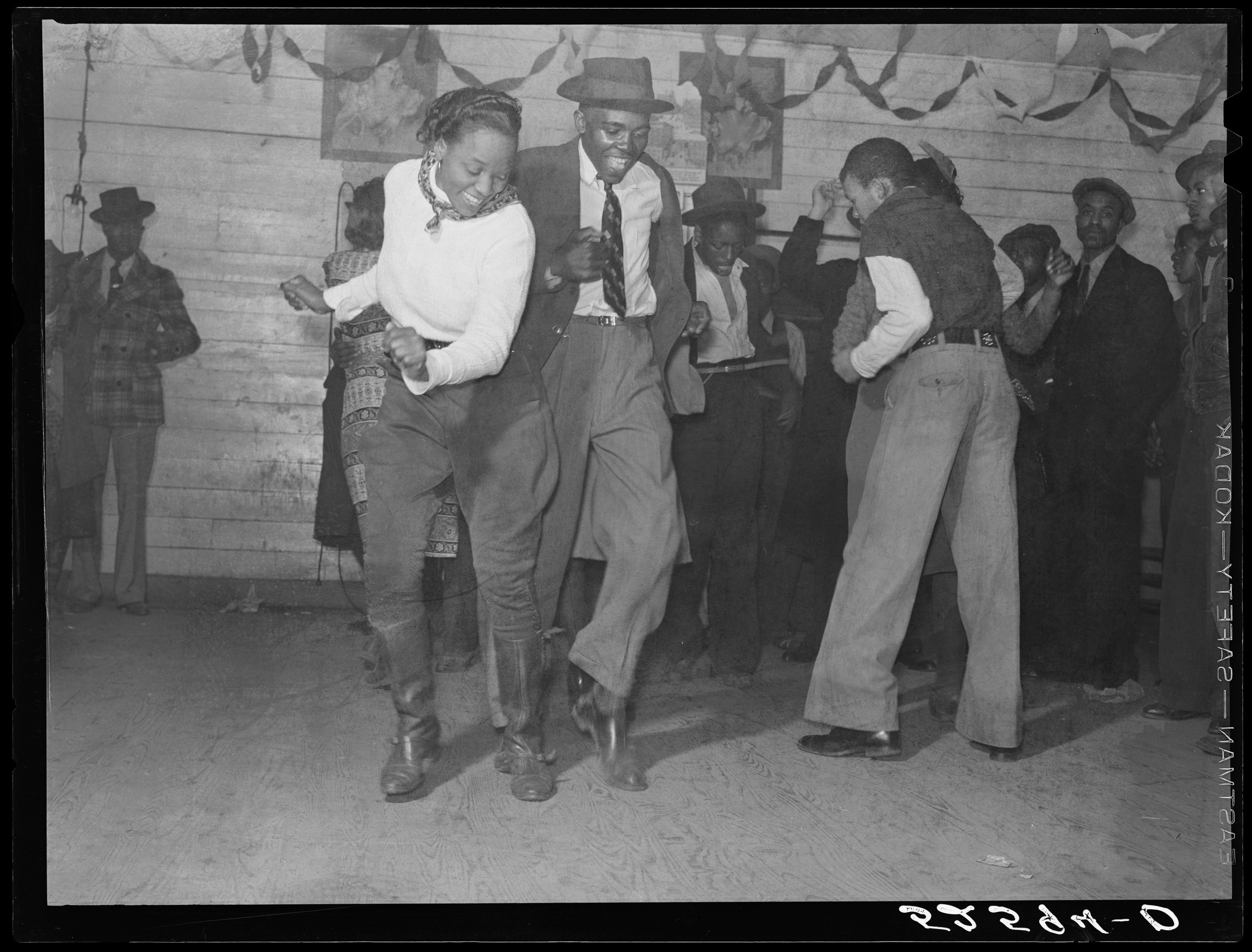
Jitterbug Wolcott FSA
Marion Post Wolcott
public_domain
Continue Exploring
Lineage of Dance
500 years of dance evolution
Champions of Dance
Winners of marquee national & world titles
Language of Dance
161 dance terms & translations
Listening of Dance
Tempo, timing & musicality tools
Gallery of Dance
5,700+ artworks from museum collections
Attire of Dance
Evolution of dance dress across eras
Keep the thread going
Dance history, technique, and the occasional rabbit hole — in your inbox. Thoughtful, infrequent, unsubscribe anytime.
Free. No spam. One click to leave.