28 works in this view — arrow keys or swipe to move between them.
Dance in Art
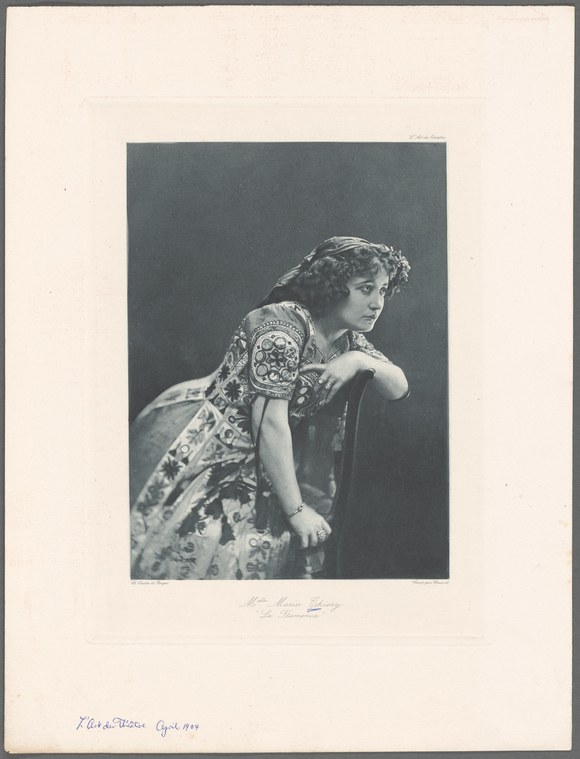
Melle. Marie Thiery, "La Flamenca"
Unknown artist
- Collection:
- Prints depicting dance
- Source:
- New York Public Library
- Rights:
- Public domain — free to use, share and adapt.
- Recorded as:
- Public Domain
This portrait reveals how flamenco was fashioned, packaged, and circulated as a commercial entertainment for European audiences at the turn of the 20th century. For historians of theatrical dance, cabaret, and the exoticization of Spanish culture in European visual culture, it records both the costume language and the performance identity of a named professional dancer whose work would otherwise leave no visual trace.
What you are looking at
A woman in a richly patterned dress is shown in three-quarter view, turned to gaze over her shoulder toward the viewer. Her costume is the photograph's focal point: a long gown with elaborate ornamental embroidery or brocade depicting bold scrolling motifs covers the bodice and sleeves, rendered in pale tones against dark fabric. The garment's construction suggests late 19th-century tailoring, with close-fitting sleeves and a high neckline. Her dark hair is arranged in the pompadour style of the 1890s–1900s, softly waved and pinned up. The photograph is taken against a dark background that throws the figure and her brilliant dress into sharp relief. The woman's pose—weight shifted, torso twisted, one arm relaxed at her side—suggests a moment between movements or a studied theatrical attitude rather than static portraiture.
The dancing
A single figure occupies the frame. Her weight is balanced but asymmetrical, with her upper body rotated toward the camera while her gaze turns further back over her shoulder. One arm hangs naturally; the other is lightly positioned across her body, framing the dress. The pose is characteristic of theatrical portraiture of the period—a display attitude rather than a dance frame, yet the twisted torso and turned head suggest the kind of rotational ease expected of a stage performer.
The dance depicted
The title identifies this as a portrait of Marie Thiery, billed as 'La Flamenca.' Flamenco had become a commercial spectacle in European cabarets and music halls by the 1890s, distinct from its Andalusian vernacular roots. This photograph documents the costume and persona of a professional performer in that entertainment tradition. The ornate dress with its bold embroidered panels and geometric patterning is consistent with the Hispanophile exoticism marketed in Belle Époque cabaret. Nothing in the pose or gesture directly captures flamenco movement—no arm styling, no heel emphasis, no dynamic weight shift—but the photograph documents the visual costume identity through which flamenco was consumed as entertainment in Paris and other cosmopolitan centers.
How it was made
This is a photographic print, likely albumen or gelatin silver, mounted on a heavier stock with a printed caption below. The technique allows sharp detail of the dress's embroidery and the subtle modeling of the face under theatrical lighting. The dark background, studio setting, and controlled lighting are consistent with professional theatrical or celebrity portraiture of the 1890s–1900s. Photography's capacity for exact detail made it ideal for documenting stage costume and establishing a performer's public image, and this print was likely produced for circulation to press, programs, or collectors of theatrical celebrities.
About this work
This is a professional theatrical portrait of a flamenco performer identified as Marie Thiery, photographed in studio setting during the Belle Époque period when flamenco entertainment had become a fashionable cabaret attraction in European cities. The image documents both the performer's persona—her styling, carriage, and gaze—and the exotic costume through which flamenco was marketed to urban audiences. The photograph belongs to a substantial body of theatrical and cabaret portraiture that shaped how late 19th-century spectators understood Spanish and Andalusian dance, often at some distance from vernacular practice. It is a document of commercial dance culture and the visual codes through which performers and their dance forms were made marketable and memorable.
How to look at it
Observe the relationship between the pose and the dress: the photograph is structured to display the costume's ornamental detail, and the woman's body is angled and positioned to show the patterned embroidery to best advantage. Notice the absence of flamenco-specific gestural vocabulary—no arched wrists, no characteristic arm frames, no emphasis on footwork or heel work. This is a celebrity portrait, not a dance documentation, yet her training as a performer is evident in the ease of her asymmetrical stance and the controlled turn of her head. The dark background and studio lighting are conventions of theatrical photography meant to isolate and elevate the performer from ordinary space.
The period
Flamenco entered European visual culture through a combination of Romantic-era interest in Spain, 19th-century colonial exoticism, and the commercial development of cabaret and music-hall entertainment. By the 1880s–1900s, 'flamenco' became a fashionable spectacle in Paris and other cosmopolitan centers, often filtered through the taste of wealthy patrons and theatrical entrepreneurs rather than rooted in Andalusian vernacular tradition. Professional performers like Marie Thiery capitalized on this market, adopting stage names and costumes that advertised Spanish or pseudo-Spanish authenticity. Photography played a crucial role in this economy, creating portable images of celebrated performers that could be collected, distributed, and displayed. Theatrical portraiture of this period typically emphasizes costume and persona over captured movement, since the still photograph could not represent the kinetic reality of performance.
Where it lives
The photograph is held by the New York Public Library in a collection of prints depicting dance. The handwritten annotation visible in the lower left ('Floraston April 1902' or similar) may indicate a date or performer name, though the printed caption below provides the identification 'Melle. Marie Thiery, "La Flamenca."'
Dance in this work
Questions about this work
Is this photograph of an actual flamenco dancer?
Marie Thiery was a professional performer billed as 'La Flamenca,' likely working in European cabaret or music-hall venues in the 1890s–1900s. Whether she trained in vernacular Andalusian flamenco or performed a European theatrical version marketed as flamenco is not documented here. The photograph shows her in costume and pose for a public audience, not in the act of dancing.
What do the embroidered patterns on her dress mean?
The bold geometric and scrolling ornament was part of the visual language through which 'Spanish' or 'flamenco' exoticism was marketed to European audiences. It draws on Spanish textile and decorative traditions but was adapted and exaggerated for theatrical impact. The costume communicates 'Spain' and 'flamenco' to viewers through visual association rather than historical accuracy.
When was this photograph taken?
The catalogue record does not provide a date. The hairstyle, dress construction, and photographic technique are consistent with the 1890s–1905 period. A handwritten annotation on the mount may provide additional information, though it is not fully legible in the image.
Why is she looking back over her shoulder?
This is a convention of theatrical portraiture: the turned gaze creates a sense of engagement with the viewer and suggests movement or liveliness. It is not a dance pose but a studied attitude meant to convey the performer's theatrical presence and charisma.
More dance artwork





