35 works in this view — arrow keys or swipe to move between them.
Dance in Art
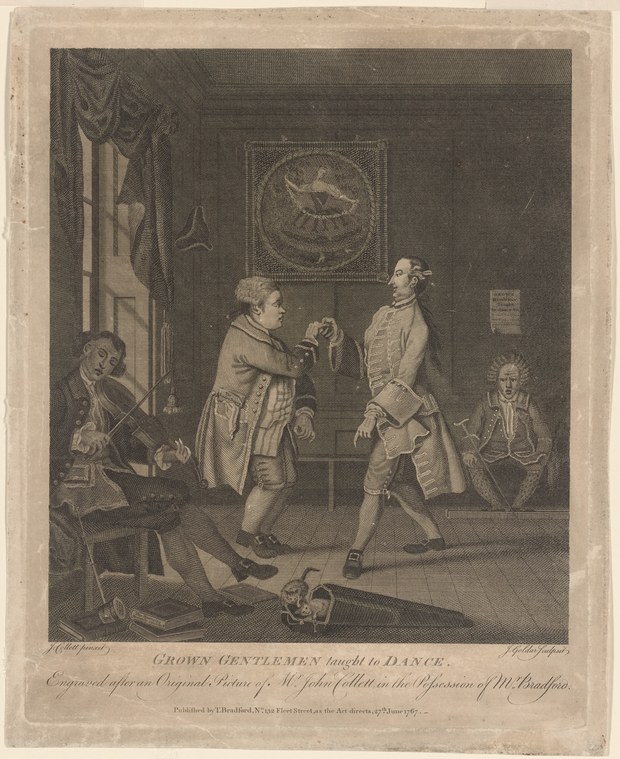
Grown gentlemen taught to dance: engraved after an original picture of Mr. John Collett, in the possession of Mr. Bradford
Unknown artist
- Collection:
- Prints depicting dance
- Source:
- New York Public Library
- Rights:
- Public domain — free to use, share and adapt.
- Recorded as:
- Public Domain
This engraving is documentary evidence of how the minuet was taught in the 18th century and how it was understood as the definitive mark of a gentleman's education. It also reveals period attitudes toward the body, age, and the learning of dance—not as an athletic or artistic pursuit, but as an essential social and courtly accomplishment. The work places dance at the center of gentlemanly identity and social standing.
What you are looking at
This is a satirical engraving depicting a dance lesson in an elegant interior. A portly, older gentleman in light-colored breeches and coat stands at the center, being instructed by a slim, younger man in fashionable dress who gestures with one arm extended, demonstrating proper dance posture. The setting is a grand room with tall windows draped in swags, classical wall decorations, and a relief sculpture above—markers of aristocratic refinement. A small ensemble watches from the sides: a seated musician on the left with what appears to be a stringed instrument, and two fashionably dressed women on the right, one seated and one standing. The floor is polished and spacious. The lighting is even but warm, typical of interior scenes of the period. The whole composition emphasizes the comedy of an ungainly older man attempting to master graceful movement under the guidance of a professional dancing master.
The dancing
The two central figures stand nearly upright in an open, instructional frame rather than a closed dancing hold. The dancing master's posture is erect and exemplary, with one arm raised in demonstration; his body shows the elongation and refinement expected of the period. The student stands somewhat stiffly, his weight unevenly distributed, his body less aligned—his physical ungainliness is the joke. The onlookers maintain formal posture appropriate to their social station. No footwork is clearly visible, but the open spacing and upright carriage suggest a minuet or similar court dance.
The dance depicted
This depicts a minuet lesson, the most fashionable and socially essential dance of the 18th century. The minuet was a fundamental accomplishment for gentlemen of rank, and professional dancing masters were commonly employed to teach it. The satire targets older men attempting to acquire grace and elegance they should have mastered in youth—a common subject of 18th-century wit. The image captures the formal pedagogical moment: the master demonstrates, the pupil attempts to follow. The presence of a musician and witnesses suggests a semi-public lesson, as such instruction was sometimes attended by family or household members.
How it was made
This is an engraving, as stated in the title. Engravings were the principal medium for reproductive prints and satirical commentary in 18th-century Britain. The fine parallel lines (hatching) create tone and shadow, particularly visible in the clothing folds and the darker interior walls. Engraving's ability to render fine detail and expression made it ideal for narrative satire and social comedy. The technique allowed for wide distribution at modest cost, reaching a broad public audience—satirical engravings were popular among educated urban viewers and collectors.
About this work
A satirical engraving mocking the attempts of an older, ungainly gentleman to learn the minuet from a professional dancing master in an aristocratic interior. The work captures the social importance of dancing as an accomplishment in 18th-century polite society, and the comedy of belated instruction. The composition contrasts the master's elegant deportment with the student's stiff, unsuccessful attempt, using the contrast in bodies to convey both technical expertise and social pretension. This is a work of social satire commenting on class, age, and the fashionable pursuit of refinement—dance serves as the vehicle for commentary on gentlemanly aspiration.
How to look at it
Observe the contrast between the two male bodies: the master's elongated, upright frame and refined gesture versus the student's squat posture and stiff carriage. The artist has chosen the moment of instruction itself—the demonstration—rather than a moment of actual dancing, which allows the comedy of the master's perfect form against the student's failure to approximate it. Note the setting: the elegant room, the attendant musician, the watching women—these signal that this is not a private lesson but a semi-public affair, heightening the social stakes and the comedy of the man's inadequacy.
The artist
The engraving is credited as 'Engraved after an Original Picture of Mr. John Collett,' indicating that Collett (a known 18th-century painter and social satirist) created the painting from which this print derives. The engraver is not named in the available record. This was standard practice: original artworks by known painters were often reproduced as engravings for public sale, with the reproductive engraver sometimes uncredited. Collett's work typically focused on social satire and genre scenes of fashionable life.
The period
The minuet reached its cultural peak in the 18th century, particularly in Britain and France, as the essential accomplishment of a gentleman. Dancing masters were professional fixtures in aristocratic and gentry households. By the later 18th century, satirists frequently lampooned the social pretensions surrounding dance instruction and the vanity of older men attempting to master youthful graces. Engravings of this kind were produced for the print-collecting market and were read as witty social commentary by the educated public. The image reflects an era when dance and deportment were inseparable from social identity and status.
Where it lives
The work is held in the New York Public Library's Prints collection, part of a broader holding of dance-related prints. It is identified as a reproductive engraving based on an original painting in the possession of Mr. Bradford at the time the print was made.
Dance in this work
Questions about this work
What is the minuet and why did gentlemen need lessons in it?
The minuet was the most prestigious social dance of the 18th century, essential to courtly and aristocratic life. It required precise, slow, elegant movement and proper deportment. Mastery of the minuet was a marker of gentle breeding and refinement; a gentleman who could not dance it well was considered deficient in education and social grace. Professional dancing masters were hired to teach it.
Is this engraving meant to be funny?
Yes. The satire targets older men attempting to learn grace they should have acquired in youth, and the physical comedy of an ungainly body trying to imitate elegant movement. The contrast between the master's perfect form and the student's stiffness is the joke. 18th-century satirists frequently mocked social pretension and the vanity of attempting to improve one's station through fashionable accomplishments.
How do we know this depicts a minuet lesson?
The open frame, the upright posture, the formal indoor setting, and the presence of a musician all identify this as minuet instruction. The title also specifies 'taught to dance.' The posture and spacing are characteristic of minuet pedagogy, not other dances of the period.
Who was John Collett?
Collett was an 18th-century British painter and printmaker known for satirical and genre scenes of fashionable life. The original painting was in a private collection; this engraving is a reproductive print based on his work, likely made for public sale.
More dance artwork





