36 works in this view — arrow keys or swipe to move between them.
Dance in Art
Prints after William Hogarth
Unknown artist
- Collection:
- Prints depicting dance
- Source:
- New York Public Library
- Rights:
- Public domain — free to use, share and adapt.
- Recorded as:
- Public Domain
Hogarth's fair scene is one of the most detailed visual records of popular social dancing in the 18th century, capturing the informality and exuberance of vernacular dance outside courtly or theatrical contexts. The work shows how dance was embedded in public leisure and urban social life, and how it was perceived—with a mixture of fascination and moral anxiety—by the educated classes. For historians of dance and culture, it is invaluable evidence of how ordinary people moved, gathered, and socialized in public space.
What you are looking at
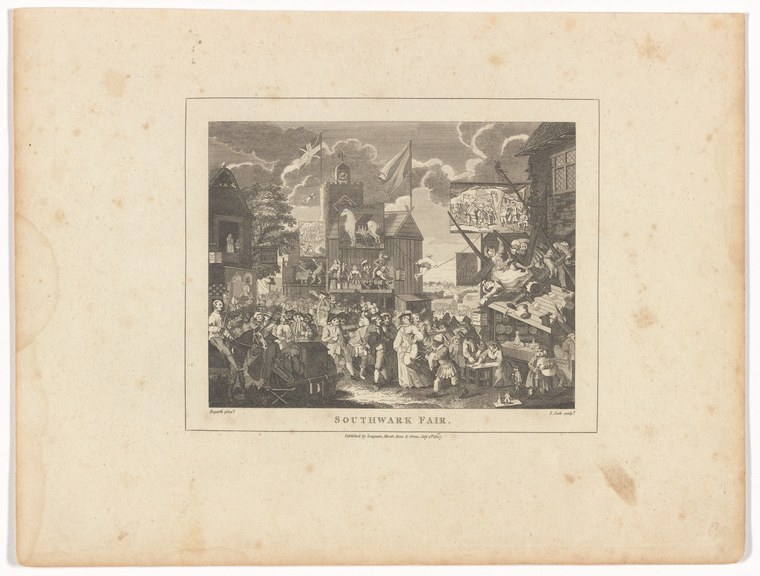
This engraving depicts the Southwark Fair, a crowded outdoor festival teeming with figures in 18th-century dress. The composition is dense and theatrical, with multiple levels of activity: a stage or booth structure dominates the middle distance, festooned with flags and banners; crowds mill about below and around it; a church steeple rises in the background under a dramatic sky with billowing clouds. The foreground is occupied by figures in various states of activity—some dancing, some watching, some engaged in the boisterous entertainments typical of a fair. The light is strong and directional, creating deep shadows that give the scene vitality and movement. Every corner of the frame contains incident: musicians, revelers, acrobats, and onlookers jostle together in an atmosphere of licensed disorder and revelry.
The dancing
The bodies are rendered with Hogarth's characteristic attention to individual expression and posture. Several figures are clearly dancing—some in pairs, others in loose groups—with arms raised and bodies twisted in exuberant motion. The dancers' clothing billows with movement: women's skirts flare, men's coats swing open. The holds are informal and social rather than formal; couples interact with energy and abandon rather than restraint. A number of figures lean, reach, or stride with emphatic gestures. The overall impression is of uncontrolled, popular merriment rather than ballroom discipline.
The dance depicted
This appears to depict social, popular dancing at a fair—the kind of recreational dancing that would have occurred at public festivals in 18th-century London. The setting is explicitly identified as Southwark Fair, a licensed gathering place for the working and middle classes. The dancing shown is vernacular and informal: country dances, reels, and perhaps improvised movement to the music of street musicians. This is not theatrical or courtly dance, but the social dancing of ordinary people at leisure. Hogarth's characteristic moralizing eye captures both the gaiety and the disorder of such occasions—the dance is exuberant but also chaotic, a site of potential mischief and transgression.
How it was made
This is an engraving, a medium that allowed for fine detail and mass reproduction. The technique is evident in the crosshatching used to create shadow and texture, and in the precise linear work that defines form. Engravings could be printed and sold in quantity, making them the primary way such scenes reached a broad audience in the 18th century. This particular work belongs to Hogarth's satirical print tradition, which relied on narrative complexity and moral commentary delivered through closely observed social scenes. The medium was ideal for popular distribution and for the kind of moral and social criticism Hogarth specialized in.
About this work
This is a print after William Hogarth, one of the most influential English artists of the 18th century, known for his moralizing and satirical narratives rendered in paint and print. The Southwark Fair scene is part of Hogarth's project of depicting contemporary social life with unflinching attention to both character and conduct. The work exists at the intersection of social documentation and moral fable: it records the actual entertainments and amusements of a public fair while simultaneously inviting the viewer to judge the behavior on display. For a gallery devoted to dance in art, the work is essential: it captures a moment in the history of popular and recreational dance, showing how ordinary people danced in public, unscripted contexts. The engraving demonstrates how dance functioned as a site of social mixing, pleasure, and potential disorder in 18th-century urban life.
How to look at it
Look first at the composition: Hogarth has arranged the scene to pull your eye across multiple zones of activity, none more important than any other. The dancing is woven into a larger tapestry of fair-going rather than isolated as a spectacle. Notice how the dancers are dressed—their clothes are contemporary and ordinary, not costume—and how their movement is caught mid-gesture, arms and legs akimbo, bodies contorted with effort and pleasure. The style is anti-classical: there is no grace, no elongation, no refinement of line. What Hogarth shows instead is the physicality and messiness of actual bodies in motion, and the moral questions that such motion raises. The fair itself, with its stage, its crowds, its flags and pennants, is a site of authorized transgression where normal rules do not apply.
The artist
William Hogarth (1697–1764) was an English painter, printmaker, and social critic whose work revolutionized artistic practice in Britain. He pioneered the 'modern moral subject,' a form of narrative art that combined satirical observation with technical mastery. Hogarth was fascinated by social behavior and used his art to critique and comment on contemporary life, from courtship and marriage to crime, consumption, and public spectacle. His prints—particularly his series on social themes—were enormously popular and influential, establishing a tradition of satirical visual narrative that extended far beyond his lifetime. Hogarth's interest in dance appears across his work, often as a marker of social pretension, disorder, or the collision between aspiration and reality.
The period
In early 18th-century England, fairs like Southwark were vital public institutions where classes mixed, entertainments proliferated, and social hierarchies were temporarily suspended. Dance at such venues was improvisational and vigorous, drawing on country dance traditions and the music of street performers. This was also a period of intense interest in social criticism and moral satire in British visual culture; Hogarth's work was part of a broader project of holding up a mirror to contemporary society. In terms of dance history specifically, this was an era when recreational and popular dance existed in a different register from courtly or theatrical dance, and when the distinction between them was becoming more visible and more morally charged.
Where it lives
This is a print from the New York Public Library's collection of prints depicting dance. The work is a later engraving or reproduction after Hogarth's original—the catalogue does not specify the date or the printmaker responsible for this particular version. Southwark Fair was a popular subject and multiple prints after Hogarth circulated.
Dance in this work
Questions about this work
Is this a painting or a print?
This is an engraving—a print made by incising lines into a metal plate and inking them. The technique allowed Hogarth to create multiple copies of his compositions, distributing them to a broad audience. Hogarth himself was an innovator in the print market, understanding that satirical narrative art aimed at social commentary needed to reach beyond the collectors of unique paintings.
What is Southwark Fair?
Southwark Fair was a licensed annual festival held in the parish of Southwark, a working-class district south of the Thames in London. It was a major public gathering where all classes mingled, and where entertainers, musicians, dancers, and performers of all kinds set up booths and stages. It was also a site of petty crime, gambling, and disorder—precisely the kinds of social anxieties that fascinated Hogarth.
What kind of dance is shown here?
The dancing depicted is social and recreational, not theatrical or courtly. It would have been country dance, reels, or improvised movement to street music. The dancers are ordinary people amusing themselves at a public event, not professionals or trained performers. The movement is vigorous and uninhibited, a marked contrast to the more formalized and restrained dancing of aristocratic contexts.
Why does Hogarth include dance in this scene?
Dance is one marker among many of the fair's licensed chaos and social mixing. For Hogarth, dance—particularly popular, uncontrolled dance—was a potent symbol of pleasure, disorder, and the temporary suspension of social hierarchy. It fits into his larger project of documenting and commenting on the actual behavior of people in public space.
More dance artwork





