41 works in this view — arrow keys or swipe to move between them.
Dance in Art
Prints after William Hogarth
Unknown artist
- Collection:
- Prints depicting dance
- Source:
- New York Public Library
- Rights:
- Public domain — free to use, share and adapt.
- Recorded as:
- Public Domain
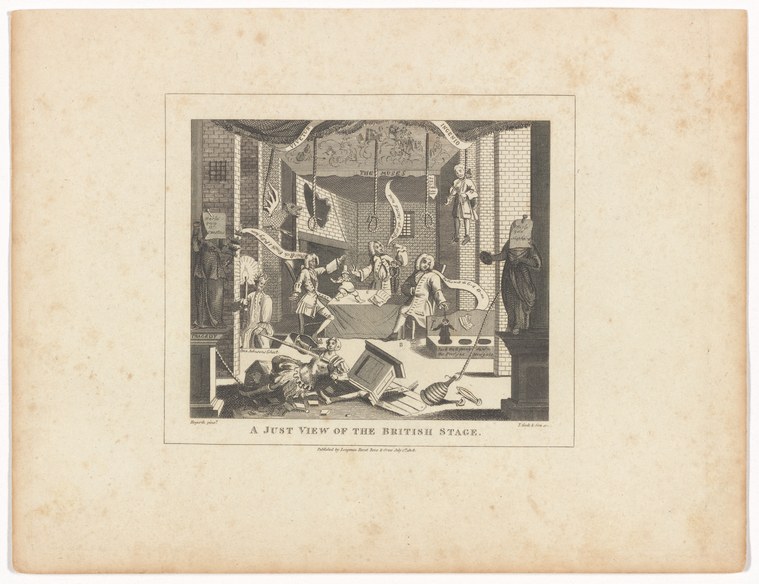
This print documents how formal dance was understood in 18th-century Britain—as a site of social aspiration and artificial refinement worthy of satire. Hogarth's detailed observation of both the dancers and the chaos surrounding them captures the actual labor and confusion behind theatrical performance, challenging any romanticized view of the stage. For historians of dance, the image reveals period attitudes toward performance, formality, and the body, while the technical sophistication of the engraving itself exemplifies how satirical prints functioned as social critique.
What you are looking at
This is a satirical engraving depicting the backstage chaos of a British theatrical production, likely 18th century. The composition is crowded and deliberately chaotic: stagehands, performers in various states of costume and undress, and theatrical properties tumble across a compressed interior space. In the center, dancers in elaborate dress perform on a raised stage visible through an architectural frame, while around them the machinery of theatre—ladders, set pieces, rigging ropes—creates a visual pandemonium. The foreground is filled with fallen props, scattered costumes, and figures in energetic, ungainly postures. The scene satirizes both the pretension of theatrical performance and the absurd labor required to sustain it. High dramatic contrast between the orderly, formal dancers onstage and the slapstick disorder of those working to enable the performance.
The dancing
The onstage dancers are posed in upright, formal attitudes typical of theatrical convention—controlled posture, arms positioned for display, bodies arranged in tableau. The dancers visible center-stage appear to be in a stately court configuration, suggesting formal ballroom or court dance. In sharp contrast, the surrounding figures adopt exaggerated, contorted poses: figures bend backward, struggle with equipment, collapse under burdens, tumble over obstacles. The gestural vocabulary shifts dramatically between the dignified formality required onstage and the grotesque physicality demanded of those working offstage, creating visual comedy through bodily contrast.
The dance depicted
The onstage dancers appear to be engaged in a formal court or ballroom dance, possibly a minuet or quadrille given the period dress and formal configurations visible. However, this is a satire of theatrical dance rather than a genuine record of dance practice—Hogarth uses the dance as a symbol of artificial refinement and pretense. The image suggests that this formal, ordered dance is only possible because of the invisible chaos and labor surrounding it. The composition itself mocks the gap between the idealized performance and the messy reality of its production.
How it was made
This is an engraving, created using the fine-line technique characteristic of Hogarth's satirical prints. The dense cross-hatching and intricate detail allow Hogarth to pack enormous amounts of narrative information into a single composition—every corner contains satirical incident and visual jokes. The print medium enabled wide circulation and reproduction, making such satirical commentary available to a broad urban audience. The technical precision of engraving contrasts with the chaotic subject matter, which is itself part of the satire.
About this work
This is a satirical engraving satirizing the theatrical world of 18th-century Britain, using dance as a symbol of artificial social order. Hogarth places formal, dignified dancers onstage within a frame of visual chaos—the offstage machinery, laboring bodies, and collapsed props that make theatrical illusion possible. The image belongs in a gallery of dance in art because it documents both the dance itself and the cultural meaning attached to it: the tension between performance as refined spectacle and the ungainly human effort required to produce it. Hogarth's satirical approach suggests skepticism about claims of theatrical or social refinement.
The work is historically significant as a record of 18th-century theatrical practice and Hogarth's role as a visual satirist and social commentator. His attention to the bodies onstage and the behaviors surrounding them demonstrates how dance was understood as a marker of social pretension and artificiality during this period.
How to look at it
Attend first to the contrast between the orderly onstage dancers and the tumultuous activity surrounding them—this visual opposition is the satire's core. Notice the careful detail of the dancers' dress, posture, and spatial arrangement, which marks them as formal and controlled. Then trace outward to the surrounding chaos: the energetic, ungainly bodies; the scattered props; the machinery of theatrical production. Hogarth captures the moment of performance, but frames it to expose all the effort and disorder it conceals. The composition deliberately packs in as much satirical incident as possible, rewarding close looking.
The artist
William Hogarth (1697–1764) was an English painter, printmaker, and social satirist whose work combined keen observation of human behavior with moral and political commentary. He is celebrated for sequential narrative paintings that were then engraved and published as prints, which circulated widely among the London public. His prints often depicted scenes of everyday and theatrical life, using visual wit and accumulated detail to critique social pretension, vice, and folly. Hogarth's approach—combining artistic skill with accessible satire—made him one of the most influential visual commentators of his era.
The period
This image dates to the 18th century, a period when theatrical dance in Britain was dominated by continental European forms—minuets, gavotts, and other court dances performed in elaborate costume. Dance was a marker of gentility and social status; even theatrical professionals aspired to the refined, controlled movement associated with aristocratic practice. Simultaneously, this was the era when London's theatrical world was expanding and professionalizing, with permanent theaters, companies of actors and dancers, and growing middle-class audiences. Hogarth's satire responds to this moment: theater was becoming a subject of public fascination and also of social anxiety about artifice and pretense.
Where it lives
This print is held by the New York Public Library in a collection of prints depicting dance. The work is identified as a Hogarth print, though the specific title, date, and edition details are not provided in the catalogue record consulted here.
Dance in this work
Questions about this work
Is this a record of what theater dances actually looked like in the 18th century?
Yes and no. The onstage dancers are depicted with reasonable accuracy—their posture, dress, and spatial arrangement reflect genuine 18th-century practice. But Hogarth's primary purpose is satire, not documentation. He exaggerates and distorts the surrounding figures to make a moral point about artifice and pretense. Use the image as evidence of dance practice, but remember that the composition is organized to make a joke.
What dance are the onstage figures performing?
The exact dance is difficult to identify from the image alone, but the formal dress, upright posture, and measured spatial arrangement suggest a court dance such as a minuet or quadrille. The dancers are arranged in a configuration typical of formal ballroom practice rather than theatrical spectacle dance. The satire lies partly in the contrast between this refined, orderly dance and the chaos surrounding it.
Why did Hogarth make prints instead of paintings?
Prints allowed Hogarth to reach a much wider audience than paintings could. Engravings were relatively cheap, could be mass-produced, and circulated among London's growing middle class. This made them ideal for social satire and commentary. Hogarth's prints became instruments of public discourse, shaping how people thought about society and morality.
What is the satirical message here?
Hogarth suggests that refined, orderly, formal behavior (represented by the dance) depends on messy, chaotic, undignified labor (represented by the offstage activity). He mocks both theatrical pretension and the gap between public performance and private reality. The image implies skepticism about claims of refinement and elegance.
More dance artwork





