48 works in this view — arrow keys or swipe to move between them.
Dance in Art
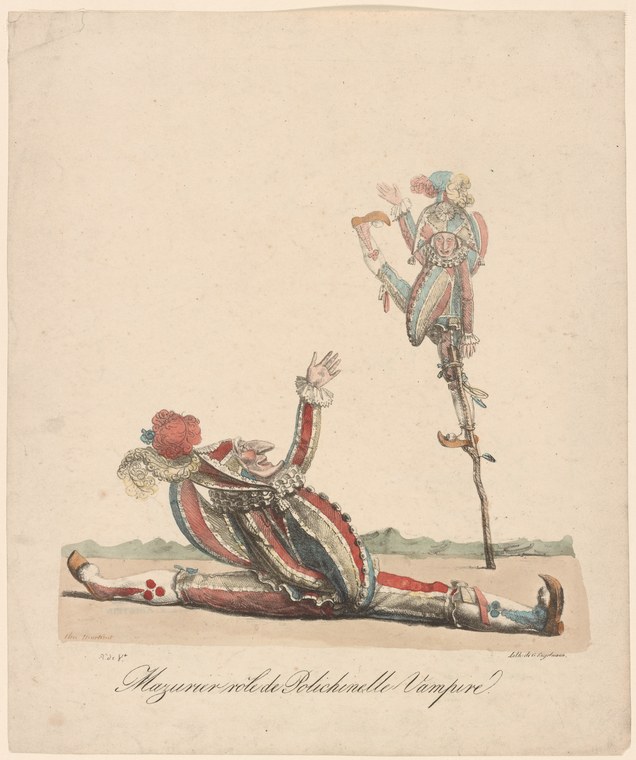
Mazurier rôle de Polichinelle vampire
Unknown artist
- Collection:
- Prints depicting dance
- Source:
- New York Public Library
- Rights:
- Public domain — free to use, share and adapt.
- Recorded as:
- Public Domain
This work documents a crucial but often-overlooked chapter in theatrical dance history: the acrobatic, pantomimic, and spectacular performances that existed alongside and sometimes influenced ballet. The virtuosity on display—the extreme contortions and the control required to execute them—reveals that early 19th-century audiences valued not only the ethereal and refined but also the grotesque, the powerful, and the darkly comic. The work also preserves a record of a specific performer (Mazurier) and a specific theatrical moment that shaped taste and technique in its era.
What you are looking at
A theatrical scene in two registers shows a figure in elaborate commedia dell'arte costume in a dramatic moment of transformation or supernatural encounter. In the lower register, a prone figure in rich red and gold brocaded costume lies sprawled on the ground, one leg extended upward in an exaggerated pose, the body twisted and contorted. The figure wears a plumed headdress and ornate mask. In the upper register, a skeletal or demonic vampire figure floats or hovers above, rendered in pale blue and earth tones, one arm raised in an arresting gesture. The background is minimal—a distant horizon line suggesting an outdoor or liminal space. The composition captures a moment of supernatural encounter, with the lower figure's extreme bodily distortion suggesting either violent movement, magical compulsion, or death itself. The hand-colored engraving technique allows rich detail in the fabrics and an atmospheric quality to the supernatural elements.
The dancing
The prone figure below displays an extreme contortion: the torso twisted, legs splayed with one rising sharply, arms extended, the entire body arranged in an anatomically improbable position suggestive of either acrobatic virtuosity or violent supernatural subjugation. The vampire figure above is rendered weightless and ethereal, hovering rather than standing, its gesture imperative and controlling. The two figures establish a clear power dynamic: the lower body dominated, the upper body commanding. The movement is grotesque and theatrical, not naturalistic—it reads as performance rather than genuine distress.
The dance depicted
This is a theatrical representation of a commedia dell'arte scene, most likely from a specific pantomime or acrobatic spectacle involving the character Polichinelle (Pulcinella) and a supernatural vampire element. The lower figure's extreme contortions suggest this is not ballet proper but rather a fusion of acrobatic dance, physical comedy, and macabre spectacle—genres that were popular in early 19th-century European theatre, particularly in Paris. The title references Mazurier, a noted performer known for dance-acrobatics and pantomime roles. The vampire plot device and the surreal bodily distortions situate this in the Gothic and fantastic entertainments of the period. The movement vocabulary belongs neither to classical ballet nor to everyday dance, but to the spectacular physicality of circus-influenced stage performance.
How it was made
This is a hand-colored engraving or aquatint, identifiable by the fine linear detail, the precise plate lines, and the selective application of watercolor or gouache over a printed base. The technique allowed wide circulation—such prints were affordable and portable, designed to publicize theatrical productions and capture spectacular moments for audiences who had not seen the performance. The coloring is restrained but evocative: the rich reds and golds of the lower figure's costume create visual weight and earthiness, while the pale blue and ghostly rendering of the vampire emphasize its supernatural nature. The precision of the engraved line contrasts with the softer washes of color, a common strategy in theatrical prints of this era to balance legibility with atmosphere.
About this work
This is a theatrical print documenting an early 19th-century Parisian stage spectacle: a commedia dell'arte pantomime or acrobatic entertainment featuring the Polichinelle character in an encounter with supernatural forces. The work belongs to the tradition of theatrical publicity prints that captured sensational or innovative performance moments. It documents a fusion of acrobatic dance, pantomime, and Gothic spectacle that was popular in the 1820s–1830s, a period when the boundaries between ballet, circus, and dramatic theatre were highly permeable. The extreme bodily distortion and supernatural framing situate this outside classical ballet and within a broader landscape of popular theatrical performance—a lineage that would influence modern experimental and contemporary dance through its emphasis on the body's capacity for grotesquerie, contortion, and narrative expressivity beyond the balletic norm.
How to look at it
Attend first to the lower figure's impossible bodily contortion: the artist has chosen a moment of maximum distortion, not repose. This is not the balletic suspended weightlessness of Romantic ballet, but rather a display of corporeal plasticity and control—closer to acrobatics or modern contortionist performance. The supernatural vampire hovering above creates a narrative framing: we are watching not a dancer, but a figure under magical compulsion. Notice how the engraver has rendered the two figures in different visual registers and different degrees of finish: the lower figure is richly colored and detailed, while the vampire is ghostly and sketchy, a visual language that was conventional for distinguishing the supernatural from the corporeal. The moment is one of crisis or transformation, not of grace or harmony.
The artist
The artist is not recorded in the catalogue, but the signature visible on the print (lower left) may provide identification. The work is part of a substantial tradition of theatrical prints produced in Paris, often engraved by specialists in this genre and published by theatrical print houses. Such prints were often created from sketches or descriptions provided by theatre artists and circulated rapidly to capitalize on popular productions. The quality of execution suggests a professional shop attuned to the demands of theatrical publicity and the visual tastes of an urban, entertainment-hungry audience.
The period
This work dates to a period—likely early 1820s–1830s—when Parisian theatre was experiencing a boom in spectacular and macabre entertainments. The rise of Romanticism brought Gothic and supernatural themes into popular theatre, while the emergence of acrobatic performers and circus arts created new hybrid forms that borrowed techniques and aesthetics from both high theatre and street performance. Ballet itself was evolving: the Romantic ballet (epitomized by works like *La Sylphide* in 1832) was establishing itself as the dominant form of theatrical dance, yet acrobatic pantomime and dance-theater remained robust popular attractions. This print captures a moment when the boundaries of theatrical dance were contested and fluid.
Where it lives
This work is held in the New York Public Library's collection of prints depicting dance. It is a theatrical publicity print, the kind that would have been sold at or near the theatre where the performance took place, circulating among playgoers and collectors of theatrical ephemera. Such prints were typically produced in small to medium runs and distributed commercially.
Dance in this work
Questions about this work
Who was Mazurier?
The catalogue identifies this print as depicting Mazurier in the role of Polichinelle Vampire. While biographical details are limited, Mazurier was a noted acrobatic dancer and pantomime performer active in Parisian theatres in the early 19th century. He was known for dance roles that emphasized physicality, spectacle, and comedic-grotesque elements rather than the refined technique of classical ballet.
What is Polichinelle, and why is there a vampire version?
Polichinelle (or Pulcinella) is a stock character from commedia dell'arte—a short, hunchbacked, witty servant with a distinctive costume and voice. In early 19th-century theatre, popular characters were frequently put into new and sensational scenarios. A 'Vampire' version would have capitalized on the era's fascination with Gothic and supernatural themes, blending the comedic tradition of the character with the melodramatic frisson of the undead.
Is this ballet?
No, this is acrobatic pantomime or dance-theatre, not ballet. While ballet was becoming the dominant form of theatrical dance in this period, acrobatic and comedic performance remained popular and prestigious. The extreme contortions, the supernatural narrative framing, and the commedia dell'arte character tradition all place this outside the classical ballet world and within a broader landscape of theatrical spectacle.
How do we know this is a print and not a painting?
The fine parallel lines visible throughout the image, the even tonal areas, and the signature style are characteristic of engraving or aquatint. The hand coloring is secondary—watercolor or gouache applied over a printed plate. This technique was standard for theatrical prints in the early 19th century, allowing multiple copies to be produced and sold.
More dance artwork





