49 works in this view — arrow keys or swipe to move between them.
Dance in Art
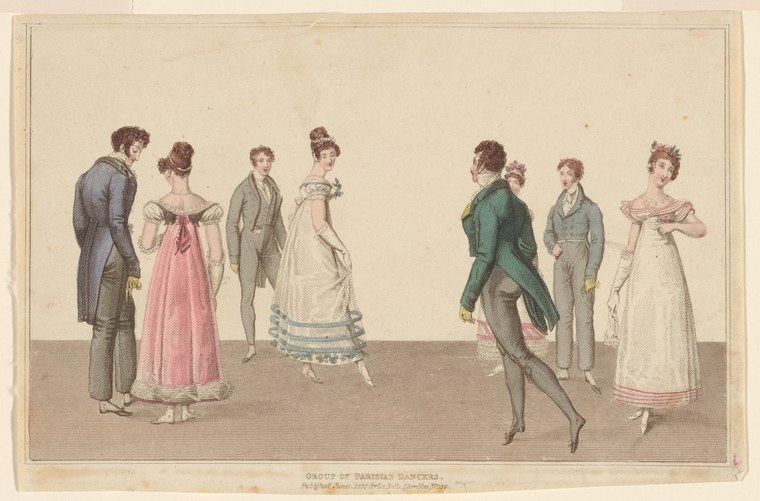
Group of Parisian dancers
Unknown artist
- Collection:
- Prints depicting dance
- Source:
- New York Public Library
- Rights:
- Public domain — free to use, share and adapt.
- Recorded as:
- Public Domain
This engraving is a rare visual document of Regency-era ballroom practice at the moment when the Quadrille and Cotillion were reshaping European social dance. It demonstrates that early 19th-century social dancing was understood and valued as a matter of presentation and refined bearing—not the footwork or formations we might expect from a text-based description. For historians of dance and dress, it provides concrete evidence of how the human body was arranged and displayed in fashionable society.
What you are looking at
This hand-colored engraving depicts a fashionable social gathering of seven figures arranged in two groups across a plain interior space. The composition captures a moment of leisure and courtship among the Parisian elite. On the left, a gentleman in a dark blue coat bends slightly toward a woman in a pink gown; beside them stands a man in olive-green and a woman in a high-waisted white dress with blue hem decoration, the latter gesturing gracefully with one arm extended. On the right, another gentleman in green engages with two women, one in pale blue-green and one in white with pink accents. The figures display the refined posture and elegant clothing of early 19th-century society. The scene is lit evenly across a neutral ground with subtle shadow, emphasizing the delicate details of the costumes—high waistlines, long skirts, and careful attention to the drape of muslin and silk. The sparse setting and plain background focus attention entirely on the figures and their interaction.
The dancing
The bodies are held in the upright, elongated posture typical of Regency-era elegance. The women display the characteristic high waistline and extended arm positions of the period's fashionable carriage. The nearest couple on the left shows a man leaning toward a woman in pink with a formal, attentive stance; the woman in white on the left gestures with her arm extended, suggesting a moment of speech or animation. The figures maintain considerable spatial distance from one another, consistent with the etiquette of public social dance. Weight appears lightly balanced on both feet, with no suggestion of rapid footwork or traveling across the floor. The overall impression is of restrained, mannered movement within the conventions of ballroom decorum.
The dance depicted
This is almost certainly a depiction of a Regency-era social gathering centered on one or more of the formal dances of the period—most likely a Quadrille, Cotillion, or Country Dance. The title's reference to 'Parisian dancers' and the fashionable dress date the work to the early 1800s, when such group dances were the centerpiece of ballroom entertainment. The spatial arrangement and the numbers of figures (seven people, likely representing multiple couples) are consistent with the formation-based group dances popular in Paris and London during this era. The refined posture and arm positions suggest trained deportment rather than folk or theatrical movement. However, the static nature of the engraving makes it impossible to determine the specific figure being executed or the footwork involved; we see attitude and setting rather than action.
How it was made
This is a hand-colored engraving, recognizable by the fine parallel lines and careful cross-hatching that define form and shadow, overlaid with watercolor or gouache tints applied by hand. The technique allowed for mass reproduction of the outline while permitting variation in the coloring of individual impressions, making it an ideal medium for publishing fashionable social scenes to a middle and upper-class audience. The delicate line work and subtle modeling of the figures suggest a skilled reproductive engraver, possibly after a drawing or painting. Hand-coloring indicates this was either a luxury edition or a later hand-finished impression; the care lavished on the details of dress and complexion suggests it was intended as a document of fashionable taste for collectors or as a record of social etiquette.
About this work
This engraving captures the refined world of Parisian ballroom society in the early 19th century, a period when formal group dances governed social interaction among the elite. The work documents not a moment of vigorous dancing but the decorous spacing, dress, and bearing expected in fashionable circles. It belongs in a dance gallery because it preserves visual evidence of how ballroom movement was understood and presented—as a matter of elegant posture, careful distance, and controlled gesture rather than athletic virtuosity. The image survives as a record of an entire system of social choreography that has otherwise left no trace except in dancing masters' manuals and the novels of the period.
How to look at it
Attend to the precise positioning of the figures and the careful attention to the angles of arms and the tilt of heads—these details record how the body was held and presented in ballroom society. Note the evident space between the figures and the restraint of gesture; a viewer accustomed to 20th-century dance photographs may find this image static, but the Regency observer would have read it as an epitome of refined movement. The engraver has chosen a moment of pause or conversation rather than active footwork, which tells us that for this society, the grace of standing and the elegance of social address mattered as much as any step.
The period
This engraving dates to the Regency era (circa 1811–1820) or the early post-Napoleonic period, a time of intense cultural exchange between Paris and London. The Quadrille had recently arrived in Paris from Saint-Domingue and Russia, and it was rapidly displacing the Cotillion as the dominant group dance of fashionable society. Engravings of social scenes were a thriving commercial genre, printed in series for parlor collections and as illustrations in periodicals. Parisian fashions were the model for all of Europe, and prints documenting them served as cultural ambassadors. This work fits within a large body of fashion and social satire engraving, though it lacks the caricatural edge of contemporary artists like Cruikshank or Rowlandson, suggesting it was intended as a straightforward document of elegance rather than social comment.
Where it lives
The work is held in the New York Public Library's collection of prints depicting dance. It is catalogued as 'Group of Parisian dancers' with no recorded artist, date, or medium specifications in the holding collection's records.
Dance in this work
Questions about this work
What dance are these people doing?
The engraving does not depict active dancing so much as the moment before, after, or between dances—a social gathering in a ballroom. The figures and setting are consistent with Regency-era Quadrilles, Cotillions, or Country Dances, all of which were popular in Paris in the early 1800s. The print documents the decorum and dress of ballroom society rather than the specific steps of any dance.
How do I know this is from the early 1800s?
The women's dresses show the high waistline (under the bust) and long skirt characteristic of Regency and Empire fashion, roughly 1810–1820. The men's coats and the overall styling match fashion plates and portraits from this period. The title refers to 'Parisian dancers,' and Paris was the fashion capital and the center of the ballroom dance world at this time.
Is this a famous work?
The work is not attributed to a named artist in the NYPL's records, so it may be the work of a commercial or reproductive engraver rather than a celebrated master. It represents a common genre—the fashionable social scene engraving—that was widely produced and circulated but rarely preserved with full documentation.
Why do the figures look so still?
Engravings of ballroom scenes typically froze the moment of greatest elegance and refinement rather than the moment of greatest motion. The Regency ideal was restrained grace, not athletic display. An engraver depicting a Quadrille would show the figures in their most poised attitude, not mid-leap or mid-spin.
More dance artwork





