49 works in this view — arrow keys or swipe to move between them.
Dance in Art
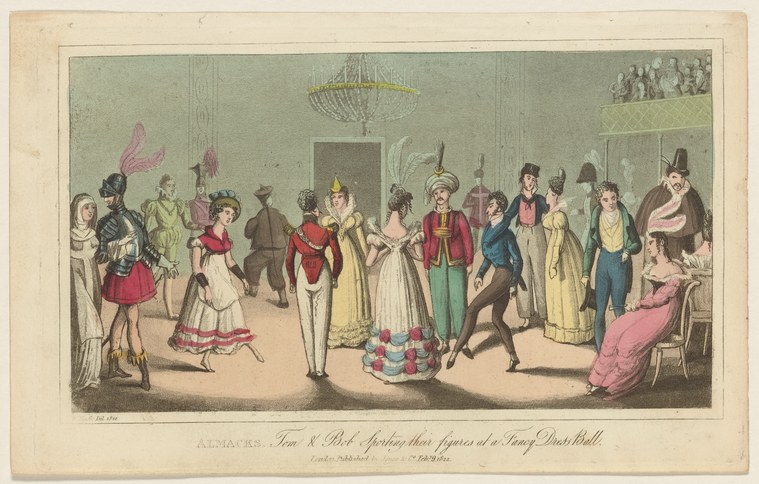
Almacks.: Tom & Bob sporting their figures at a fancy dress ball
Unknown artist
- Collection:
- Prints depicting dance
- Source:
- New York Public Library
- Rights:
- Public domain — free to use, share and adapt.
- Recorded as:
- Public Domain
For historians of Regency dance, this print documents the permissive and performative dimension of masked balls—moments when rigid ballroom etiquette was suspended in favor of comic display and physical exuberance. The precision of the costume and figure detail reveals what Georgian and Regency dancers actually wore and how they moved when encouraged to be theatrical rather than restrained.
What you are looking at
A masquerade ball in full swing, depicted in a crowded interior lit by a chandelier. The composition centers on two elaborately costumed male figures—"Tom" and "Bob"—striking exaggerated poses in the center of the floor. Tom wears a red military-style coat with elaborate trim; Bob is dressed in white with a tall feathered headdress and an outlandish costume. Around them, roughly twenty elegantly dressed guests—men in dark coats and tails, women in high-waisted Regency gowns—form a loose semicircle as spectators. Some couples appear to be dancing or standing in conversation; others watch the performance from the periphery. At upper right, additional figures are visible in what appears to be a gallery or mezzanine level. The color palette is muted—greens and creams dominating—with touches of pink, red, and gold in the costumes. The figures occupy the full height of the composition, creating a sense of crowded conviviality.
The dancing
Tom and Bob dominate the center through pose and costume rather than through ballroom position. Their bodies are angled toward each other in attitudes of theatrical display—legs extended, arms lifted in exaggerated gesture—rather than in the closed or open holds of standard ballroom dance. Both figures adopt what appears to be a caricatured "showing off" stance, with weight distributed for visual effect rather than for executing a specific dance step. The surrounding figures maintain proper Regency posture—upright, composed—but several lack the close partnering of active dancers. The contrast between the central performers' theatricality and the observers' restraint is the formal organizing principle of the scene.
The dance depicted
This is a fancy dress ball—a masquerade entertainment of the Regency period—rather than a depiction of a specific structured dance. Tom and Bob are performing an extemporaneous display or "sport," as the title states, for the amusement of the assembled company. The title's verb "sporting their figures" suggests competitive or comedic physical showing-off rather than the execution of a recognized dance form. Some guests in the background may be executing country dances or quadrilles (evident from the spacing and positioning of several couples), but the focal point is the vaudeville-like performance of the two costumed men. The work documents a moment of social dance as entertainment and spectacle rather than as choreographed form.
How it was made
This is a hand-colored engraving or aquatint, characteristic of early 19th-century satirical and social commentary prints. The technique allowed for fine linear detail in the costumes and architectural setting, combined with tinted washes applied by hand or printing block to suggest color and atmosphere. The legible inscription at the foot—"Almacks: Tom & Bob sporting their figures at a fancy dress ball"—is typical of commercial prints intended for collectors and the fashionable public. The composition and coloring suggest production by or in the manner of a London print shop, likely Ackermann or a competitor, circulating among readers of satirical journals and social observers of Regency life.
About this work
This is a satirical or documentary print of Regency-era social life, centered on the moment when two elaborately costumed guests commandeer the dance floor at Almack's—London's most exclusive assembly rooms—for an exaggerated performance. The work captures not a formal dance but a disruption of ballroom decorum: the "sporting" or showing-off that masked balls permitted and encouraged. It is as much about costume, status, and social comedy as about dance itself, but it preserves precise visual evidence of how Regency bodies moved, posed, and used fancy dress in the context of the ballroom. The inclusion of attentive spectators frames the event as entertainment for the assembled company, not merely social participation.
How to look at it
Look first at the contrast between center and periphery: Tom and Bob's theatrical, almost acrobatic poses versus the composed, upright figures around them. Notice the precision of the costumes—the red coat with its specific trim, the feathered headdress—which suggests the artist had firsthand knowledge of Regency dress. Observe how the crowd is arranged as witnesses rather than active dancers, framing the scene as a moment of performance and disruption rather than orderly social dance. The chandelier overhead and the legible architecture anchor the scene in a real place (Almack's assembly rooms), lending credibility to what is essentially a recorded moment of social theatre.
The period
This work dates to the height of the Regency era (c. 1811–1820), when London assembly rooms like Almack's set the standard for fashionable society. Masked balls and fancy dress entertainments were seasonal attractions, offering escape from strict propriety. The rise of satirical and social prints during this period—particularly hand-colored engravings and aquatints—reflected growing middle-class interest in observing and commenting on the lives of the ton. Dance in this era was rigidly codified in formal settings (country dances, cotillions, quadrilles) but permitted licensed excess in costume and masquerade contexts.
Where it lives
This work is held in the New York Public Library's collection of prints depicting dance, suggesting it was valued as a social and dance historical document from its time of issue onward. It is a commercial print, likely issued in multiple hand-colored impressions and sold to collectors of contemporary social satire.
Dance in this work
Questions about this work
What is Almack's?
Almack's Assembly Rooms on King Street, St. James's, was London's most exclusive and fashionable assembly venue during the Regency era. Admission was controlled by a committee of patronesses, and the rooms hosted subscription dances, masquerades, and social events for the aristocracy and gentry. A voucher to Almack's was a marker of social status.
What is a fancy dress ball?
A masked or costume ball where attendees wore elaborate disguises and fantastical costumes. Unlike formal subscription dances, fancy dress balls licensed theatrical and comedic behavior. They were seasonal attractions at assembly rooms and private venues, offering temporary escape from rigid ballroom decorum.
Are Tom and Bob really dancing?
Not in the formal sense. The title says they are "sporting their figures"—performing exaggerated, comic displays for the amusement of other guests. They are showing off in costume rather than executing a recognized dance form. This kind of theatrical interruption or display was part of the entertainment at fancy dress events.
What dances would have been performed at Almack's?
Formal country dances, cotillions, and quadrilles in the regular subscription dances; on masked ball nights, these continued but were interspersed with moments of comic performance and display. The print shows evidence of both—structured couples in the background, chaotic theatrical performance at the center.
More dance artwork





