49 works in this view — arrow keys or swipe to move between them.
Dance in Art
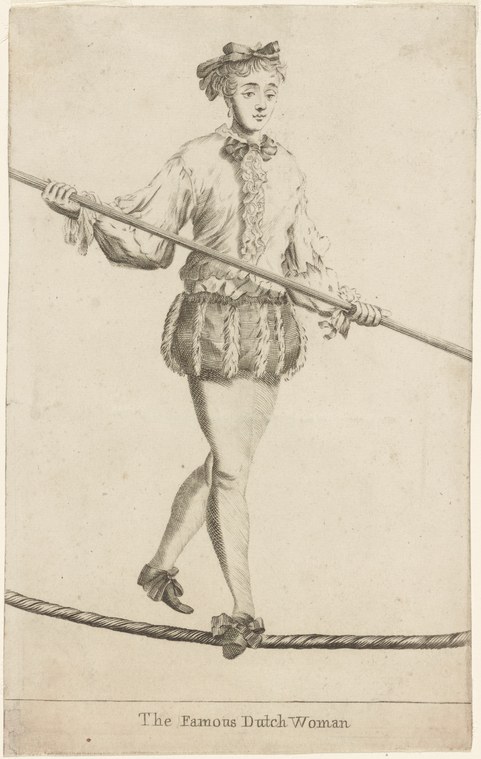
The famous Dutch woman
Unknown artist
- Collection:
- Prints depicting dance
- Source:
- New York Public Library
- Rights:
- Public domain — free to use, share and adapt.
- Recorded as:
- Public Domain
Rope dancing was a major form of public entertainment and a rare vehicle for women to achieve professional recognition and financial independence as performers. This image documents the skill and the costume of such performances, and the fact that the dancer's name (or at least her nationality) was considered worth recording suggests she was celebrated enough to merit circulation as a printed image.
What you are looking at
A single female figure stands balanced on a taut rope, posed in profile facing left. She wears a fitted jacket with ornamental fringe or tassels at the hem, a decorative bow at the neck, and her hair is styled up with a bow. Her legs are bare and she wears heeled shoes. She holds a long pole horizontally across her body, gripping it with both hands at roughly shoulder height. The composition is spare: the figure dominates the frame against a plain cream background, with only a second rope line visible at the bottom of the frame to anchor the scene. The print is rendered in fine black line work, characteristic of 18th-century engraving technique, with careful attention to the fall of fabric and the musculature of the exposed legs. The title at the base reads "The Famous Dutch Woman" in period typography.
The dancing
The dancer stands in a vertical line with her weight distributed evenly across the rope—a posture requiring substantial core control and balance. Her arms are extended horizontally, slightly flexed, holding the pole steady as a counterweight. Her body is upright but not rigid; there is a sense of active engagement rather than passive standing. The positioning suggests a moment of poise rather than active motion—the dancer is not mid-stride but settled into stillness, which is the essential skill being demonstrated.
The dance depicted
This is a tightrope or rope-dancing performance, a popular form of acrobatic entertainment in 17th and 18th-century fairs and theatres. The pole serves as a balance aid, a standard tool for rope dancers. The figure is identified as a Dutch woman, suggesting this commemorates a specific celebrated performer. Rope dancing was a trained professional skill, often performed by women in public venues, and required exceptional proprioception and strength. The costume—fashionable and decorative rather than functional—signals that this was staged entertainment, not practical labour.
How it was made
This is an engraving, identifiable from the fine parallel line work (hatching and cross-hatching) used to model form and suggest texture, the crisp black lines against cream paper, and the overall aesthetic of 18th-century print production. Engravings were labour-intensive to produce but relatively inexpensive to print and distribute, making them a primary medium for documenting and promoting celebrated performers and spectacular acts. The care given to anatomical detail and costume suggests this was made to circulate among an educated public interested in curiosities and theatrical novelties.
About this work
This engraving documents a celebrated rope dancer, identified as a Dutch woman, posed at the moment of balanced stillness on the rope—the apex of control that made the feat spectacular. Rope dancing was a recognisable professional entertainment genre in the 17th and 18th centuries, drawing audiences to fairs, pleasure gardens, and theatres across Europe. The print serves both as a record of a specific performer and as a representation of acrobatic skill and the (often female) bodies that performed such feats for public astonishment. It belongs in a dance history because rope dancing was a codified, trained physical practice that blurred the line between dance, acrobatics, and theatre.
How to look at it
Look first at the posture: the dancer's body is vertical, neither tilted nor in motion, and the pole is held level—this is the point of maximum control, the moment that proves the feat. Notice the bare legs and the heeled shoes: this is fashionable dress, not athletic wear, which is precisely what made the performance more astonishing. The engraver has taken care to show the musculature of the legs and the detailed construction of the costume, treating the performer as worthy of the same visual attention as a portrait.
The period
Rope dancing flourished in Europe from the 16th through 18th centuries as part of a wider culture of spectacular public entertainment. It appeared at fairs, in pleasure gardens, and increasingly in purpose-built theatres. The 18th century saw an expansion in the documentation of such performers through engravings and other prints, reflecting both the commercial value of publicity and a broader curiosity about human physical achievement. The costume and style of this print place it in the 18th century, when such entertainment was at its height.
Where it lives
This work is held in the New York Public Library's collection of prints depicting dance. It is catalogued with minimal metadata—artist unknown, date unknown, medium unrecorded in the original record—which is not uncommon for prints from this period, particularly those documenting popular entertainment.
Dance in this work
Questions about this work
Who was the famous Dutch woman?
The record does not identify her by name. She is known only by her nationality and her fame as a rope dancer, which was typical for printed entertainment publicity of the period. Many celebrated rope dancers of the era are now known only through such anonymous or partially identified images.
How did rope dancers balance without falling?
Balance was achieved through extreme proprioceptive training and physical conditioning. The pole, held horizontally as shown here, provided a counterweight and visual reference for balance adjustment. Rope dancers typically trained from childhood and often came from families of performers, passing the skill down through generations.
Was rope dancing dangerous?
Yes. Falls were common, and many rope dancers were injured or killed in performance. The danger was part of the spectacle—audiences paid to watch a feat they understood to be genuinely risky, which added to the thrill.
Why did so many rope dancers appear to be women?
Women dominated the profession, possibly because they were perceived as more graceful, lighter in weight, or more visually appealing to audiences, and because entertainment was one of few professions open to women. Many earned substantial sums and achieved celebrity status.
More dance artwork





