49 works in this view — arrow keys or swipe to move between them.
Dance in Art
The Royal Italian Opera before & behind the curtain. Selections
Unknown artist
- Collection:
- Prints depicting dance
- Source:
- New York Public Library
- Rights:
- Public domain — free to use, share and adapt.
- Recorded as:
- Public Domain
For a historian of dance, this image is invaluable as a record of the physical costume, body types, and working conditions of professional ballet dancers in the mid-19th century—information that performance itself does not preserve. For anyone studying theatrical culture and the social position of female performers, it documents the stark contrast between the romanticized stage and the crowded, practical, often undignified reality of theatrical labor.
What you are looking at
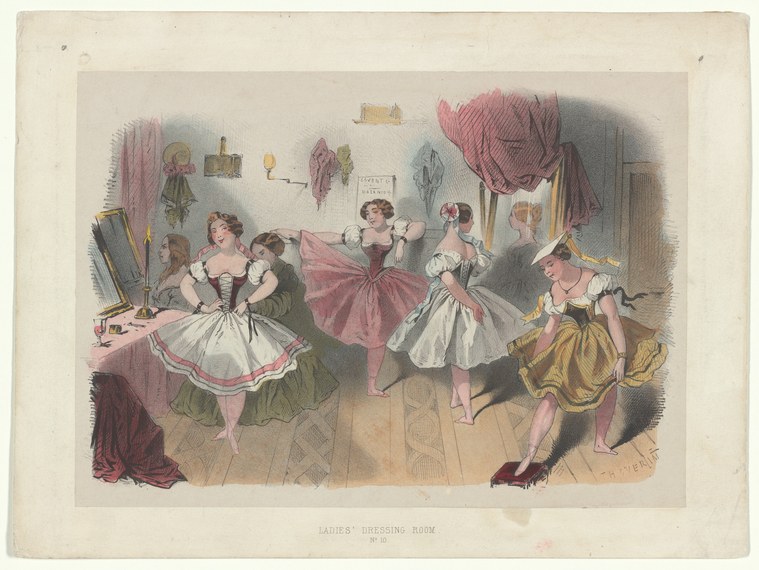
A colored engraving depicts a backstage dressing room at the Royal Italian Opera, alive with activity and half-dressed performers. Six women in various states of undress occupy a shallow interior space rendered in soft grays and pinks, the walls lined with hanging costumes in deep reds and golds. In the foreground, a woman seated at a dressing table adjusts her hair while a second stands nearby; others stand or move through the crowded space, some already in ballet costume with tutus and pointe shoes, others still in street dress or undergarments. A large mirror, makeup bottles, and scattered fabrics indicate the practical work of theatrical preparation. The right side of the composition shows a woman in a golden-yellow skirt already costumed, while the left reveals rumpled street clothes discarded on a chair. The soft, diffuse light and detailed cross-hatching create an intimate, theatrical atmosphere—we are witnessing the unglamorous labor that precedes the public spectacle.
The dancing
The dancers are rendered in naturalistic poses: seated, standing, adjusting costume pieces, and moving through the tight space with the ungainly ease of people at work rather than in performance. Their bodies show no formal dance positions or holds; instead, they are caught in moments of practical dressing and grooming—one reaches to fasten a skirt, another bends forward to see into a mirror, a third stands waiting. The artist demonstrates anatomical knowledge, rendering the female form with attention to weight distribution and the varied postures of a busy, crowded room.
The dance depicted
This is not a depiction of dance itself, but of the theatrical and social world surrounding professional ballet performance in the mid-19th century. The costumes—short tutus, pointe shoes, tight bodices—identify these women as ballet dancers preparing for the Royal Italian Opera stage. The engraving is part of a larger comedic or satirical work that contrasts the elaborate spectacle audiences see with the mundane, crowded, and often unglamorous reality of the backstage world. It documents both the technical costume of the period and the actual labor of theatrical production.
How it was made
This is a hand-colored engraving, likely made from an etched or engraved plate and colored afterwards by hand or in a workshop. The precision of the line work—visible in the cross-hatching that models form and shadow—combined with the applied watercolor or gouache indicates commercial theatrical print production of the mid-19th century. Such works were widely circulated as satirical or documentary commentary on theatrical life, affordable to middle-class readers, and often bound into periodicals or sold as individual sheets. The technique allowed for sharp detail and repetition, making this type of subject matter accessible beyond the theater itself.
About this work
This engraving belongs to a tradition of backstage theatrical imagery that emerged in the 19th century, when ballet had become a fashionable public spectacle and the lives of dancers an object of bourgeois curiosity and gossip. The work sits at the intersection of two registers: the documentary record of mid-19th-century ballet costume and technique, and social commentary on the gap between theatrical illusion and backstage reality. It is not a dance scene, but a work about dancers—and about what the act of watching theater reveals and conceals. Such images were produced in quantity and circulated widely, suggesting genuine public interest in the conditions under which ballet was made.
How to look at it
Look first at the contrast between undress and costume: some women are fully prepared, others partially changed, still others in everyday clothes. Observe the density and crowding of the space—no romantic spacing, no graceful repose, just practical efficiency. Notice the artist's attention to the details of ballet costume: the shortness of the tutus, the pointe shoes, the tight bodices, which are historically accurate to mid-19th-century stage wear. The soft lighting and muted palette, despite the hand-coloring, creates an atmosphere of intimate access—you are seeing something you are not meant to see, which is the point of the satire.
The period
This engraving was produced during the height of Romantic ballet in Europe, when the image of the ethereal, otherworldly ballerina had become a cultural obsession. The 1840s–1860s saw ballet become a major form of commercial entertainment, with imported Italian and French companies touring European cities and establishing resident companies at major opera houses. The same period saw the emergence of theatrical caricature and satire as popular forms, with artists using humor and exaggeration to comment on fashionable society and its contradictions. Backstage scenes became a favorite subject of such commentary, revealing the labor and commerce that underlaid the fantasy of high art.
Where it lives
The work is held in the New York Public Library as part of a collection of prints depicting dance. It is one of a series titled 'The Royal Italian Opera before & behind the curtain,' which suggests it was originally issued as a multi-part satirical or documentary suite about theatrical life in a specific company or city.
Dance in this work
Questions about this work
Is this a ballet scene?
No. It depicts a dressing room, not a stage performance. The dancers are not dancing; they are preparing for a ballet that will happen elsewhere. However, it documents the costume, technique, and professional conditions of mid-19th-century ballet, making it valuable evidence for understanding how ballet was actually made and performed.
Why are the women partially undressed?
The image is a backstage scene, and the women are changing into and out of costume. The semi-undress is essential to the satire: it reveals the unglamorous, practical reality behind the ethereal illusions presented to the public. The contrast is intentional social commentary.
What company or theater is this from?
The title indicates the Royal Italian Opera, but the specific venue and date are not established in the catalogue record. The style and costume suggest mid-19th-century European production, but further research would be needed to identify the exact company and the date of the work.
What technique was used to make this?
It is a hand-colored engraving: a design was first incised or etched into a metal plate and printed, then the impression was colored by hand. This was a common and affordable method for producing satirical and documentary prints in the 19th century, allowing wide distribution to middle-class audiences.
More dance artwork





