49 works in this view — arrow keys or swipe to move between them.
Dance in Art
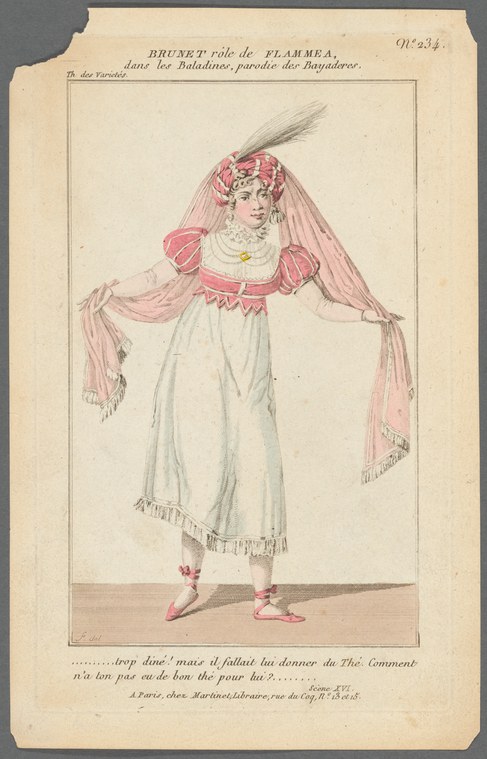
234. Brunet, role de Flammea, dans Les baladines, parodie des Bayadères, Th[éâtre] des Variétés
Unknown artist
- Collection:
- Prints depicting dance
- Source:
- New York Public Library
- Rights:
- Public domain — free to use, share and adapt.
- Recorded as:
- Public Domain
This image shows how theatrical dance in the 19th century was mediated to the public through printed costume studies rather than through notation or photograph—the visual record that survives is a record of costume and promotion, not of movement itself. The orientalist fantasy on display here also marks the moment when European audiences began to consume 'exotic' dance as a consumable commodity, a practice that would dominate 20th-century concert and commercial dance.
What you are looking at
A young woman in elaborate early 19th-century dress stands alone against a plain ground, posed as if mid-performance. She wears a white Empire-waist gown with a deep flounced hem and a short pink bodice with puffed sleeves; a pink veil or scarf drapes from her headdress and trails at her sides nearly to the ground. Her headdress is crowned with flowers and feathers. She stands in a relaxed contrapposto, her weight on one leg, arms held at mid-height with the pink drapery gathered in her hands. The figure is rendered in watercolor and ink on paper, with careful attention to the shimmer and texture of the fabrics. The pose and costume suggest a stage character rather than a ballroom dancer—the draping and theatrical headdress belong to costume drama rather to social dance.
The dancing
A single female figure, standing upright with weight shifted to one leg in a relaxed, naturalistic stance that is nonetheless arranged for display. Her arms are raised to chest and shoulder height, the hands holding the pink drapery in graceful, controlled folds rather than in active motion. The body shows no tension or turnout; the posture is that of an actress holding a tableau rather than a dancer mid-movement. The small pink slippers visible at the hem suggest stage footwear, but the stance shows no evidence of balletic technique—no elevation, turnout, or closed positions.
The dance depicted
This image documents a costume for a character role in theatrical performance, almost certainly in a stage dance or pantomime rather than in ballroom or concert dance. The catalogue record identifies this as 'Brunet, role de Flammea' in *Les Baladines*, a parody of *Les Bayadères* (likely Delibes's 1877 ballet) at the Théâtre des Variétés in Paris. 'Bayadères' names a class of Indian temple dancers, and parodies of orientalist ballet were common in 19th-century music halls and variety theatres. The figure here is a performer in a burlesque or comedy version, costumed in a romanticized approximation of 'exotic' dress and posed for the audience's view rather than engaged in active dancing. The soft stance and theatrical framing suggest this is a costume study or prompt portrait rather than a representation of actual movement.
How it was made
This is a hand-colored engraving or etching, executed in ink with careful watercolor wash applied to the figure's dress, veil, and complexion. The technique allowed for fine linear detail in the headdress, the articulation of the gown's construction, and subtle modeling of the face and décolletage. The medium and hand-coloring indicate this was a commercial print—likely a souvenir or publicity image distributed to audiences or collected by theatre patrons. The quality of the execution and the care taken with the figure's presentation suggest it was made for a substantial audience, not a private sketch.
About this work
This is a costume portrait of a performer in a 19th-century Parisian variety-theatre production that parodied orientalist ballet. The image documents both the theatrical fashion of the era and the practice of selling illustrated costume studies to audiences as souvenirs or publicity. It belongs in a gallery of dance imagery because it captures how stage dance was consumed and remembered—not as notation of movement, but as a tableau of the performer's body in character dress. The figure's pose and costume tell us more about Parisian commercial entertainment and the period's relationship to 'exotic' fantasy than they do about actual dance technique, but they do show us how dance performance was marketed and what audiences paid to see.
The work is typical of its time and venue: a hand-colored engraving from the holdings of a major theatre collection, part of the accumulated visual record of popular performance. Such costume portraits formed a significant market in 19th-century Paris, rivaled only by caricature and society portraiture in volume and circulation.
How to look at it
The key to reading this image is recognizing that it is not a dance study but a costume portrait. The figure is posed, not captured mid-movement; the stance is theatrical and frontal, designed for viewing from the house seats. Attend to the contrast between the careful, almost doll-like posture of the body and the luxuriant, almost excessive presentation of the dress and headpiece. The lack of any suggestion of actual bodily engagement with the space—no weight shifts, no dynamic tension in the limbs—tells you that this is a figure presented for admiration of costume and visual novelty rather than for demonstration of skill or technique. The pink veil is the star here, not the body beneath it.
The artist
The artist is not recorded. The image bears a museum accession number (90434) that suggests it entered a major collection—most likely the Bibliothèque Nationale de France or a Paris theatre archive. Hand-colored engravings of this type were produced by small theatrical print shops, often in partnership with theatres, to supply audience demand for keepsakes and costume reference. Individual engravers are rarely credited on such prints; the work was industrial rather than artisanal.
The period
This image dates to the era of the Théâtre des Variétés, a major Paris venue for popular comedy, pantomime, and music-hall entertainment. The 1870s and 1880s saw an explosion of orientalist and exoticist performance across European stages—fed partly by colonial expansion, partly by the success of Delibes's *La Source* (1866) and *Coppélia* (1870), and partly by the appetite of middle-class audiences for spectacle and novelty. *Les Bayadères* as a ballet had been performed at the Opéra; the parody at the Variétés would have offered a comedic, burlesque version of the same orientalist fantasy, with emphasis on costume, satire, and the performer's body rather than on ballet technique. Printed costume studies like this one served a dual function: they were mementos for paying audiences and advertisements for the theatre, circulating the image of the performer and the appeal of the spectacle.
Where it lives
This work is held as part of a collection of hand-colored engravings documenting dance in 19th-century Parisian theatre, now at the New York Public Library. Such prints were typically sold or distributed by the theatre itself during the run of a production and later acquired by libraries and museums as primary documents of theatre history.
Dance in this work
Questions about this work
Was this a real person, or an imaginary character?
Both. Brunet was a real performer at the Théâtre des Variétés, and Flammea is the character she played in *Les Baladines*. This image documents her costume for that role. We know nothing else about her from the catalogue record, but she was famous enough that her likeness and costume were worth printing and selling.
What is a 'bayadère' and why does it matter that this is a parody?
A bayadère is a classical Indian temple dancer; the term was adopted in 19th-century European ballet to mean an exotic female dancer, usually costumed in orientalist fantasy dress. When the Théâtre des Variétés performed a parody of *Les Bayadères*, they were mocking the pretensions of high-art orientalism—the ballet world's fantasy about Asia. The parody would have emphasized comedy, spectacle, and the absurdity of the costume rather than ballet technique.
Is this actually a dancer, or an actress in costume?
The image shows a performer; whether she trained primarily as a dancer or actress, the venue (variety theatre) and the pose (static, costume-focused) suggest her role was as much visual spectacle as choreographic display. In 19th-century Parisian variety theatre, those boundaries were fluid.
More dance artwork





