49 works in this view — arrow keys or swipe to move between them.
Dance in Art
Columbine mazurkas
Unknown artist
- Collection:
- Prints depicting dance
- Source:
- New York Public Library
- Rights:
- Public domain — free to use, share and adapt.
- Recorded as:
- Public Domain
The print documents how the Mazurka—a European folk dance—was transformed into respectable middle-class entertainment and professional theatrical spectacle in the nineteenth century. For dancers and historians, it provides a dated, named record of a specific performance tradition and shows how a couple dance was visualized, marketed, and remembered during a pivotal moment in ballroom dance history.
What you are looking at
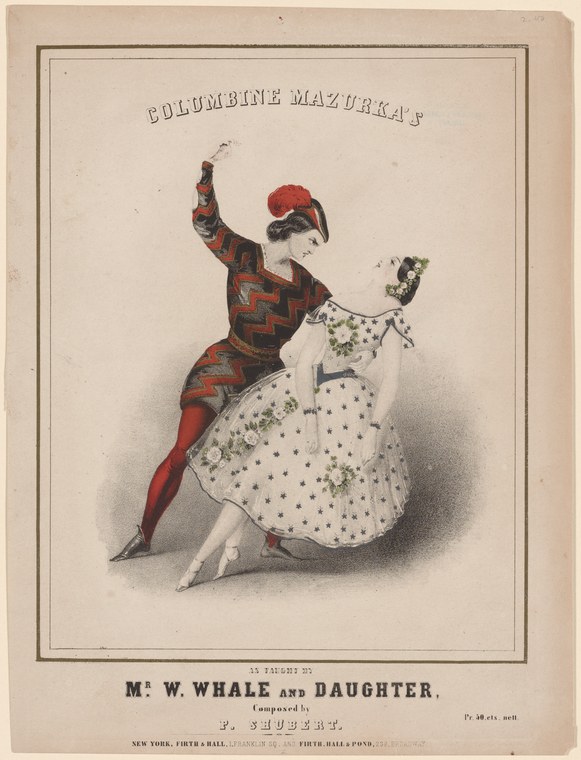
A hand-colored engraving shows two dancers in an exuberant moment of a Mazurka. The male dancer, dressed in a red and gold patterned tunic with a red cap, leans back dramatically with his left arm raised high and his body arched. The female dancer, in a white muslin dress with a small blue and green floral or ornamental pattern at the neckline and hem, is captured mid-turn with her skirt lifting to reveal her legs. Her posture is upright and animated, her head turned sharply. The composition emphasizes the vigor and social gaiety of the dance, with the woman's billowing skirt and the man's dynamic lean creating a sense of rapid movement frozen in an instant. The background is plain, allowing the figures to occupy the full visual focus.
The dancing
The male dancer's frame is open and exaggerated: his torso arches backward at the waist, his raised arm extends upward in an expansive gesture, and his legs are braced to support the lean. The female dancer stands on one leg, her body lifted and turning, her free leg suggesting motion. Their bodies do not touch; they are separated, which is characteristic of some couple dances of the period. The woman's arms are held close to her body, and her skirts are caught mid-movement, creating the visual drama of the pose. Both dancers are depicted with pointed toes, suggesting trained execution.
The dance depicted
This depicts the Mazurka, a Polish couple dance that was immensely popular in European and American ballrooms during the nineteenth century, particularly among the urban upper and middle classes. The title *Columbine Mazurkas* suggests this is a theatrical or staged version, with the male figure possibly representing a stock character (Columbine's male counterpart or partner). The mazurka's characteristic features include spirited movement, closed and open positions, and improvised flourishes—all of which this image captures. The dramatic arching and arm lift of the male dancer, combined with the woman's high-spirited turn, reflect the dance's reputation for showing off elegance and exuberance. The composition emphasizes the moment of greatest visual interest rather than a stable position.
How it was made
This is a hand-colored engraving, a reproductive print technique allowing for wide distribution. Engraving produces fine lines through incision into a metal plate, which permits the detailed rendering of costume, facial features, and the subtle modeling of light and shade visible here. The hand coloring—applied after printing—was a common way to enhance commercial prints intended for a broad audience. As a commercial music or dance publication (the inscription reads 'As danced by M^r W. Whale and Daughter'), this print served both as promotional material and as a souvenir of a popular performance, suggesting a professional theatrical or ballroom performance of note.
About this work
This is a record of the Mazurka as it was danced and celebrated in the nineteenth-century Anglo-American theater and ballroom. The print commemorates specific performers—W. Whale and his daughter—suggesting that this image documents an actual performance or at least the popularization of their interpretation of the dance. The theatrical quality of the print, the titled composition, and the emphasis on spectacle and elegance reflect the dance's status as an emblem of refined entertainment during the Gilded Age. The work belongs in a gallery of dance imagery because it captures not only the physical form of a specific historical dance but also its function as a vehicle for displaying grace, athleticism, and social status.
How to look at it
Notice the exaggeration in the male dancer's posture: his arch and raised arm are not the neutral frame of a formal dance but a dramatic flourish designed to catch the eye and display the body. The woman's turning pose, with her skirts lifted, emphasizes the spectacle of the movement. The artist chose the moment of greatest dynamic energy rather than a stable position, which was a commercial choice—the print needed to convey liveliness and entertainment value. Observe how the engraver rendered the muslin dress with fine detail to suggest the quality of the fabric and the expense of the costume, reinforcing the dance's association with elegance.
The artist
The artist is not recorded. The print is credited to music composer Valleria, and published by Firth & Hall of New York and London, major publishers of theatrical and popular music during the mid-nineteenth century. Such prints were typically engraved by skilled commercial workshop artists rather than celebrated named engravers, reflecting the industrial nature of print production for the mass market.
The period
The Mazurka reached the height of its popularity in Europe and America between the 1830s and 1880s. It was both a folk dance from Poland and a vehicle for display in European court and ballroom settings, where it was refined and theatricalized. During the mid-nineteenth century, when this print was likely produced, the Mazurka was a staple of ballroom dancing for the urban middle class and a frequent subject of theatrical performance and music publication. The dance's associations with Romantic nationalism and exotic European origins made it fashionable during an era of intense interest in folk culture and historical dance forms.
Where it lives
The print is held by the New York Public Library in a collection of prints depicting dance. It is a commercial music publication, likely issued as sheet music cover or supplementary promotional material accompanying or promoting a musical composition titled 'Columbine Mazurkas.'
Dance in this work
Questions about this work
Who were W. Whale and Daughter?
The inscription indicates these were performing dancers known for dancing the Mazurka in the nineteenth century. Beyond their name and the fact that this print commemorates their performance, little additional documentation is readily available. The print serves as a record that they were notable enough to warrant a commercial engraved souvenir.
Was the Mazurka a folk dance or a ballroom dance?
It was both. The Mazurka originated as a folk dance in Poland, but during the nineteenth century it was adopted, refined, and popularized in European and American ballrooms and theaters. This print represents the theatrical, urban version performed by professional or semi-professional dancers for middle-class audiences.
What is Columbine in the title?
Columbine is a traditional character from commedia dell'arte—a maidservant or soubrette figure. The title suggests either that this dance was performed within a theatrical context featuring this character, or that the piece was marketed using theatrical associations to enhance its appeal. It may also be a compositional title unrelated to a specific character.
How common were hand-colored engravings like this?
Very common for commercial music and theater publications during the nineteenth century. Hand coloring was labor-intensive but affordable at scale, and such prints were used to advertise performances, sell sheet music, and serve as souvenirs. They were a mass-market product intended for a broad middle-class audience.
More dance artwork





