49 works in this view — arrow keys or swipe to move between them.
Dance in Art
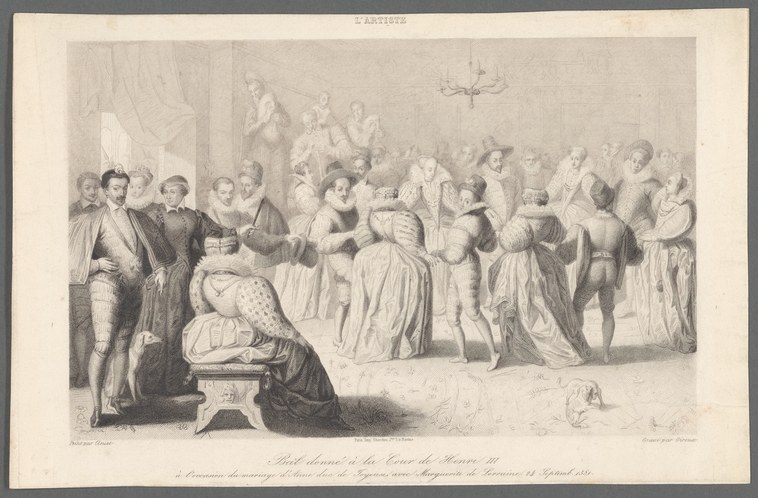
Bal donné à la Cour de Henri III à l'occasion du mariage d'Anne duc de Joyeuse, avec Marguerite de Lorraine. 24 Septemb. 1581
Unknown artist
- Collection:
- Prints depicting dance
- Source:
- New York Public Library
- Rights:
- Public domain — free to use, share and adapt.
- Recorded as:
- Public Domain
This is one of the most detailed surviving visual records of 16th-century court dancing in practice, showing the actual spacing, grouping, and formal decorum of a royal ball rather than an idealized or allegorical representation. For historians of Renaissance dance, it provides concrete evidence of how men and women positioned themselves, how the dances moved through space, and how dancing was integrated into court ceremony and political life at the highest level.
What you are looking at
A formal court ball in progress, rendered as an engraving in a classical style. The scene is crowded with richly dressed courtiers in 16th-century garments—the men in doublets, hose, and cloaks; the women in elaborate gowns with full skirts and high bodices. The composition is staged like a theatrical tableau: figures are arranged across the picture plane in clusters of conversation and interaction, with some engaged in dance at the center while others observe or await their turn. The setting appears to be a grand interior space with drapery visible at the upper left, and the lighting is even and classical, typical of Renaissance court imagery. In the foreground at lower left, a single figure kneels or bows in a posture of deference or petition. The mood is formal, ceremonial, and celebratory—this is a state occasion documented for posterity rather than a spontaneous gathering.
The dancing
The dancers visible in the crowd appear to be in couples and small groups, moving through the space rather than holding fixed patterns. The women's full skirts suggest movement in turns and gliding steps; the men stand upright with formal carriage. The kneeling figure in the foreground may be presenting a gift or toast to the assembled court. Overall, the bodies are upright, controlled, and dignified rather than dynamic—the energy is courtly restraint rather than exuberant motion. The grouping and spacing suggest a dance that unfolds through the room rather than one executed in tight formation.
The dance depicted
This engraving depicts a Renaissance court dance at the wedding of Anne, Duke of Joyeuse (also known as the Duke of Joyeuse), and Marguerite of Lorraine on 24 September 1581 at the court of Henry III of France. The scale and occasion suggest this was a grand ball involving multiple dances in sequence. The formal dress, the spacing, and the mixture of dancers and observers are consistent with 16th-century court dancing as it was practiced in France—likely a mixture of basse danse, pavane, galliard, and volta, dances that were central to aristocratic social ritual. The engraving was created to commemorate the event and circulate an image of it beyond those present, making it a documentary record as much as an artistic interpretation.
How it was made
This is an engraving—a print made from an incised metal plate—identified by the fine parallel lines (hatching) that model form and shadow and the characteristic linear quality of the line work. Engravings allowed for wide circulation and reproducibility in the 16th and 17th centuries, making this image of the royal wedding available to a courtly and educated audience across Europe. The technique required careful planning and skilled hand work and was suited to historical and ceremonial subjects intended for commemoration and study. The formal, orderly composition and the attention to costume detail and spatial arrangement reflect the engraver's dual role as both artist and chronicler.
About this work
This engraving records a royal wedding ball at the court of Henry III of France in 1581, depicting the formal court dance culture of the French Renaissance at a moment of high ceremonial importance. The work documents not a single dance but the entire social and ritual event—the gathering, the costumes, the hierarchy, and the mixture of dancing and observation that characterized aristocratic social life. It belongs in a gallery of dance in art because it preserves visual evidence of how Renaissance courtiers moved, interacted, and performed their social roles through dancing, and because the act of creating and circulating such an image was itself part of the cultural meaning of the event.
How to look at it
Attend first to the overall composition: how the artist has arranged figures in space to show both motion and ceremony, with dancers interspersed among observers and attendants. Look closely at the couples and small groups in the middle ground—the positioning of hands, the relationship of the partners, and the way the women's skirts are shown in motion. The formal upright posture and the absence of violent or acrobatic movement distinguish Renaissance court dance from other dance traditions. Notice how the artist has used costume and grouping to establish hierarchy and occasion—this is a state ritual, not a folk gathering or theatrical performance.
The period
The wedding of the Duke of Joyeuse in 1581 was one of the most celebrated court events of the reign of Henry III, a king known for his lavish and culturally refined court. This was the height of the French Renaissance, a moment when court dancing was at the center of aristocratic identity and political display. The engraving was likely produced in the immediate aftermath of the event to commemorate it and circulate images of the royal court's splendor and order to a wider European audience. This was standard practice for major court events—visual documentation was part of the event's cultural authority and legacy.
Where it lives
The engraving is held in the New York Public Library's collection of prints depicting dance, part of a broader effort to document visual representations of dance and movement across media and periods.
Dance in this work
Questions about this work
What was the Duke of Joyeuse's wedding, and why was it so grand?
Anne, Duke of Joyeuse, was a favorite of King Henry III of France and married Marguerite of Lorraine in 1581. The wedding was a major state occasion celebrated with elaborate festivities, including a famous ball. The scale of the event reflected the duke's political importance and the king's wealth and cultural ambition. Creating and circulating an engraving of the ball made it part of royal propaganda—a way of showing the power and refinement of the court to Europe.
What dances would have been performed at a ball like this?
A Renaissance court ball in France typically featured a sequence of dances, including the pavane (a stately processional dance), the galliard (a lively jumping dance), the volta (which involved lifting and turning), and variations on the basse danse. Dances would have been announced and led by the master of ceremonies, and participation was hierarchical—the highest-ranking couples would dance first, followed by others in order of status.
How can you tell this is a 16th-century French court dance and not something else?
The evidence lies in the costume (the men's doublets and hose, the women's high-waisted gowns with full skirts and ruffs around the neck), the formal upright posture of the dancers, the spacing (couples move through the room rather than executing geometric formations), and the inscription on the engraving itself, which names the event and date explicitly. The style of the engraving—its composition and technique—is also consistent with French and Flemish court documentation from this period.
Why would the court commission an engraving of a ball?
Court balls were political events as much as social ones—they displayed the king's wealth, his patronage of the arts, and the social order of his court. Creating an engraving allowed the event to be circulated and remembered beyond those who attended. The image became part of the court's legacy and its cultural authority, showing not just that a grand ball took place, but that it was worth documenting and preserving for posterity.
More dance artwork





