49 works in this view — arrow keys or swipe to move between them.
Dance in Art
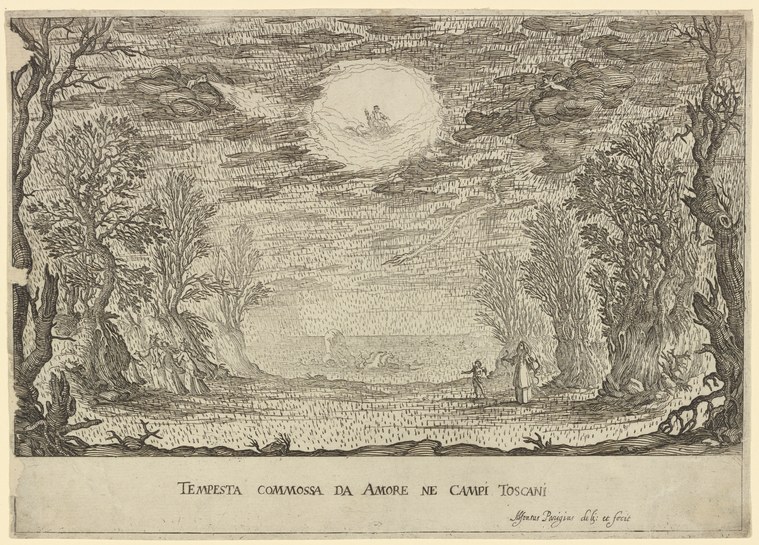
Tempesta commossa da Amore ne campi Toscani
Unknown artist
- Collection:
- Prints depicting dance
- Source:
- New York Public Library
- Rights:
- Public domain — free to use, share and adapt.
- Recorded as:
- Public Domain
This work is valuable for understanding how Renaissance and early-Baroque artists and writers imagined dance—not primarily as social entertainment or technical display, but as a visible manifestation of invisible passion and supernatural power. It shows dance being used allegorically and poetically, a mode that would persist in court ballet and literary drama for the next century. The engraving also documents how dance imagery was disseminated through prints, shaping what educated Europeans understood a dancing body to express.
What you are looking at
A tempestuous landscape engraving presents a wooded valley under a full moon, its light breaking through roiling clouds. In the foreground, couples and individual figures move through an open clearing ringed by gnarled, wind-bent trees whose trunks frame the scene like a baroque proscenium. The figures are small and distant, rendered in the fine parallel hatching typical of 17th-century engraving, their bodies caught mid-gesture in what appears to be rapid, agitated movement. The composition reads as a narrative moment: Love (Amore) has stirred up a storm in the Tuscan countryside, and the inhabitants respond with urgent, perhaps ecstatic motion. The foreground is stippled with rocks and rough ground; the middle distance opens to a wide field; the far trees rise toward a sky turbulent with wind-driven clouds. The overall mood is one of supernatural disturbance—elegiac, romantic, and charged with the instability of desire.
The dancing
The dancers are scattered across the middle ground in small clusters and pairs, their scale emphasizing the vastness of the landscape around them. Individual figures appear to be in rapid transit—arms raised, bodies leaning, some with apparent momentum forward or upward. Several pairs are distinguishable, but the distance and fine engraving lines make precise hold and frame difficult to determine with certainty. The postures suggest frenetic, ecstatic movement rather than formal courtship dances—heads thrown back, limbs extended, the body language of abandonment or transport rather than measured steps.
The dance depicted
The title references Amore (Cupid/Love) stirring a tempest in the Tuscan fields, suggesting this depicts an allegorical scene of love-induced madness or ecstasy expressed through dance. This is consistent with late 16th and early 17th-century literary and artistic treatments of Petrarchan themes, where love's power manifests in supernatural disturbance and involuntary motion. The dancers do not appear to be performing a specific codified dance; rather, they embody a poetic conceit—spontaneous, emotionally driven movement prompted by divine or erotic force. Without clearer visibility of footwork or hold, the specific dance tradition cannot be identified, but the allegorical framing suggests literary rather than strictly social or theatrical dance.
How it was made
This is an engraving, identifiable by its fine parallel hatching (crosshatching), clear tonal gradation through line density, and the characteristic printed appearance of 17th-century intaglio work. The signature-like inscription at bottom suggests it is a numbered or catalogued print. Engravings of this type were laboriously hand-cut into copper plates and could be printed in quantity, making them a primary medium for distributing allegorical and mythological imagery to educated audiences across Europe. The medium's precision allowed fine detail in landscape and costume while requiring the artist to work in reverse; the print would have circulated among collectors, libraries, and courts.
About this work
This is an allegorical engraving depicting figures dancing in a landscape thrown into tumult by the power of Love. The work belongs to a tradition of Renaissance and early-Baroque printmaking that married classical and Petrarchan themes with landscape and figure composition. It documents not a specific dance type but rather the early modern use of dance as a poetic vehicle—the body in motion as an expression of invisible force, whether divine, erotic, or emotional. For a gallery centered on dance in art, it represents a crucial moment when choreographed social dance was beginning to be depicted in print, and when the language of the body in motion was consciously deployed to illustrate philosophical and literary ideas.
How to look at it
Attend to the postures and dispersal of the figures: they are not arranged in formal court dress or in the measured attitudes of a galliard or pavane, but scattered and apparently in rapid, almost frenzied motion. The landscape itself is the primary subject, and the dancers are its inhabitants responding to a supernatural event—the storm that Amore has sent. The engraver has chosen a moment of upheaval and transport rather than a stable, posed arrangement. The small scale and distance of the figures, and the dominance of landscape and weather, reflect an early modern understanding of human agency as subject to larger cosmic and emotional forces.
The period
This work dates stylistically to the late 16th or early 17th century, an era when allegorical landscape prints were a major form of learned artistic production across Northern Europe and Italy. The title's invocation of Tuscan fields and the mythological apparatus of Cupid reflect the Renaissance revival of classical and Petrarchan motifs. Simultaneously, this is the period when court ballet was crystallizing in Italy and France as a form combining dance, spectacle, and allegorical narrative. Prints like this one helped circulate the idea that dance—spontaneous or choreographed—was a proper vehicle for expressing passion, virtue, and the operations of invisible forces on the human body.
Where it lives
This work is part of the New York Public Library's collection of prints depicting dance. It is catalogued in the library's holding as an engraving of unknown artist and undated, indicating it survives as a loose print rather than in a bound volume.
Dance in this work
Questions about this work
Who is 'Amore' in the title and why is this a dance scene?
Amore is Cupid, the classical god of love. In Renaissance and Baroque literature and art, Cupid's arrows and power over human hearts were imagined to cause involuntary emotional and physical responses—including passionate, ecstatic movement. The 'tempest' Amore has stirred is thus both literal (the storm in the landscape) and metaphorical (the upheaval of passion in human hearts). Dance becomes the body's visible expression of that inner disturbance.
Is this engraving a record of an actual dance or a literary fancy?
It is primarily literary and allegorical. The work illustrates a poetic idea—love's power to move the body—rather than documenting a specific courtly or popular dance tradition. However, it reflects the early modern understanding that dance was a proper and eloquent way to express emotion and virtue, an idea that shaped the development of court ballet and later theatrical dance.
What can we learn about dance from this image?
It shows how educated Europeans of the period understood dance conceptually: as involuntary, emotionally driven, spontaneous in appearance, and expressive of forces larger than the individual body. It also demonstrates that dance was considered worthy of serious allegorical treatment in high art, not merely a courtly pastime or folk custom. The scattered, energetic postures suggest that ecstatic and rapid movement, not measured courtly steps, was the visual language chosen to express love's power.
More dance artwork





