49 works in this view — arrow keys or swipe to move between them.
Dance in Art
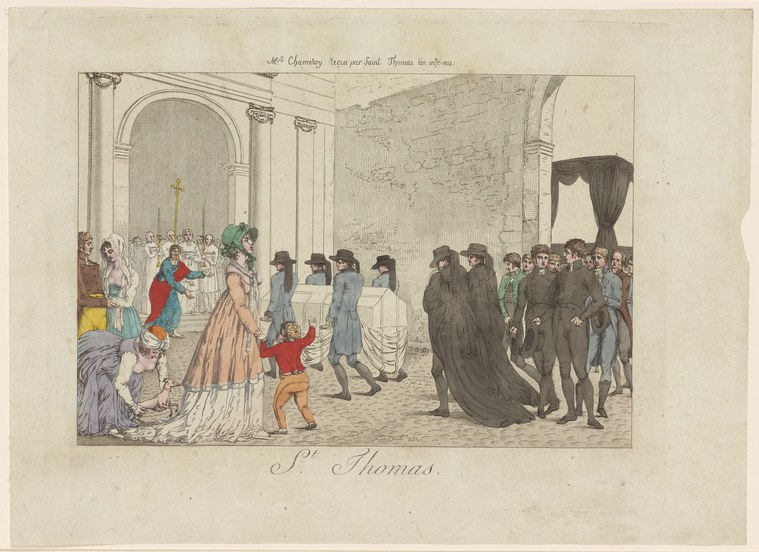
M'elle Chameroy reçue par Saint Thomas, l'an onze - 1802
Unknown artist
- Collection:
- Prints depicting dance
- Source:
- New York Public Library
- Rights:
- Public domain — free to use, share and adapt.
- Recorded as:
- Public Domain
For a dance historian, this image matters because it shows the grammar of formal European court ceremony in the early 19th century: the stillness of display, the processional approach, the spatial hierarchy that organized formal receptions. It demonstrates that 'dance' in institutional settings was as much about posture and processional order as it was about footwork, and that the vocabulary of court ballet extended into ceremonial life well beyond the theatre. The image documents a moment when traditional court ritual was being preserved or reinvented under the new French state.
What you are looking at
A formal reception or ceremonial moment in a neoclassical interior: a woman in an ochre-colored gown with long train stands at the center-left, attended by figures in 18th-century dress, facing toward an arched alcove where a crucifix is mounted above an altar or shrine. To the right, a processional group of male figures in dark coats and hats moves across the floor from right to left, their movement forming a clear directional line. The architectural setting is spare but imposing: fluted columns, a coffered arch, and walls rendered in pale washes suggest a chapel or reception hall of some formality. The print's French handwriting at top indicates this depicts the reception of Mlle Chameroy by Saint Thomas in the year "onze" (eleven — likely Revolutionary calendar year 11, or 1802–3). The composition stages a social or ceremonial encounter between secular and sacred authority: the woman, centrally lit and attended, represents the living subject; the cross and formal procession represent institutional witnessing.
The dancing
The woman stands upright in a frontal pose, her arms composed, her long skirt and train arranged with deliberate formality — this is display posture, not movement. The male figures in the procession move in a loose column, bodies upright but not rigidly aligned, suggesting a ceremonial walk rather than a coordinated dance. No closed holds or partner work is visible. The attendant figures on the left (in pink and lighter dress) are static, framing the woman rather than engaging her in motion. The overall picture is one of formal presentation and witness, not of bodies in active dance partnership.
The dance depicted
This is not a dance image in the modern sense, though it depicts a ceremonial procession and formal reception that belong to the vocabulary of Court Ballet and the movement vocabularies that emerged from 18th-century court ritual. The 'dance' here — if it can be called that — is the choreography of presence and processional order: the measured approach of the male witnesses, the composed stance of the woman being received, the hierarchical arrangement of figures. Mlle Chameroy's reception may have included formal courtship dances (menuet, contredanse) not shown in this moment, but the print itself captures the ceremonial and social framing that surrounded such occasions. The image documents ritual movement and social positioning rather than technique.
How it was made
This is a hand-colored engraving or etching, likely French, with watercolor or gouache applied to define the clothing, skin tones, and architectural shadows. The line work is clean and architectural; the color work is spare and flatly applied, distinguishing status and gender through costume rather than through painterly modeling. The technique of engraving allowed for mass circulation — this was a print for sale or distribution, documenting a social event of enough note to warrant recording in this form. The hand coloring suggests a deluxe copy or that individual buyers commissioned coloring after purchase. The formal presentation and clear narrative caption mark it as a news print or social chronicle, a visual record of an event of public interest.
About this work
This is a hand-colored engraving documenting the ceremonial reception of a woman named Chameroy by or in the presence of Saint Thomas — most likely a secular social event recorded in the language of sacred witnessing, or an event of religious significance presented in formal social register. It dates to the period of the French Revolution or its immediate aftermath (c. 1802–3), when the calendar was numbered from the Revolution and when elaborate court ceremonies had been interrupted but ceremonial forms persisted in modified shape. The print belongs to the tradition of social documentation and court life imagery that engravers produced for circulation among the educated classes. As a dance document, it records not technique or partnership but the formal arrangement of bodies in ritual space — the choreography of social and institutional encounter.
How to look at it
Read this print as a document of spatial order rather than of bodily technique. The artist has frozen a moment of stillness — the presentation of the woman at the center, the approach of the procession — that frames the social transaction. Notice the directional force of the male procession (right to left) and the static frontality of the woman: the composition itself creates hierarchy and narrative without showing movement. The formal dress (the woman's long train, the men's coats and hats) and the architectural setting (the crucifix, the columns) establish this as an event of institutional importance. The caption in French at the top is not decorative but essential — it tells you that this is a news event, something the printmaker expected viewers to recognize or care about. Look at how the artist has used line weight and space to separate the active witnesses (the procession) from the passive center of attention (the woman) — a visual language of social ritual that predates photography and survives in ceremonial dress and state occasions today.
The period
This print was made in the year 11 of the French Revolutionary calendar (1802–3), during the Consulate of Napoleon and the transition from revolutionary upheaval to the reorganization of French state ceremonial. The formal court ceremonies of the ancien régime had been abolished, but elaborate ritual and procession had not disappeared; they were redirected into state occasions and civic ceremonies. Mlle Chameroy's reception, witnessed by or in the presence of 'Saint Thomas,' suggests either a religious ceremony (a canonization, beatification, or clerical appointment recorded in allegorical form) or a civil ceremony framed in the language of sacred authority. The print's careful documentation of dress, order, and spatial arrangement marks it as an official or semi-official record, designed to circulate among the educated and to establish the legitimacy of the occasion through visual witness. In this period, the formal menuet and contredanse were still the dances of elite society, but their performance was becoming increasingly associated with private entertainments rather than state ceremony.
Where it lives
This print comes from the New York Public Library's collection of prints depicting dance. Its cataloguing as a dance image suggests it was acquired as part of a broader effort to document movement, ceremony, and social performance in historical visual culture. The hand coloring and the formal French inscription indicate it was intended for educated collectors, not mass circulation without further finishing.
Dance in this work
Questions about this work
Was Mlle Chameroy a dancer?
The print does not indicate that she was a professional dancer. Her formal dress, her static pose, and the ceremonial setting suggest she was a woman of social standing being formally received or presented — possibly at a religious or civic ceremony. If she danced, that dance is not depicted here.
What does 'l'an onze' mean?
'L'an onze' means 'the year eleven' in French Revolutionary calendar, which would correspond to 1802–3 in the Gregorian calendar. The French Revolution introduced a decimal calendar system; 'year 11' of the Revolution dates the print to the period of the Consulate, when Napoleon was consolidating power and reconstituting state ceremony.
Is this a ballet or a court dance?
It is neither in the technical sense. The print documents a ceremonial reception or presentation, which may have been preceded by dancing (menuet or contredanse were typical of elite social occasions in this period), but this image freezes a moment of formal standing, not active dance. It belongs to the visual culture of court life and ceremony rather than to the record of dance technique or performance.
Why is there a cross and an altar in a reception scene?
The presence of the crucifix and the formal altar-like space suggests this was either a religious ceremony (or a ceremony blessed by religious authority) or a secular ceremony framed in the language of sacred witness and legitimacy. In the context of post-Revolutionary France, elaborate ceremonial invested such images with political as well as social meaning.
More dance artwork





