49 works in this view — arrow keys or swipe to move between them.
Dance in Art
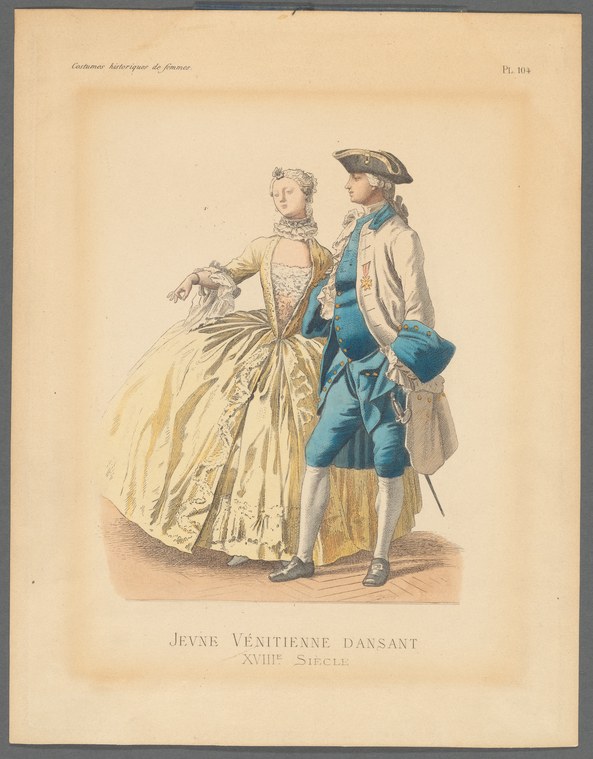
Jeune vénitienne dansant, XVIIIe siècle
Unknown artist
- Collection:
- Prints depicting dance
- Source:
- New York Public Library
- Rights:
- Public domain — free to use, share and adapt.
- Recorded as:
- Public Domain
This print is evidence of how 18th-century dance was visually standardized, marketed, and circulated through images. It shows not only what Venetian dancers wore but also how they were meant to carry their bodies—upright, composed, aware of display. For historians of dance costume and ballroom society, such prints are primary documentation of performance practice and social choreography.
What you are looking at
A young Venetian woman in an elaborate cream-colored gown stands at the center, her dress a study in 18th-century luxury with its wide panniers, decorative bows, and voluminous skirts that sweep across the composition. She wears a lace fichu at her neck and her hair is gathered up in the fashion of the period. Beside her stands a man in aristocratic dress: a blue velvet coat with gold buttons, cream breeches, a tricorn hat, and a sword at his side. His posture is courtly and attentive, angled toward the woman. The setting is spare—a pale, neutral ground—which places all emphasis on the figures and their fashionable dress. The hand-coloring of the print gives warmth to the flesh tones and richness to the fabrics, especially the luminous quality of her gown. The composition captures a moment of social interaction between two figures of evident status, rendered with the precision characteristic of 18th-century fashion and theatrical costume plates.
The dancing
The woman's body shows the characteristic posture of 18th-century courtly movement: upright, with one hip slightly cocked as if caught mid-turn or in a moment of social display. Her arms are positioned expressively—one extended as if gesturing or beginning movement, the other held with controlled grace. The man stands at a respectful distance but with clear engagement, his weight balanced and his gaze directed toward her. The distance between them and their relative positions suggest a formal social dance or promenade rather than an active partnered turn. Both figures maintain the elongated vertical line and composed deportment essential to aristocratic movement of the period.
The dance depicted
This appears to depict a moment from a Venetian social dance of the 18th century, most likely a minuet or a related courtly dance form such as a rigaudon or gavotte. The title specifies a young Venetian woman dancing, and her dress—particularly the panniers and elaborate trimming—aligns with Venice's position as a center of aristocratic fashion and theatrical culture. The formal positioning, the attention to costume, and the social framing suggest this is a representation of ballroom or theatrical courtly dance rather than folk practice. The image may document an actual costume or be a generic illustration of a fashionable dance type meant to circulate as a print for visual reference.
How it was made
This is a hand-colored engraving or lithograph (the record does not specify medium, but the fine line work, even tonal background, and hand-applied watercolor are consistent with early-to-mid 19th-century print practice, possibly reproducing an 18th-century original design). The technique allowed for wide distribution of fashion and dance imagery among the literate classes. The precision of line and the delicate hand-coloring suggest this was a commercial product of some quality, intended for audiences interested in costume history, theatrical reference, or fashionable dress.
About this work
This hand-colored print documents an 18th-century Venetian dance costume and social posture at a moment when such imagery circulated as fashion reference and theatrical documentation. The woman's elaborate gown and the man's aristocratic dress place them within the world of court dance and ballroom society. The composition captures not movement itself but the formal, composed stance of courtly dancers at rest or in transition—the visual grammar of 18th-century elite social interaction through dance. The work belongs to a tradition of costume and dance prints that served both as records of theatrical practice and as aspirational images of fashionable behavior.
How to look at it
Attend to the woman's posture and arm position: this is the formal, composed stance of a courtly dancer between movements, not the dynamic mid-turn of folk dance. Notice how her gown is arranged to show its structure and trimming—this is a fashion plate as much as a dance image. The man's positioning and attire establish the social context: this is aristocratic ballroom society, not popular entertainment. The neutrality of the background directs the eye entirely to dress and bearing.
The artist
The artist is unrecorded in the catalogue. The print is attributed to a tradition of 18th-century fashion and costume plate production, possibly part of a larger series on European dress and theatrical costume. Such prints were often produced by engravers whose names do not survive with the individual works, particularly in the case of commercial, reproducible imagery.
The period
The 18th century saw the minuet and its related courtly forms reach their height as both social dance and theatrical spectacle. Venice, as a center of carnival, theater (commedia dell'arte), and patrician society, was a nexus of dance innovation and fashion display. Printed costume and dance imagery proliferated in the 18th century as a tool for disseminating fashionable behavior across Europe. Such prints often blurred the boundary between documentary record and idealized aspirational image—showing not what people actually wore but what fashionable people ought to look like.
Where it lives
The work is held in the New York Public Library's collection of prints depicting dance. It is part of a broader archival tradition of dance imagery used for reference, research, and historical documentation.
Dance in this work
Questions about this work
Is this a real person or a costume type?
The print documents a costume and body posture typical of 18th-century Venetian dance, but there is no evidence it depicts a specific historical dancer. Such prints often presented idealized types rather than individuals—a 'young Venetian woman' as a role or stereotype rather than a portrait.
What dance are they doing?
The formal positioning and aristocratic dress suggest a minuet, rigaudon, or similar courtly form of the 18th century. The static pose captures a moment of transition or display rather than a dynamic movement, which is typical of how ballroom dance was represented in prints of this period.
Why would Venice be significant for 18th-century dance?
Venice was Europe's most famous center of carnival, theater, and mask culture. It was also home to an elite patrician society that cultivated refined ballroom practice. Venetian fashion and entertainment were aspirational across Europe, making Venetian dance imagery valuable for fashion and theatrical reference.
More dance artwork





