49 works in this view — arrow keys or swipe to move between them.
Dance in Art
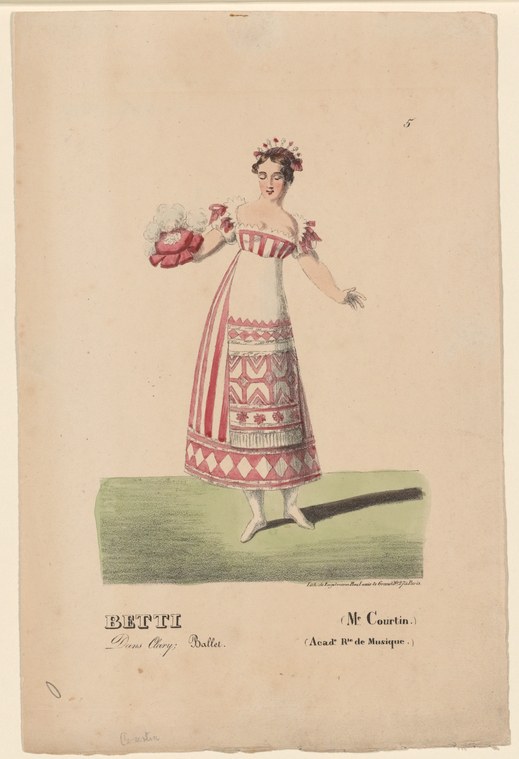
Betti (Me. Courtin.) Dans Clary; ballet
Unknown artist
- Collection:
- Prints depicting dance
- Source:
- New York Public Library
- Rights:
- Public domain — free to use, share and adapt.
- Recorded as:
- Public Domain
This print documents a named historical performer and a specific ballet production, preserving both the visual identity of a dancer and the material culture of early 19th-century theatre. It is evidence of how dancers were marketed, remembered, and celebrated in print form before photography—and reveals that dancers were understood as visual spectacles worthy of circulation and collection in their own right.
What you are looking at
A single female dancer stands against a plain cream background, posed in a moment of theatrical display. She wears a striking striped bodice in rose and white with a deep décolletage and short puffed sleeves, paired with an ornately decorated skirt featuring geometric patterns in pink and cream—a costume of evident richness and formality. A long pink sash drapes from her waist. She has dark curled hair crowned with flowers, and her face is turned toward the viewer in a composed, engaging expression. Her right arm extends outward in a graceful gesture while her left hangs naturally; her weight appears settled on her right leg, left leg slightly relaxed. The pose is one of presentation rather than active movement—she faces us squarely, inviting the gaze of the audience. A thin green ground line suggests a stage floor, and a dark shadow beneath her emphasizes the theatrical space. The work appears to be a hand-colored engraving or lithograph, executed with delicate precision in the fashion-plate tradition.
The dancing
A single dancer occupies the composition, her body upright and frontal, with no sense of dynamic action or partnering. Her extended right arm curves gracefully outward in an open, welcoming gesture; the other arm remains at her side. The stance is fundamentally static—posed for presentation to an audience rather than caught mid-movement. Her weight settles evenly, with no indication of the balletic turnout, elevation, or articulated footwork that would characterize more active dance gesture. This is an attitude of display and introduction rather than virtuosic performance.
The dance depicted
This is a portrait of a dancer—specifically, the performer known as Betti (Mlle Courtin) in the ballet *Dans Clary* (or possibly *La Danse de Clary*). The image functions as a theatrical portrait or costume study, documenting her stage persona and dress for a specific production rather than capturing a moment of actual dance. No specific dance style is clearly demonstrated in the static pose; instead, this is a gallery of costume and character—the dancer as a visual spectacle to be admired. Such portraits were common currency in early-to-mid 19th-century theatrical culture, used to advertise performers and productions.
How it was made
The work is a hand-colored engraving or lithograph—likely from the 1820s–1840s based on the style of costume and production technique. The delicate colored detail, the smooth tonal surfaces, and the signature line at the base are consistent with the printed theatrical souvenirs and prints that circulated in Europe during this period. Hand coloring allowed each impression to be individually tinted, making these modest prints affordable both as theatrical merchandise and as collector's items for dance enthusiasts and theatre-goers. The technique was ideal for wide distribution and advertising of performers.
About this work
This is a hand-colored theatrical portrait documenting a named performer—Betti (Mlle Courtin)—in her costume for the ballet *Dans Clary*. It belongs to the tradition of early 19th-century actor and dancer prints, produced and circulated as both souvenirs and advertisements. The work does not depict an action or virtuosic moment, but rather a composed presentational pose: a performer in rich costume, facing the audience in an attitude of greeting or introduction. It tells us about theatrical costume, performer celebrity, and the visual culture of early Romantic-era ballet, when dancers were promoted and remembered as much through their pictorial likenesses as through reviews or descriptions of their movement.
How to look at it
Look at the pose: it is not a moment of dance, but a formal presentation. The dancer faces you directly, her arm extended in a gesture of address or welcome. This is the pose of theatrical self-display—the dancer introducing herself and her costume to the audience. Notice the extreme detail and ornamentation of the dress, which dominates the composition more than the body itself. The artist has chosen to emphasize costume, beauty, and social presence over any demonstration of technical skill or movement vocabulary. This reflects how dancers in this period were understood: as visual spectacles first, moving bodies second.
The artist
The artist is not recorded. The work is a product of the commercial theatrical print industry, likely executed by a professional printmaker or engraving house specializing in actor and dancer portraits. Such prints were often made by anonymous studio hands following a commission from a theatre or print publisher, making individual artistic attribution difficult or impossible. The signature at the bottom—partially legible—may be the printmaker's mark or that of the publisher rather than a named artist.
The period
This print dates to the Romantic era of ballet, when female dancers in European theatres had become major celebrities and the subject of widespread visual and literary attention. The early 19th century saw an explosion in printed theatrical souvenirs, from which this portrait emerges. Ballet was becoming professionalized, standardized in training and repertory, and increasingly marketed as entertainment for a paying public. Dancers like Betti were household names in their own cities, and their likenesses were sold to fans as collectibles—precursors to the fan photographs and posters of later centuries. The ornate, heavily decorated costume in this image is consistent with the visual excess of early Romantic ballet, which emphasized visual spectacle, elaborate dress, and the transformation of the dancer's body into a fantasy figure.
Where it lives
The work is held in the Prints collection of the New York Public Library, part of a broader holding of dance-related prints and theatrical images. Such prints were commercial products, intended for broad circulation and sale to theatre patrons, making provenance often unclear and copies widely dispersed across institutions.
Dance in this work
Questions about this work
Who was Betti (Mlle Courtin)?
Betti, performing under the stage name Mlle Courtin, was a dancer active in the early-to-mid 19th century. Beyond the identification in this print and her association with the ballet *Dans Clary*, specific biographical information is limited. She was celebrated enough to warrant commercial portrait prints, indicating she held some prominence in European theatre, but further details about her training, career, or performances are not currently available in standard dance histories.
What is 'Dans Clary' and when was it performed?
The exact identity and dating of *Dans Clary* (or possibly *La Danse de Clary*) is uncertain from available records. It was likely a ballet or dance work performed in France or another European theatre in the early 19th century, but no production details, choreographer information, or performance dates can be confirmed from this print alone. The work's obscurity today is not unusual for ballets from this period, most of which were ephemeral and left behind few documents.
How were dancers promoted before photography?
Hand-colored theatrical prints like this one were the primary means of circulating a dancer's image before photography became common in the 1860s. These affordable, reproducible prints were sold at theatres and through print shops, allowing fans to collect images of favorite performers. Dancers also appeared in literary works, reviews, and caricatures, but the theatrical portrait print was the most direct and controlled representation a performer could offer of her appearance and costume to a paying public.
What does the costume tell us about this ballet?
The elaborate striped bodice, geometric patterned skirt, and floral headdress are consistent with early Romantic ballet aesthetics, which prized visual richness, colorful ornament, and the transformation of the dancer into a fantasy or exotic figure. The particular motifs—the geometric patterns and the degree of ornamentation—suggest either a character role (possibly ethnic or fantastical) or simply the heightened visual spectacle typical of ballet in the 1820s–1840s. Without documentation of the ballet itself, precise interpretation is difficult.
More dance artwork





