49 works in this view — arrow keys or swipe to move between them.
Dance in Art
Elizabethan ball
Unknown artist
- Collection:
- Prints depicting dance
- Source:
- New York Public Library
- Rights:
- Public domain — free to use, share and adapt.
- Recorded as:
- Public Domain
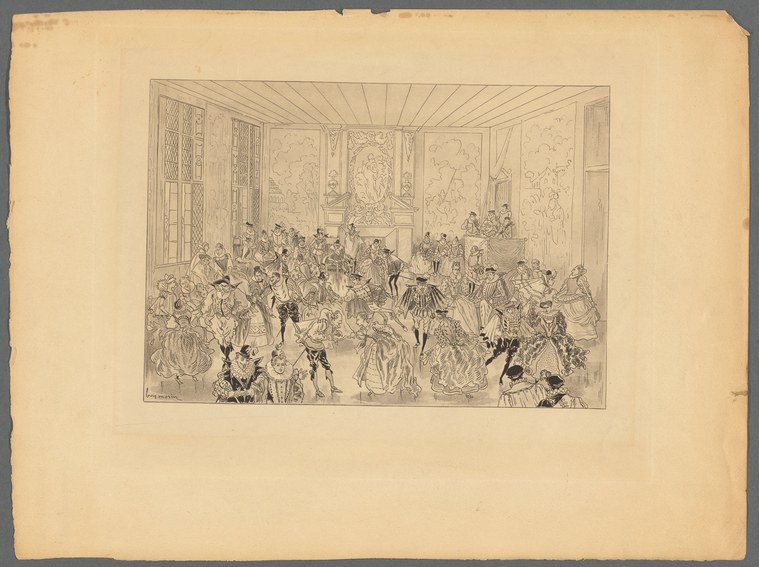
This work is one of the few surviving visual records of how social dancing actually looked in motion during the Renaissance court. It shows not a theoretical ideal or a single idealized couple, but the crowded, energetic reality of a ball—how bodies moved, how much space skirts occupied, and how dancers of all levels mingled in a single festive space. For historians of dance, costume, and social practice, such images are invaluable evidence.
What you are looking at
A crowded ballroom or great hall during an elaborate social dance, rendered in pen with fine crosshatching. The room features high ceilings with radiating beams, ornate wall panels with decorative flowering motifs, and tall windows. The floor is filled with dozens of figures in period dress, most wearing the voluminous skirts and fitted bodices characteristic of Elizabethan or Jacobean costume. The dancers occupy the full depth of the space, some in the foreground engaged in active movement, others clustered in conversation or observation toward the back. The lighting is uniform and dry, typical of an engraved or etched print, with no dramatic shadows. The composition creates a sense of animated social spectacle—this is not a formal procession but a living, fluid moment of courtly recreation.
The dancing
The figures are depicted in varied poses suggesting social interaction rather than synchronized movement. Several couples and groups appear to be dancing, with visible arm gestures and turning postures. The women's full skirts dominate the visual field, creating an impression of swaying and rotation. Men in doublets and hose are interspersed among them. The scale of the crowd—at least 40–50 figures visible—emphasizes the collective, participatory nature of the event. Individual arm positions and the slight forward lean of several figures suggest sprightly movement, though the engraver has not attempted anatomical precision in the limbs.
The dance depicted
This depicts a Renaissance or early Jacobean court ball, most likely a mix of social dances of the period. The crowded, informal arrangement and the range of postures suggest this is not a formal figured dance (such as a pavane) but rather a scene of simultaneous social dancing—couples engaging in their own movements within a larger gathering. The voluminous skirts and the casual clustering suggest dances like the galliard, volta, or almain, which were customary at English and Northern European courts in the late 16th and early 17th centuries. Without inscription or clear context, the identification rests on costume and the period convention of representing ballroom leisure.
How it was made
This is a black-and-white engraving or etching on paper, printed from a metal plate. The technique is evident in the fine, parallel hatching lines that model form and shadow, the crisp line work defining the architectural elements, and the deliberate variation in line density to suggest depth and texture in fabric. The print medium allowed for relatively inexpensive mass production and circulation among educated and courtly audiences. The absence of color and the controlled formality of the technique suggest this was a formal print, likely part of a series or collection documenting courtly life and manners.
About this work
This engraving captures a moment of aristocratic leisure—a crowded court ball in which dozens of figures in Elizabethan or Jacobean dress engage in the social dances of their time. The work is valued both as a historical document of costume and ballroom practice and as an example of how printmakers of the Renaissance represented collective movement and social spectacle. The image reveals the density, informality, and participatory character of court dancing, in which multiple couples danced simultaneously in shared space rather than as an ordered procession or formal tableau. Such prints were created to satisfy curiosity about courtly manners and to serve as models for etiquette and decorum among the educated elite.
How to look at it
Attend to the chaos and density of the composition—this is emphatically not a orderly line dance or a single paired form, but a crowded floor of simultaneous, individual movements. Notice the range of arm gestures and body angles, suggesting the dancers are not moving in unison. Look at the fabric: the engraver has devoted significant effort to rendering the volume and texture of the women's skirts, which would have constrained and shaped movement. The architectural frame—the high ceiling, the ornate panels, the scale of the hall—emphasizes that this is a formal, magnificent space, not a street or domestic setting. The print style deliberately flattens and formalizes the scene; what you are seeing is a composed representation of leisure, not a literal snapshot.
The period
In the late 16th and early 17th centuries, the European court ball was a central institution of aristocratic social life and political courtship. Dancing masters published detailed instructions for dances like the pavane, galliard, and almain, and dancing skill was considered essential to courtly accomplishment. Printmakers began producing images of courtly life for a growing market of urban, educated viewers who wished to learn or admire the manners of the court from afar. Such prints often emphasized the spectacle and energy of the court, rather than the disciplined geometry of a single, formally taught dance.
Where it lives
This print is held in the New York Public Library's collection of prints depicting dance. The catalogue record provides no artist attribution, date, or medium specification; these details have been inferred from the visual evidence of the engraving technique.
Dance in this work
Questions about this work
What dances would people have danced at an Elizabethan ball?
Common court dances included the pavane (a slow, processional dance), the galliard (a jumping, athletic dance often paired with the pavane), the almain (a German dance with a gliding step), and the volta (a vigorous turning dance). This engraving likely shows a mix of these forms happening simultaneously on the same floor. Most court dances involved couples or small groups, not the whole assembly dancing in unison.
How do historians know what Renaissance dances looked like?
Dance manuals written by Renaissance masters such as Thoinot Arbeau and Fabrizio Caroso provide detailed instructions for steps, rhythms, and figures. Paintings and engravings like this one offer visual evidence of how these dances were performed in social settings, the clothing worn, and the scale and atmosphere of the ballroom. Together, these sources allow modern dancers to reconstruct and perform Renaissance dances with some confidence.
Is this a specific event or a generic 'ball'?
The print does not appear to document a specific historical occasion; rather, it represents a type of scene—the aristocratic ball in general. It may have been created to illustrate courtly manners or to satisfy curiosity about court life among a wider public. Without an inscription or known provenance, we cannot identify the event, location, or date.
More dance artwork





