49 works in this view — arrow keys or swipe to move between them.
Dance in Art
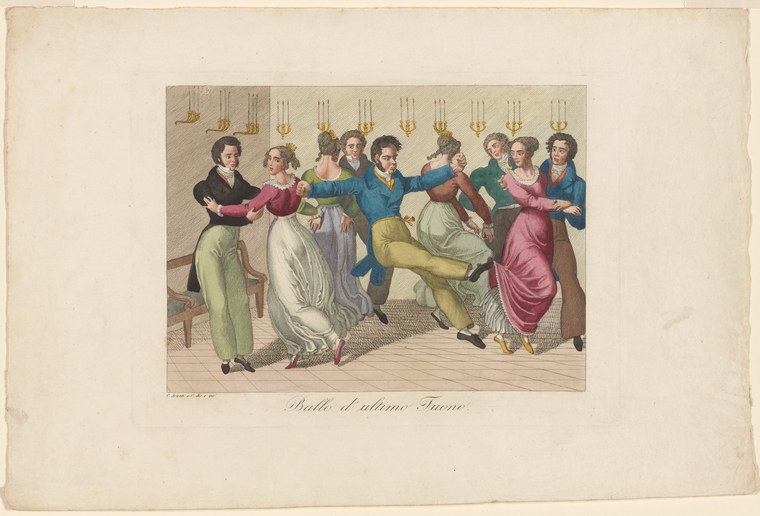
Ballo d'Ultimo tuono
Unknown artist
- Collection:
- Prints depicting dance
- Source:
- New York Public Library
- Rights:
- Public domain — free to use, share and adapt.
- Recorded as:
- Public Domain
This image is one of the few visual records of how the ballroom dances of the Regency era were actually performed—the body angles, the use of elevation and rotation, and the open frame between partners. It also shows us the social context: the gendered roles, the spectatorial pleasure, and the formal architecture of the ballroom itself. For dance historians reconstructing early 19th-century social dance, this print is a primary source of movement quality and aesthetic values.
What you are looking at
A lively ballroom scene populated by approximately a dozen fashionably dressed figures arranged in a loose circle around two central dancers. The composition is crowded and energetic, with observers clapping or gesturing in encouragement. The two main dancers occupy the center: a man in yellow breeches and a woman in a white or pale skirt are caught mid-movement, their bodies angled dynamically. The woman's skirt billows outward, suggesting rapid rotation or elevation of the legs. The setting is a wooden-floored interior lit by hanging brass candelabra suspended from the ceiling—a sign of wealth and a formal ballroom rather than a casual gathering space. The onlookers wear the fashionable dress of the early 19th century: high-waisted gowns in jewel tones (blues, greens, reds, pinks) for the women, with tailored jackets for the men. The overall mood is one of animated pleasure and social display.
The dancing
The central male dancer leans backward with one leg extended or raised, while the female dancer's torso twists away from him, her arms spread and her full skirt caught in flight. This open-position, separated frame with vigorous leg action and rotational movement is characteristic of social dance from the Regency and early Romantic periods. The surrounding figures stand in relaxed attitudes, some with hands raised in appreciation or clapping. No couple maintains a closed ballroom hold; instead, the dancers move with visible separation and dramatic use of the entire body and skirt.
The dance depicted
The title 'Ballo d'Ultimo Tuono' (Ball of the Last Thunder or Thunderbolt) suggests an Italian social dance, likely from the early 19th century. The energetic elevation, rotation, and open frame align with dances of the Regency and early Romantic era—the period when cotillion figures, galops, and early waltzes were gaining popularity in European ballrooms. The dramatic use of the woman's skirt and the man's extended leg position suggest a dance with significant elevation and rotational figures, possibly a galop or a cotillion variant. The Italian title and the style of dress indicate this is likely a published print documenting a fashionable ballroom dance of the 1810s–1830s, though without inscription or signatures visible, the specific dance master or occasion cannot be confirmed.
How it was made
This is a hand-colored engraving or aquatint, as evidenced by the fine line work, the hatching in the background and floor, and the characteristic pale tones overlaid with watercolor or hand-applied pigment. The technique was well-suited to rapid reproduction and circulation as a print, allowing the image to document and promote fashionable dance practices to a literate, leisured audience. The delicate coloring and precision of the line work indicate this was a commercial publication of some quality, likely intended for the domestic market or for collectors of dance and social prints.
About this work
This print documents a moment of elite social dancing in the Regency or early Romantic period, capturing the energy and decorum of a fashionable ballroom. The scene is a record not only of a specific dance but of the theater of social display: the formal setting, the wealth signified by the candelabra, the fashionable dress, and the attentive audience all underscore dancing as a central practice of polite society. The print circulated as a visual record of how people of fashion moved and socialized, making it both a dance document and a social document of its era.
For a gallery of dance in art, this work matters because it preserves the lived kinetic reality of early 19th-century ballroom practice. Unlike a written description of dance steps, the print allows us to see the body positions, the energy, the separation and frame, and the gendered dynamics of the couple in motion. It is evidence of what dancers valued: height, rotation, the display of the female figure through billowing fabric, and the appearance of effortless vigor.
How to look at it
Attend first to the central couple's frame and body angles: note the separation between the partners, the backward lean of the man, and the rotational twist of the woman's torso. This tells you the dance valued open movement, elevation, and dynamic use of the torso rather than the tight, upright posture of later 19th-century ballroom dancing. Next, look at how the woman's skirt is rendered—billowing and caught in motion—which shows us that the skirt itself was an important visual and kinetic component of the dance. Finally, observe the onlookers' reactions: their clapping and animated postures confirm that this was social dancing in the modern sense, a pleasure shared among peers rather than a formal courtly display.
The artist
The artist is not recorded in the catalogue. The print's style, technique, and subject matter suggest it was produced by a commercial printmaker active in early 19th-century Italy or the Italian-speaking regions of Europe. The hand-coloring and quality of the engraving indicate this was likely a professional workshop product rather than an amateur effort, intended for circulation among the urban middle and upper classes who danced in fashionable ballrooms.
The period
The early 19th century was a period of rapid innovation and codification in social dance. The Regency era (1811–1820) and the early Romantic period saw the waltz rise to dominance in European ballrooms, while cotillion figures and galop variants remained popular. Simultaneously, the print market for dance instruction and social documentation was flourishing: publishers across Europe issued colored engravings showing fashionable couples and group dances, in part to teach steps and decorum to an aspiring middle class. This print sits squarely within that tradition of visual dance instruction and social reporting. The Italian title and style suggest this may have been produced for a central or southern European audience, documenting a local variation or interpretation of the broader pan-European ballroom culture of the era.
Where it lives
This print is held in the Prints collection of the New York Public Library. It is one of many hand-colored engravings documenting European ballroom dance from the 18th and 19th centuries in that collection, making it part of a larger archive of visual dance documentation.
Dance in this work
Questions about this work
What dance is this?
The Italian title suggests a specific ballroom dance of the early 19th century, but without additional documentation or inscriptions on the print itself, we cannot identify it with certainty. The body positions and energy suggest it could be a galop, a cotillion figure, or an early waltz variant. The print is evidence of the dance, but not proof of its name.
Why is the woman's skirt rendered so dramatically?
In the early 19th century, the high-waisted, lightweight gown with a full skirt was the height of fashion, and the way the skirt moved in dancing was part of its appeal. Artists rendering fashionable dance emphasized the skirt's volume and motion to show both the elegance of the garment and the vigor of the movement. This was a marker of social status and modernity.
Who danced this?
This was an elite or upper-middle-class social dance, performed in formal ballrooms by people of fashion. The setting—the candelabra, the formal dress, the attendance—makes clear this was not a folk or popular dance but a practice of the literate, leisured classes of Italy or the Italian-speaking regions of Europe.
Is this a real dance or artistic invention?
It is almost certainly a real dance, documented and circulated in print form to teach and promote fashionable movement. Italian dance masters and European printmakers of this period produced such images as primary sources of instruction and social documentation, so this image likely records an actual ballroom practice, even if the specific name and steps are now lost.
More dance artwork





