49 works in this view — arrow keys or swipe to move between them.
Dance in Art
Isadora Duncan
Unknown artist
- Collection:
- Prints depicting dance
- Source:
- New York Public Library
- Rights:
- Public domain — free to use, share and adapt.
- Recorded as:
- Public Domain
This print documents how a revolutionary dancer and her practice were understood and represented in the visual culture of her own era. It shows that Isadora Duncan and interpretive dance were considered worthy of serious artistic study and formal portraiture, not merely performance entertainment. The work is evidence of the dialogue between modernist visual art and modernist dance in the early twentieth century.
What you are looking at
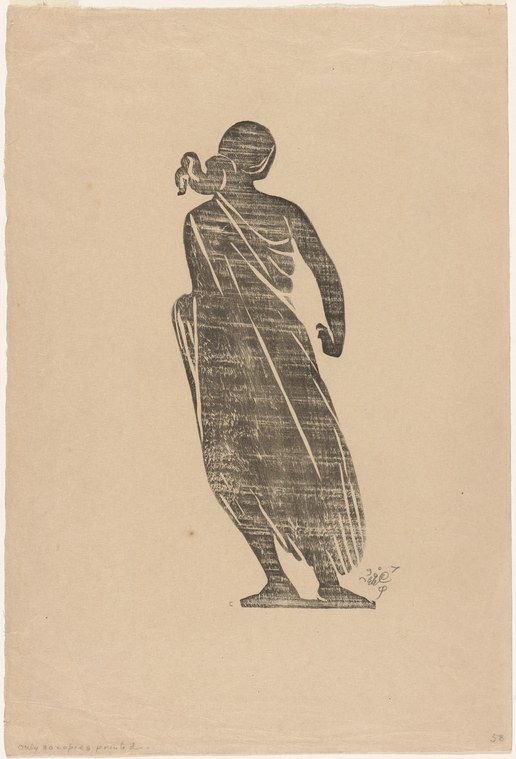
A single figure stands in a frontal pose against a plain background, rendered in bold black lines characteristic of woodcut or linocut printing. The dancer is shown in profile-frontal view, wrapped in a draped garment that falls from shoulder to ankle in vertical folds and geometric patterns. The fabric appears pleated or textured throughout, creating a columnar silhouette. The head is rendered in profile, tilted slightly upward, with what appears to be a decorative headdress or bound hair arrangement. One arm is raised and bent, the hand positioned near the head in an expressive gesture; the other arm hangs at the side. The figure's stance is upright and dignified, with weight evenly distributed. The linear hatching throughout the drapery and body creates volume and movement within the static pose. The composition emphasizes verticality and formal balance, with the figure occupying the center of the frame against unadorned space.
The dancing
A single dancer is depicted in a three-quarter frontal stance with the body held upright and composed. The raised arm bends at the elbow with the hand near the face, suggesting either a gesture of repose, attention, or emotional expression. The lower arm and hand hang freely. The weight appears centered and stable, grounding the figure. The drapery falls in long, unbroken vertical lines that obscure the actual articulation of the limbs beneath, making precise footwork impossible to assess. The overall frame is symmetrical and self-contained, with no dynamic forward momentum or turning motion evident.
The dance depicted
This appears to be a representation of Isadora Duncan or the interpretive dance style she pioneered in the early twentieth century. Duncan danced in draped Greco-Roman-style tunics rather than ballet costume, and revived classical dance on Western concert stages. The columnar drapery, the upright bearing, the single expressive gesture, and the absence of ballet technique all align with Duncanesque modern dance. However, the figure is so formalized and static that it reads as a stylized icon or memorial image rather than a capture of movement in progress. The print may document how Duncan was conceptually rather than kinetically understood by artists of her era.
How it was made
This is a relief print—most likely a woodcut or linocut—executed in bold, high-contrast black line and hatching on cream paper. The technique is characterized by geometric simplification, emphatic contour, and the use of parallel lines to suggest form and drapery rather than modeling. The bold graphic quality and reduction of the figure to essential line suggests it was designed for reproduction and circulation, indicating either an artist's print or a commercial illustration. The strength of the line-work and the economy of means place it in the early twentieth-century modernist print tradition, where simplified form and expressive distortion were valued over naturalistic detail.
About this work
This is a stylized portrait print of a dancer in Duncanesque dress, created as a formal graphic study rather than a dynamic movement document. The artist has chosen not to capture motion but rather to construct an idealized, monumental image of the figure—upright, contemplative, and timeless. The bold woodcut or linocut technique and the iconic composition suggest the work was made for circulation and public consumption, positioning the dancer (likely Isadora Duncan herself or a representative of her method) as a cultural symbol of modernist reform in early twentieth-century dance.
This print belongs to a moment when concert dance was being newly visualized for mass audiences through graphic media. The emphasis on the classical drape, the frontal pose, and the simplified formal language reflect how modernist artists attempted to communicate the philosophical and aesthetic claims of the new dance—rootedness in ancient forms, liberation from the artifice of ballet, and the return to the human body as primary artistic material.
How to look at it
Attend to the frontality and stillness of the figure: the artist has not chosen a moment of vigorous movement but rather a pose of dignity and repose. This choice reflects how early twentieth-century artists often represented modern dance—not as technical display but as spiritual or philosophical statement. The drapery deserves close study: its deep folds and geometric patterning are both decorative and functional, suggesting the weight and fall of the fabric that was central to Duncan's aesthetic. The raised arm and inclined head convey emotion and introspection rather than virtuosity. Notice how the bold line-work unifies the figure: there is no distinction between the body and its covering, no separation of anatomy from dress. This formal unity was itself part of the modernist vision.
The artist
The artist is not recorded in the catalogue. The style—bold line, geometric simplification, high contrast—is consistent with early twentieth-century modernist printmaking, particularly German Expressionism and the woodcut revival of that period. The formal approach and the choice of Duncan as subject suggest a serious artist documenting a culturally significant figure, though without attribution we cannot determine whether this was a professional commission, a personal study, or a published print.
The period
This work dates to an era of radical transformation in concert dance and in the visual arts. Isadora Duncan was performing and teaching in Europe from the 1900s onward, and by the 1910s and 1920s her influence was substantial. Simultaneously, modernist movements in visual art—Expressionism, Cubism, and the revival of woodcut as a fine art medium—were dismantling academic conventions. Many modernist artists were interested in dance as a subject: it represented the body liberated from constraint, the expression of inner feeling through form. This print sits at the intersection of all these currents.
Where it lives
The work is held by the New York Public Library in the Prints collection, catalogued under "Prints depicting dance." The catalogue record provides no artist attribution, date, medium, or existing description, which is not uncommon for works acquired as part of broad thematic collections. The work appears in NYPL's digital collections.
Dance in this work
Questions about this work
Is this definitely Isadora Duncan?
The catalogue record titles it "Isadora Duncan," and the visual evidence—the draped classical costume, the frontal iconic pose, the early twentieth-century printmaking style—all support that identification. The artist is not named, so we cannot confirm the attribution was contemporary or how the title was assigned. However, the combination of formal elements makes Duncan the most plausible subject.
Why doesn't the dancer look like she's moving?
The stillness is intentional. This is a portrait or icon rather than a documentation of motion. Early twentieth-century artists often represented modern dance as a philosophical or spiritual practice rather than athletic display, and a static, upright pose conveyed dignity and timelessness. The work asks us to contemplate the dancer's presence, not to follow her movement.
What technique is this—woodcut, linocut, engraving?
The bold, high-contrast black line, the geometric hatching, and the quality of the print surface suggest this is a relief print—either a woodcut or linocut. It is not an intaglio technique like engraving or etching. The catalogue record does not specify, but the visual evidence of how the line was made points to one of the relief methods.
Why is the drapery so prominent?
Draped classical costume was central to Isadora Duncan's practice and philosophy. She rejected the rigid structure of ballet costume (corsets, pointe shoes, tutus) and danced in loose Greco-Roman-style tunics that moved with the body. The artist has emphasized the drapery as the defining marker of Duncan's method and cultural identity.
More dance artwork





