49 works in this view — arrow keys or swipe to move between them.
Dance in Art
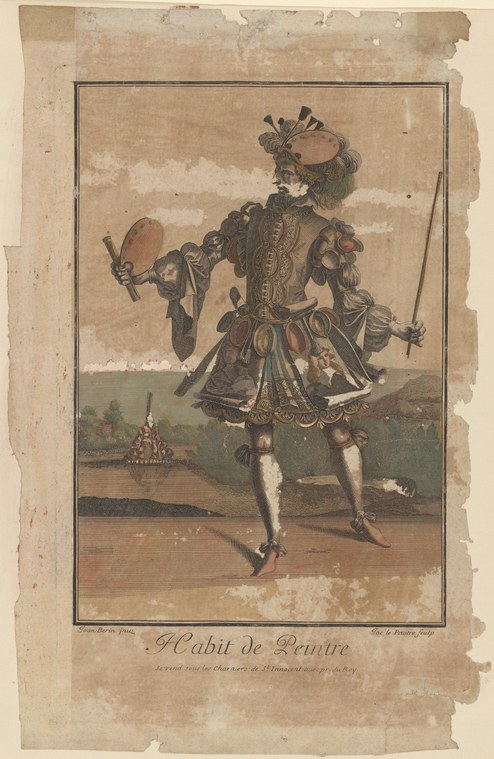
Habit de peintre
Unknown artist
- Collection:
- Prints depicting dance
- Source:
- New York Public Library
- Rights:
- Public domain — free to use, share and adapt.
- Recorded as:
- Public Domain
This print documents a specific theatrical role and costume convention from the period when French court dance was becoming theatrical entertainment. It shows how dancers' bodies were arranged for visual display, and what baroque performance expected of the body—the lifted, splayed, asymmetrical poses that conveyed nobility, wit, and dramatic character. Such costume studies are essential sources for reconstructing the physical vocabulary and aesthetic values of early modern dance.
What you are looking at
A single figure dominates this print, posed in a dramatic stance against a landscape background. The dancer wears an elaborate costume of the early 18th century: a richly decorated coat with wide skirts stiffened into a fan shape, puffed sleeves with ornamental cuffs, and stockinged legs ending in heeled shoes. The figure holds a small round object—likely a mirror or fan—in one raised hand, while the other arm gestures expressively outward. The head is crowned with an extravagant feathered headdress. The body leans back in an exaggerated contrapposto, weight thrown onto one leg, the opposite knee bent. In the middle distance, a church or chapel is visible across a river or body of water, suggesting a European landscape. The print's palette is muted—ochres, browns, and greens—with the figure rendered in fine engraved lines and light wash.
The dancing
The dancer stands in a single asymmetrical pose: weight balanced on the downstage leg, the upstage leg bent and lifted slightly, creating a dynamic diagonal line from feet through torso. The arms are separated and raised to different heights, one holding an object near shoulder level, the other extended in a sweeping gesture. The spine curves into an elaborate arch, the head tilted back to display the headdress. This is presentation posture rather than locomotion—the body is arranged for display and visual impact, not captured mid-step.
The dance depicted
This is a French theatrical costume figure from the early 18th century, most likely from the Paris Opera or a court entertainment. The title 'Habit de Peintre' (Painter's Costume) suggests this is a character or dancer dressed as a painter, possibly from a ballet or entrée comedienne. The elaborately decorated coat, the exaggerated posture, and the mirror or palette in the hand all point to a character role rather than a classical dance form. The extreme splay of the coat and the lifted leg suggest a movement or pose from the vocabulary of French court and theatrical dance of the period—possibly a révérence, courante, or an attitude de théâtre designed to showcase both the costume and the dancer's body.
How it was made
This is a hand-colored engraving, executed in fine lines with subsequent wash or watercolor applied to define the figure and landscape. The technique allows for precise delineation of the elaborate costume details—the embroidered coat, the feathered headdress, the stockings—while the wash gives atmospheric depth to the background. The small printed credit line at bottom indicates this was a commercial print, likely produced for collectors, costume reference, or theatrical documentation. Such prints circulated among dancers, designers, and the educated public as records of new roles and fashionable theatrical dress.
About this work
This is a costume study print documenting a theatrical character role from early 18th-century French court and stage dance. It records not a dance movement but a posed presentation: a single figure dressed as a painter, arranged in an attitude designed to display both the elaborate costume and the dancer's body to maximum effect. The work belongs to a tradition of theatrical and balletic imagery that used engraving and hand-coloring to circulate knowledge of new productions, roles, and performance practice across Europe. For historians of dance and theater, such prints are primary documents of how roles were conceived, what bodies were asked to do, and how the visual spectacle of theatrical dance was imagined and marketed.
How to look at it
This print is not a snapshot of motion but a formal presentation. The artist has chosen a single pose designed to display the costume and the body simultaneously—the angle and attitude make the coat fan open fully, the headdress visible, and the dancer's line of weight and direction of gaze apparent. The lifted leg and curved spine are baroque attitudes—poses that were held and displayed rather than moving through. Notice how the background landscape is minimal and distant, keeping attention on the figure; and how the hand holding the painter's attribute (mirror or palette) is positioned to frame the body rather than suggest action.
The period
This work dates from the era when French baroque dance was the dominant form across European courts and was beginning to be professionalized in Paris through the establishment of the Académie Royale de Musique (1661) and its associated stage. Theatrical dance was moving from court diversion to commercial spectacle, and costume and character roles proliferated. Engraved costume studies became a tool for disseminating fashion, theatrical novelty, and performance knowledge. The character of a 'painter' reflects the aristocratic and intellectual pretensions of entertainment: the figure is not a servant or buffoon but a cultivated figure worthy of elaborate dress and dramatic pose.
Where it lives
This work is held in the New York Public Library's collection of prints depicting dance. The catalogue record provides no artist attribution, date, or medium specification, though the visual evidence supports dating to the early 18th century and identification as a hand-colored engraving.
Dance in this work
Questions about this work
What is the dancer actually doing?
The dancer is holding a single posed attitude—not moving, but standing in a carefully arranged asymmetrical position designed to display the costume and body. This is a formal presentation for the viewer, not a moment captured mid-dance. The title 'Habit de Peintre' indicates this is a character costume, likely from a French theatrical role or court entertainment.
Why is the costume so elaborate?
This is a theatrical costume designed to convey character, status, and wit. The decorated coat, feathered headdress, and mirror identify the figure as a 'painter'—a cultivated character worthy of elaborate dress. In early 18th-century entertainment, costume was a form of characterization and spectacle, and prints like this served to publicize and celebrate new roles and fashionable dress.
How do I read the engraved lines and washes?
The fine engraved lines define the edges and details of the costume—the buttons, embroidery, and folds of the coat. The hand-applied wash (watercolor) creates volume and atmosphere, shading the body and suggesting the landscape. This combination of line and color allowed prints to convey both precise detail and visual appeal, making them valuable as both costume reference and artistic objects.
Is this a real dance or just a pose?
Both. The pose itself—the lifted leg, curved spine, raised arms, and weight balance—comes from the vocabulary of French baroque theatrical dance. Dancers trained in courante, minuet, and theatrical attitudes would recognize this as a conventional pose meant to display elegance, wit, and aristocratic bearing. It is a 'real' movement in the sense that trained dancers performed such attitudes, but it is displayed here as a static figure for the viewer.
More dance artwork





