49 works in this view — arrow keys or swipe to move between them.
Dance in Art
La valse mazurka, dite la Cellarius
Unknown artist
- Collection:
- Prints depicting dance
- Source:
- New York Public Library
- Rights:
- Public domain — free to use, share and adapt.
- Recorded as:
- Public Domain
This work documents a critical moment in dance history when national and folk dances were being adapted and formalized for ballroom society. The title's attribution to Cellarius, one of the 19th century's most influential dance pedagogues, makes it a direct record of how a specific dance master's innovations were marketed and circulated. The combination of image and title also reveals how dance was commodified and distributed as fashionable consumer culture.
What you are looking at
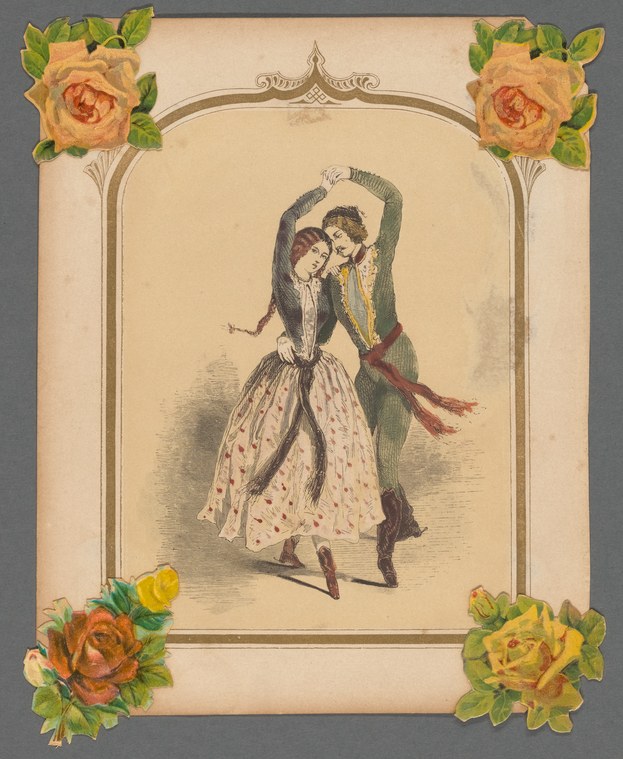
A young couple performs a waltz or mazurka in an elegant interior, framed by a decorative border of yellow and orange roses. The woman wears a white dress with a fitted bodice and voluminous skirt scattered with red or pink dots, while the man is dressed in dark formal attire with what appears to be a military or evening coat. He supports her with his right arm while his left arm extends upward in a graceful line; her left arm reaches toward his shoulder while her right arm extends into the space above. The composition captures them mid-turn, with the woman's skirt flaring outward from the momentum of the movement. The setting is intimate and formal, with soft shading suggesting an interior drawing room. The ornamental frame with its classical arch and floral garlands suggests this is a print meant for display or collection, possibly a souvenir of a fashionable dance or performance.
The dancing
Two figures in a closed ballroom hold: the man's right arm supports the woman's waist, and their upper bodies are connected while their free arms extend upward and outward, creating a vertical line of elegance characteristic of 19th-century waltz or mazurka. The woman's weight appears to be on the balls of her feet, suggesting lightness and elevation typical of Romantic-era dance technique. The man's posture is upright and formal, his frame steady. Their relative height and the way the woman's body responds to his lead indicate a hierarchical partner dynamic standard to the period. The skirt's flare and the positioning of both figures suggest they are captured mid-rotation.
The dance depicted
This is almost certainly a waltz or mazurka, most likely the latter given the title *La valse mazurka, dite la Cellarius* and the costume details. The Cellarius style refers to the refined, ballroom version of the mazurka popularized in 19th-century European salons, as codified by dance master Henri Cellarius. The print documents how this Polish-derived dance was adapted for fashionable Parisian and European ballroom society—it retained the mazurka's characteristic turned-out positions and spirited character but was performed in the upright, restrained frame of ballroom etiquette. The couple's formal dress and intimate scale suggest this was a social dance for the urban middle and upper classes, not a folk performance.
How it was made
This is a hand-colored engraving or lithograph, likely 19th-century, as indicated by the printing technique and delicate color application. The rose borders are printed or hand-applied in a naturalistic style; the figures are rendered with fine linework and subtle cross-hatching to suggest fabric drape and volume. The ornamental frame and colored border suggest this was a commercial print made for middle-class collectors—likely sold individually or in series as a souvenir, perhaps of a specific dancer or dance master's innovation, or as an instructional or aspirational image of fashionable dance. The technique allowed for quick reproduction and wide distribution, making it affordable for homes and dance studios.
About this work
This print documents the Cellarius mazurka, a ballroom dance that fused Polish tradition with 19th-century European salon refinement. The image captures two elegantly dressed dancers in a formal closed hold, the woman's skirt caught mid-flare, performing what the title identifies as *La valse mazurka, dite la Cellarius*—a specific choreographic style or variation named after the influential dance master Henri Cellarius. The ornamental frame and hand-colored printing suggest this was a commercial souvenir or instructional image, circulated among the urban middle classes who danced and aspired to dance fashionably. It belongs in a dance history collection as evidence of how folk and national dances were transformed into ballroom entertainment, and as a record of 19th-century commercial printing practices that created and spread dance fashion.
How to look at it
Notice the moment the artist chose: the woman's skirt at peak flare, suggesting a turn or pivot, not a moment of stillness. Observe the frame—the closed ballroom hold with the man's steadying right arm, standard to Cellarius's teaching—and the extension of the free arms upward and outward, which creates elegance and show. The woman's posture (slightly tilted toward her partner, weight forward on the balls of the feet) and the man's upright support reveal the physical conversation of the dance. The formal dress and interior setting assert this as respectable, fashionable social dance, not theatrical performance or folk tradition.
The period
The mazurka became fashionable in European ballrooms from the 1830s onward, arriving from Poland as a symbol of national identity and exoticism to Western European audiences. Dance masters including Henri Cellarius (active in Paris mid-19th century) systematized these dances into a repertoire of ballroom figures, teaching them to the aspiring urban middle classes. This was the era of commercial dance prints, lithographs, and hand-colored engravings that served as both instruction manuals and status symbols, allowing people to learn and display familiarity with the latest dances. The Romantic ballet was in its ascendancy during this period, emphasizing lightness, vertical carriage, and ethereal femininity—values that influenced even social ballroom dance.
Where it lives
Held by the New York Public Library in its prints collection of dance imagery. This type of hand-colored engraving or lithograph was a common commercial product of the 19th century, sold individually or in sets as instructional aids, souvenirs, or display pieces for dance studios and drawing rooms.
Dance in this work
Questions about this work
What is the Cellarius mazurka?
The Cellarius mazurka is a ballroom adaptation of the Polish folk dance, standardized and taught by Henri Cellarius, a prominent Paris-based dance master of the 19th century. Cellarius codified the steps, timing, and frame into a form suitable for European salon society, stripping away folk variations while retaining the mazurka's characteristic turned-out positions and spirited character. It became one of the fashionable dances of the Romantic era, taught in dancing academies and performed at balls.
How was this print made and used?
This is a hand-colored engraving or lithograph, a commercial product designed for a middle-class market. Such prints were sold as souvenirs, instructional aids for dance students, or display pieces to show familiarity with fashionable dances. They were affordable and reproducible, allowing dance innovations and fashions to circulate widely among those who could afford to buy them or attend dancing schools.
What does the woman's posture tell us about 19th-century dance technique?
Her upright carriage, turned-out legs, forward weight on the balls of the feet, and light appearance reflect Romantic-era aesthetics that valued elevation, verticality, and apparent weightlessness. These same principles influenced both ballet and fashionable ballroom dance, creating a unified movement vocabulary among the educated classes. Her slight lean toward her partner indicates responsive partnering—she is not rigid but reactive, following his lead.
More dance artwork





